
BTC investors transition from fear-driven selling to strategic cash positioning amid market turbulence
Market volatility intensified for Bitcoin as stablecoin transaction volumes climbed to $440 billion during the weekend, demonstrating a strategic shift toward cash positions while spot and futures trading volumes declined.

Investors holding Bitcoin (BTC) are showing a marked evolution away from panic-driven liquidations, instead choosing to accumulate cash reserves that can be deployed when attractive BTC entry points emerge. This behavioral pattern is confirmed through onchain analytics, which reveal a substantial spike in stablecoin transaction volume, with transfers of USD Coin (USDC) and Tether's USDt (USDT) totaling $440 billion on March 22.
This evolution in market participant behavior corresponds with the growing risk-averse sentiment observed across financial markets following the United States Federal Reserve's rejection of expectations for imminent interest rate reductions, compounded by escalating energy costs stemming from the continuing US and Israel-Iran conflict.
BTC realized volatility grows, yet market participants maintain composure
The latest movements in Bitcoin's valuation demonstrate a turbulent trading environment. The cryptocurrency declined 3.75% to reach $67,300 during Sunday trading before recovering above $71,700 on Monday, with these fluctuations predominantly influenced by developments surrounding the US and Israel-Iran conflict.
Consequently, the realized volatility of BTC, a metric that captures actual price movement magnitude over specified intervals, continues to show elevated readings across various timeframes. Both the three-month and six-month realized volatility indicators have advanced to 107% and 148% respectively, representing increases from previous levels of 60% and 94.5% recorded over the preceding half-year period.
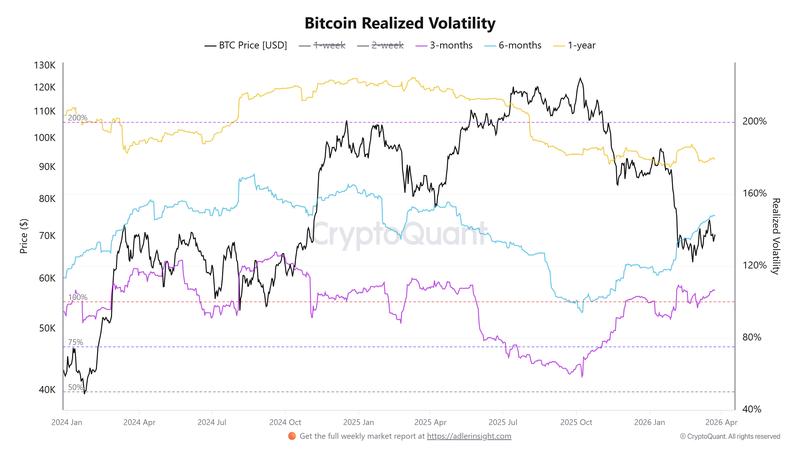
In contrast, the one-year realized volatility measurement for longer-term analysis has held steady around 180% throughout the same timeframe. This stability indicates the marketplace hasn't entered complete panic territory, instead managing uncertainty without experiencing broad-based forced liquidations.
Examining stablecoin transfer activity provides crucial context for understanding this market environment. During March 22, the aggregate volume of USDC tokens transferred jumped to 368 billion, representing an approximate 2,081% increase from the previous day to establish a new all-time record, while USDT transfers operating on the Ethereum network hit 72 billion.
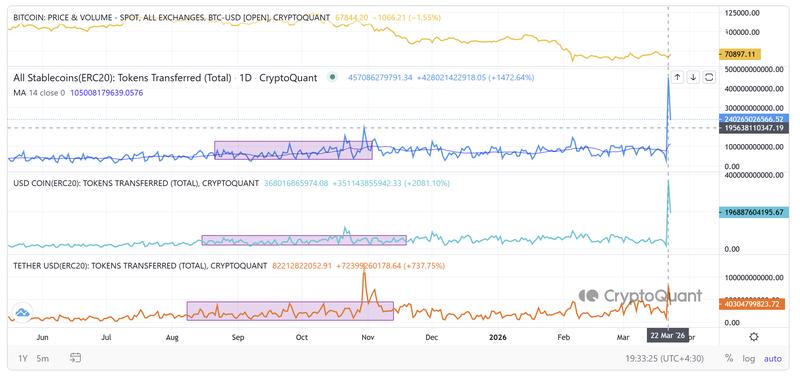
The substantial stablecoin transfer volumes suggest rapid capital reallocation and strategic repositioning activities. Market participants are proactively shifting capital into stablecoins to function as temporary value repositories, establishing a "cash buffer" that enables swift redeployment when opportunities arise.
This behavioral pattern frequently surfaces during periods of heightened volatility, when market participants may choose to emphasize price monitoring over maintaining substantial market exposure.
Trading activity in spot and futures markets remains beneath bull cycle peaks
Derivatives market metrics provide additional confirmation of the prevailing cautious market sentiment. Open interest for BTC (measured in USD) has contracted by $19 billion throughout the last six months, signaling a continuous reduction in leveraged position sizes. This unwinding demonstrates a marketplace focused on risk reduction rather than building aggressive speculative positions.
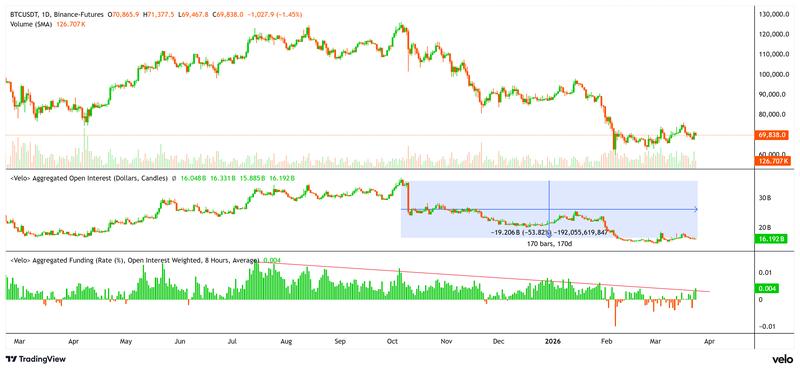
Aggregated funding rate metrics have declined to 0.01% from previously excessive levels approaching 0.1% during the July-August 2025 timeframe, periodically turning negative, while the premium on perpetual futures contracts continues trading at a discount relative to spot pricing.
Collectively, these market indicators reveal muted demand for leveraged trading and a marketplace devoid of robust directional confidence, exhibiting a modest bearish orientation.
Activity within the spot trading marketplace tells a comparable story. According to reporting from Cointelegraph, Binance appears positioned to register its weakest monthly spot trading volume since September 2023, with transaction volumes approaching approximately $52 billion.
Present participation metrics correspond more closely with intervals of diminished market engagement characteristic of previous bear market phases during 2022-2023.
Therefore, the cryptocurrency marketplace maintains robust liquidity, with capital flowing actively through stablecoin channels, yet this capital remains uncommitted to Bitcoin positions at present, as BTC holders continue monitoring current market conditions.