
BTC Holders Abandon Accumulation Strategy as $600M in Realized Losses Recorded
Major Bitcoin holders transition from buying to selling patterns while realized losses exceed $600 million amid BTC's descent to the $76,000 level.

Bitcoin (BTC) has experienced a decline of approximately 7% since reaching its recent high of $82,800, with multiple categories of wallet holders transitioning away from accumulation strategies toward distribution. Market data indicates that this selling behavior, when combined with mounting realized losses, suggests a possible reversal in market momentum.
Key takeaways:
- The absorption of freshly minted BTC supply by whales has fallen to unprecedented lows beneath -150%.
- BTC investors transition from buying to selling behavior following price decline
- Realized losses in Bitcoin climbed past $600 million within a 24-hour period as the price descended to $76,000.
Whale absorption reaches historic lows for Bitcoin
The yearly absorption metric calculates the volume of newly issued BTC that markets have absorbed throughout the previous twelve months. At present, the absorption rate at exchanges shows signs of recovery, whereas whales are experiencing coin losses at an unprecedented rate.
Of particular note, the yearly absorption rate for Bitcoin at exchanges has climbed to -75% from levels beneath -100% recorded in April as deposit activity persists.
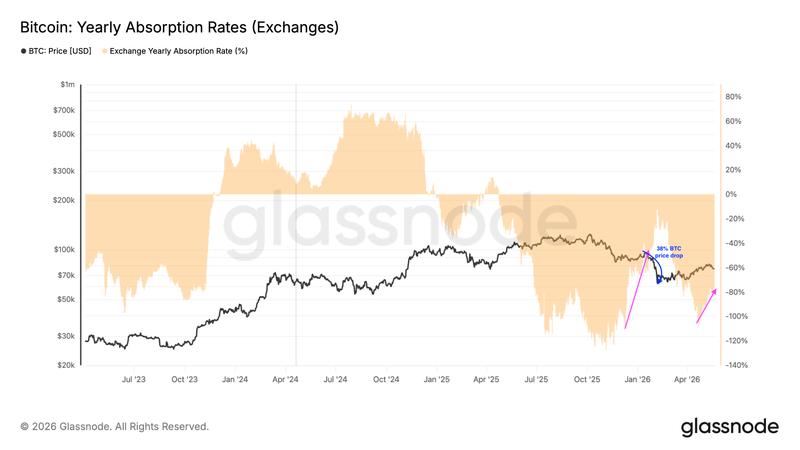
Data visualization above demonstrates that a comparable increase in the exchange absorption metric during January came before a 38% BTC price correction to $60,000 from $98,000.
Although large holders (wallets containing 100–1,000+ BTC) continue to acquire more than 150% of the fresh issuance, this rate has experienced a sharp decline since the middle of April and remains considerably lower than the peak levels witnessed in November 2025.
Concurrently, accumulation activity among whales (wallets containing over 1,000 BTC) has plummeted to -151%, representing the lowest point in Bitcoin's entire history.
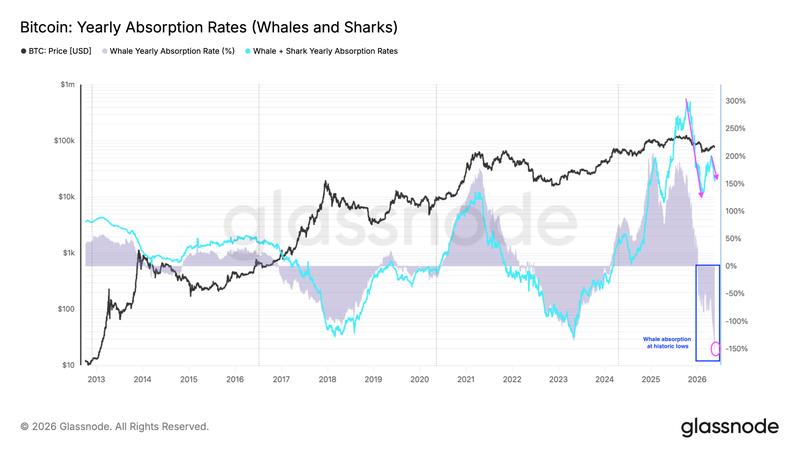
This represents a transformation in institutional market sentiment, especially considering substantial outflows from Bitcoin spot exchange-traded funds, signaling diminished long-term confidence among major holders.
Every Bitcoin holder category demonstrates "profit-taking" behavior
Market participants in Bitcoin adopted a risk-averse stance, selling their holdings as the price fell to $76,000.
The Accumulation Trend Score (ATS) from Glassnode hovers near zero (displayed in light yellow), signaling that whales are either selling their BTC or refraining from accumulation.
The decline in this trend score reveals a transition from buying to selling behavior across nearly every cohort. This behavioral shift resembles a comparable pattern that emerged in mid-January 2025, which coincided with Bitcoin's decline to $60,000 in February.
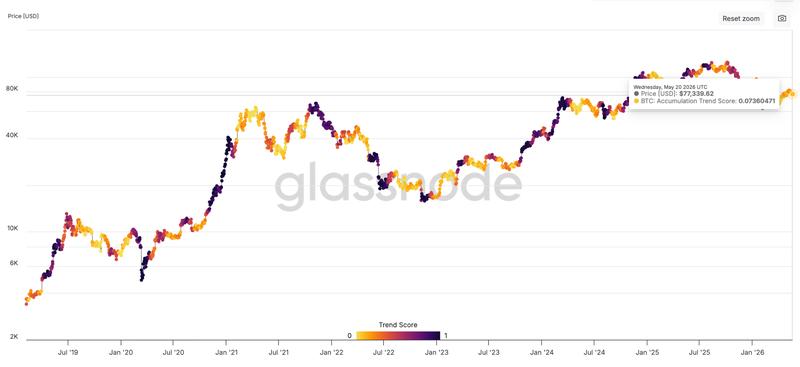
Supplementary data from Glassnode shows a movement toward distribution or dormancy among all investor categories, as illustrated in the following chart.
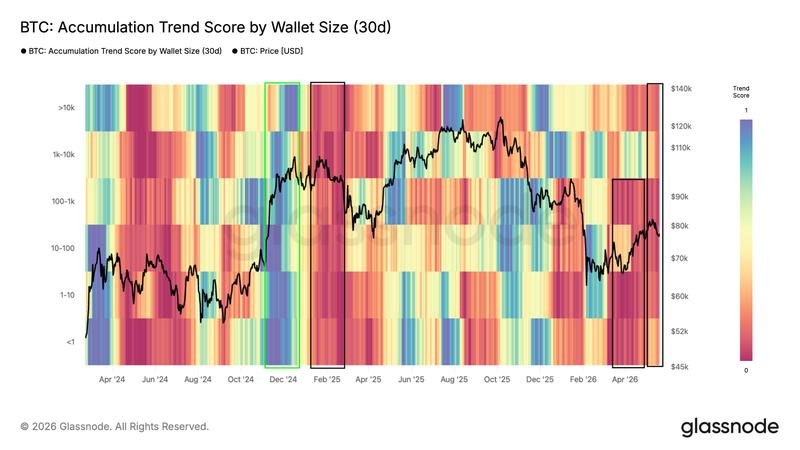
This contrasts sharply with Q4 2024, during which widespread cohort accumulation came before a sustained upward movement that resulted in BTC/USD trading above $100,000 for the first time ever, driven by the 2024 US Presidential elections.
Analyst Woominkyu from CryptoQuant pointed to "continued selling pressure" originating from whales who transferred over 8,000 BTC to exchanges on Monday.
"As Bitcoin rallied to a peak of $82,196, whales began sending coins back to exchanges," the analyst stated in a QuickTake note on Thursday, adding:
"This is a classic sign of smart money selling into strength — taking profits while retail FOMO was building."
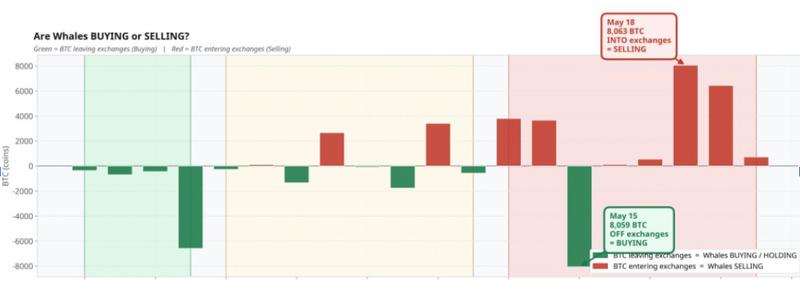
Realized losses in Bitcoin surge to $600 million
The most recent Bitcoin correction has prompted a dramatic increase in realized losses. Long-term holders (LTHs) recorded losses totaling $513.6 million on Tuesday, whereas short-term holders (STHs) experienced losses amounting to $101.8 million.
The combined realized losses for all holders hit $616 million following Bitcoin's drop to $76,000 on Monday.
This represented the largest single-day loss realization since March and an increase exceeding 1,500% in under two days, when compared with $41.5 million on Sunday.
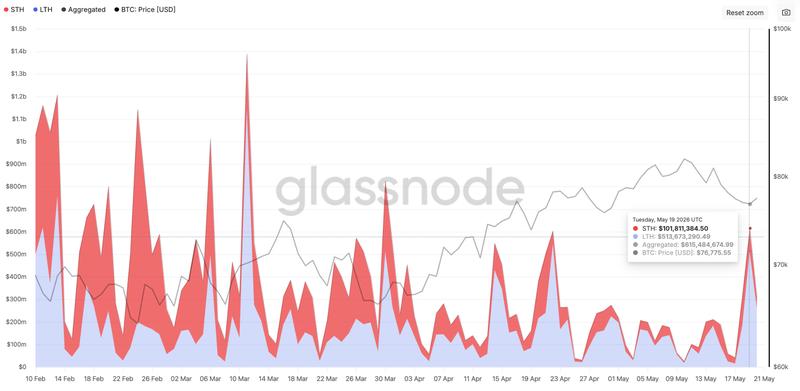
Long-term holders represent the majority of these losses, whereas short-term holder losses remain relatively limited, suggesting that the financial stress primarily affects earlier buyers.
According to Cointelegraph's reporting, Bitcoin holders who have maintained their positions for more than six months may liquidate near their initial purchase prices following prolonged drawdowns, generating substantial overhead resistance that could impede Bitcoin's recovery trajectory.