BTC Falls Below $80,000 Mark Following Record US Producer Price Jump in Four Years
Bitcoin traders worked to maintain the $80,000 support level following September's US producer inflation data that exceeded forecasts by 100 basis points, marking the highest monthly increase since March 2022

On Thursday, Bitcoin (BTC) fell beneath the $80,000 threshold following the release of US Producer Price Index (PPI) figures that substantially exceeded analyst projections.
Key points:
- The cryptocurrency momentarily dropped under $80,000 following a 100-basis-point surprise in US PPI inflation figures.
- The September PPI registered 6.3% compared to market projections of 5.3%, representing the most significant monthly surge since March 2022.
- Technical analysis of BTC pricing suggested the possibility of a "volatile retest" of trend lines near the $78,000 level moving forward.
Largest PPI surge since March 2022 creates additional Bitcoin headwinds
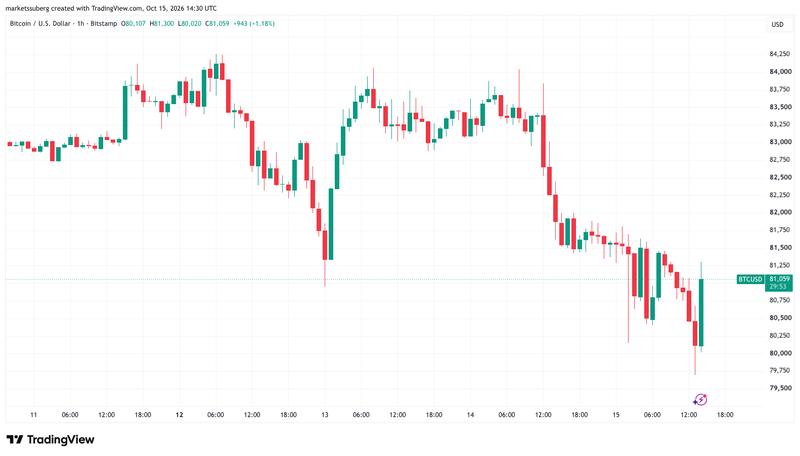
According to TradingView data, the BTC/USD pair fell to its weakest position since Sept. 18, dropping as much as 1.8% during the trading session, prior to recovering toward the $81,000 range.
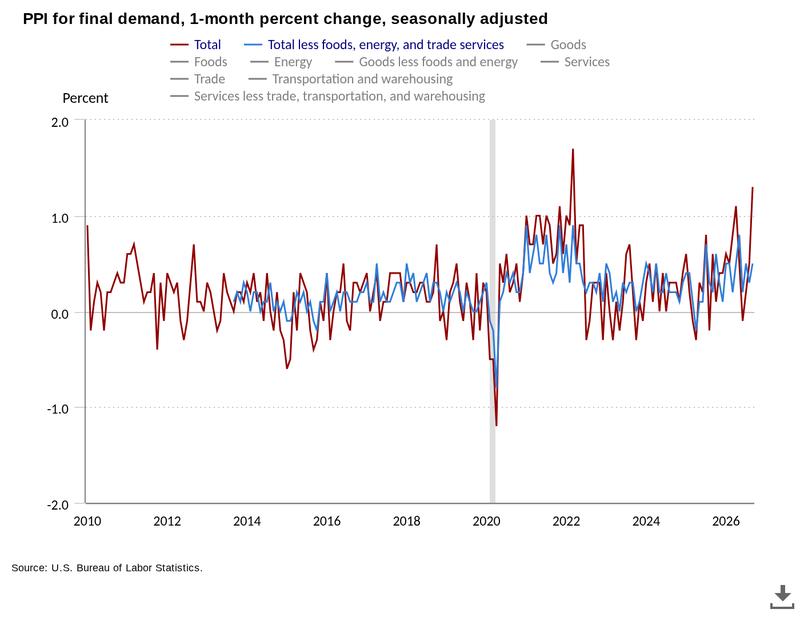
The September PPI figure reached 6.3%, representing a complete 100 basis points beyond the anticipated figure, while the core PPI climbed to 5% compared to the expected 4.4%, according to Bureau of Labor Statistics (BLS) information.
"The September increase is the largest advance since rising 1.7% in March 2022. On an unadjusted basis, the index for final demand climbed 6.3% for the 12 months ended in September, the largest 12-month increase since moving up 6.4% in December 2022," an official news release confirmed.
These figures arrived one day following the Consumer Price Index (CPI) data that similarly exceeded projections, triggering declines in cryptocurrency and risk-oriented assets. Risk-focused assets were already experiencing downward pressure due to a technology sector selloff originating in South Korea, where the KOSPI Composite Index experienced a 7.5% decline on Thursday.
Leading economist Mohamed El-Erian characterized the PPI data as "even more striking" compared to the CPI figures. El-Erian along with other market observers pointed out that US bond yields failed to increase despite the elevated inflation data. At the time of publication, the US 10-year bond yield had decreased nearly 3%, reaching its weakest point since Sept. 23.
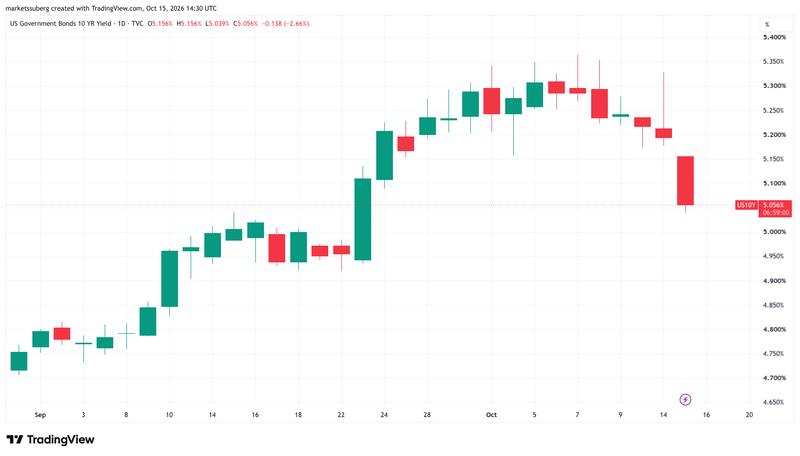
Robin Brooks, who previously served as chief FX strategist at Goldman Sachs, reiterated prior research indicating that yields had "decoupled" from US macroeconomic data as market attention shifted toward the government's management of the federal budget deficit.
Brooks analyzed the 30-day correlation between positive data surprises and daily fluctuations in the 10-year yield, discovering that it had fallen from approximately 0.6 earlier in 2026 to slightly below zero by the conclusion of August.
"That indicates that yields have decoupled from data and the obvious explanation for this is that markets are more focused on the trajectory of the deficit, so they're pushing up longer-term yields regardless of what data surprises are doing," he summarized in a blog post last month.
Technical analysis focuses on "early-stage bull market" support level retest
Meanwhile, BTC price movements redirected attention toward two critical support trend lines: the 21-week and 50-week exponential moving averages (EMA) positioned at $76,144 and $78.459, respectively.
Market trader and technical analyst Rekt Capital observed that the BTC/USD pair could potentially retest both levels while maintaining its broader upward trend trajectory.
"Deviating below them on a volatile retest to find a pullback bottom has historically happened in early-stage Bull Markets. These deviations however would occur after a bullish crossovers of these two EMAs, whereas Bitcoin is still pre-crossover," Rekt Capital said in an X post.
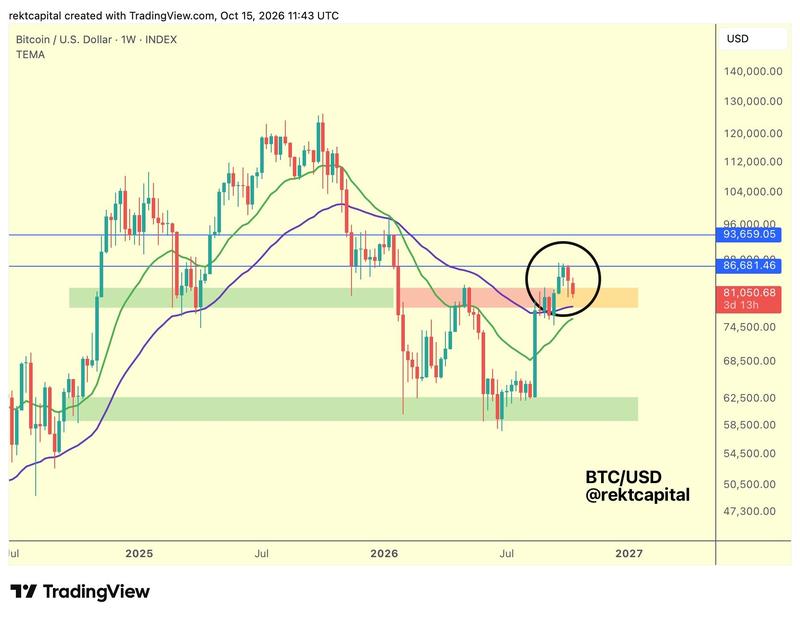
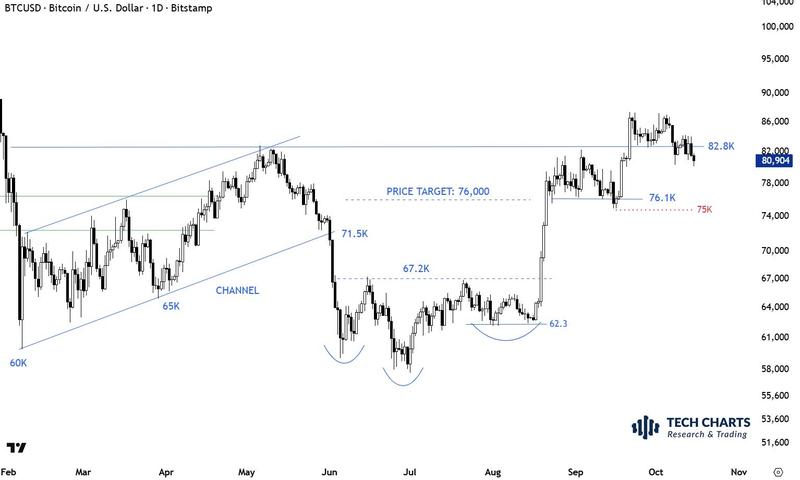
Bitcoin continued trading beneath the zone ranging from $82,500 to $82,800, representing a critical support area that has garnered significant attention in recent weeks.
Technical analyst Aksel Kibar commented that Bitcoin's most recent weekly closing price around $83,700 demonstrated insufficient momentum to qualify as a genuine breakout.
"A weekly close inside the range can resume wide consolidation between 60K-82.8K 75K can be utilized as the pattern (rectangle bottom reversal) negation level," he said.