BTC Drops to $80.1K Following KOSPI's Worst Close Since Early April
Bitcoin nears the $80,000 threshold for the first time since September's midpoint as South Korea's technology sector selloff drives 7.5% losses across the KOSPI.
Bitcoin (BTC) experienced its steepest decline in more than three weeks on Thursday, with cryptocurrency markets mirroring additional losses across South Korean equity indices.
Key points:
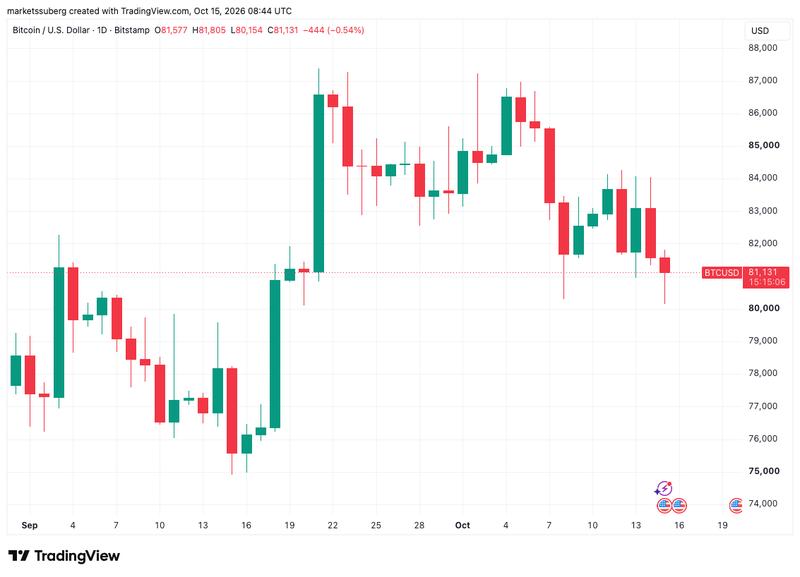
- Bitcoin touched fresh local lows at $80,154 amid renewed selling pressure in South Korean technology equities.
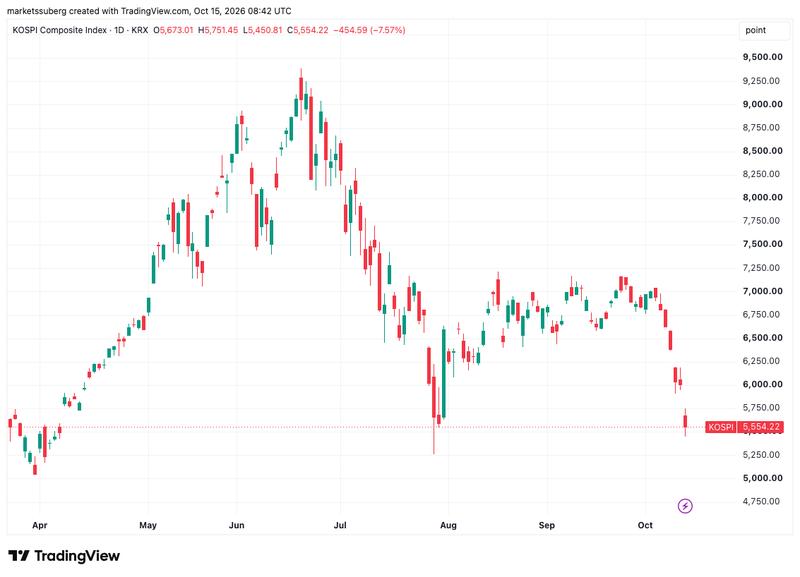
- The KOSPI index concluded Thursday's session at 5,554 points, representing its weakest closing level since the beginning of April, fueled by a technology sector rout.
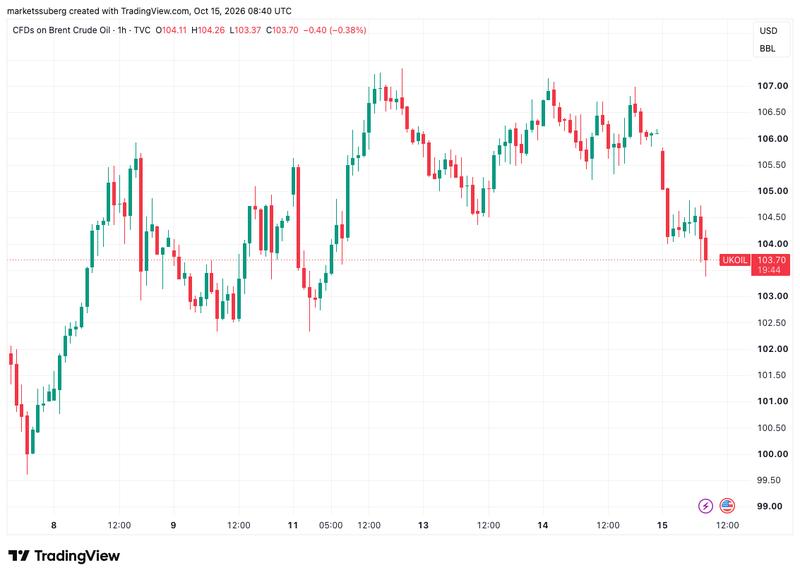
- Oil markets experienced cooling temperatures, with Brent crude falling over 2% notwithstanding an "unjustifiable" strike against a Singapore-flagged fuel tanker in the Strait of Hormuz.
Bitcoin price approaches $80,000 threshold as KOSPI plunges 7.5%
Information from TradingView indicated BTC/USD touching $80,154 on the Bitstamp exchange, representing a price point not witnessed since Sept. 20.
The downward pressure materialized following South Korea's Korea Composite Stock Price Index, or KOSPI, concluding Thursday's trading 7.5% in the red, pushing cumulative week-to-date declines to 15.5%.
Consistent with the pattern observed earlier during the week, technology sector behemoths absorbed the heaviest impact from the selloff, with SK Hynix declining 11% while Samsung Electronics closed 9.5% down for the trading day.
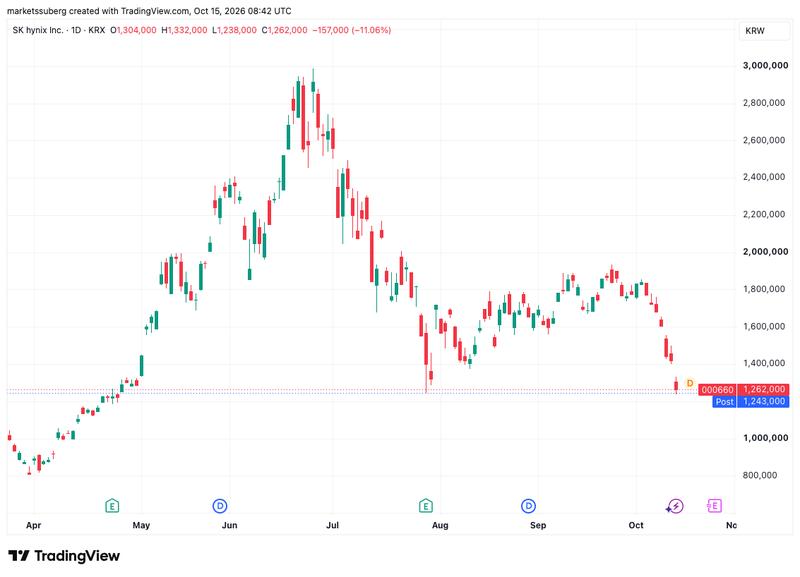
According to Cointelegraph's reporting, apprehensions surrounding AI debt obligations, foreign capital flight and competitive pressures from China played into the South Korean market turmoil, with KOSPI's 200-day moving average sliding to lows of 5,450 points, a threshold not observed since the final days of July. The index closed Thursday's session at 5,554 points, representing its weakest daily finish since April 8.
In comments to domestic news outlet The Korea Herald, analyst Kim Seok-hwan from Mirae Asset Securities cautioned that global macroeconomic challenges would introduce additional obstacles in the coming period.
Volatility is expected to persist in the near term. As domestic supply-demand conditions deteriorate, the market has become more sensitive to external risks, while a near-term improvement in the global environment appears unlikely.
SK Hynix and Samsung are scheduled to publish third-quarter earnings figures on Oct. 28 and 29, respectively, which could potentially amplify downside volatility in technology investor sentiment if the reported numbers fail to meet analyst projections. Samsung is anticipated to report Q3 sales of 195 trillion won ($145 billion) alongside an operating profit in the vicinity of 107 trillion won ($80 billion).
Oil markets decline despite Singapore tanker sinking
Downward momentum on Bitcoin intensified following Wednesday's release of US inflation figures that exceeded market expectations.
The September reading of the Consumer Price Index (CPI) registered at 3.7% year-on-year, triggering a hawkish recalibration in market forecasts regarding additional interest-rate increases by the Federal Reserve.
Does the beat force further hiking — or does credit stress prompt policy recalibration?
QCP Capital
Despite elevated oil prices representing a substantial component of the CPI increase, both WTI and Brent crude experienced declines on Thursday even as Middle East tensions escalated. A Singapore-registered oil tanker suffered a sinking in the Strait of Hormuz on Wednesday, an action that the Maritime and Port Authority of Singapore characterized as "unjustifiable."
In an interview with CNBC, Firas Bechwaty, head of business development at online trading platform ICM, expressed skepticism about Hormuz transit volumes recovering to pre-US-Iran war levels.
At the same time, Saudi crude continues to reach international buyers through alternative routes, while accelerated emergency stock releases by IEA members provide an additional buffer, preventing a sharp rise in prices, even as tensions remain elevated.
As of publication time, WTI was trading beneath $95 per barrel, registering a 0.5% decline, while Brent had fallen 2.2% lower to $103.7 per barrel.