
BTC Drops Below $50K as Gold Enters Bear Territory: Key Bitcoin Market Insights This Week
As gold slides into bear market conditions, Bitcoin trends toward its trading range floor amid mounting concerns over Iranian tensions and energy market disruption.

As Bitcoin (BTC) enters the new trading week, fresh macroeconomic challenges emerge with gold experiencing a sharp decline and market participants anticipating a drop to $50,000.
- The weekly BTC price movement concludes beneath a crucial trend line, with market analysts anticipating limited bullish momentum beyond a potential early-week recovery.
- Chart patterns increasingly mirror January's bear flag formation — with projected targets pointing toward fresh multiyear bottom levels.
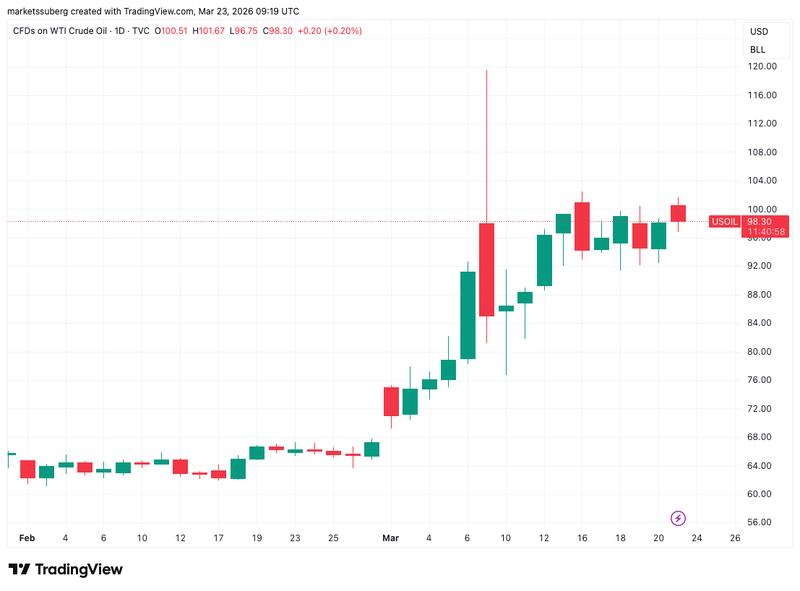
- Gold crosses into technical bear market status while oil climbs back toward $100 amid ongoing Iranian geopolitical tensions.
- Market participants begin factoring in potential Fed interest rate increases for 2026, though historical patterns may still provide some support for risk assets.
- Bitcoin's long-term holder cohort has been executing loss-taking transactions consistently throughout March.
BTC Weekly Closure Falls Below 200-Week Trend Line
Following a challenging weekend session, Bitcoin faced difficulty regaining support levels as traditional finance market participants resumed trading at the week's start.
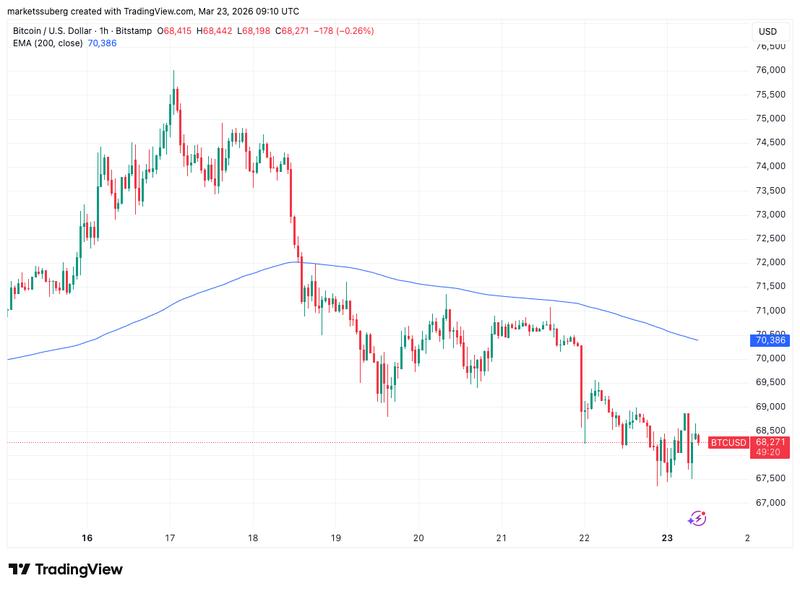
According to TradingView data, price action descended to approximately $67,400 heading into the weekly closure, resulting in a loss of the critical 200-week exponential moving average (EMA) trend line support.
Prior technical analysis had identified a weekly close maintaining position above the 200-week EMA, presently situated at $68,300, as essential for sustaining bullish momentum moving forward.
Within his most recent X platform assessment of BTC price behavior published on Sunday, market analyst CrypNuevo projected that trading would remain dependent on geopolitical developments.
"It feels like we'll be stuck in this range for the next month too," he summarized.
"We could see some conflict escalation (uncertainty) next week that could trigger a new visit to the range lows where an interesting 4h long wick still sits there."
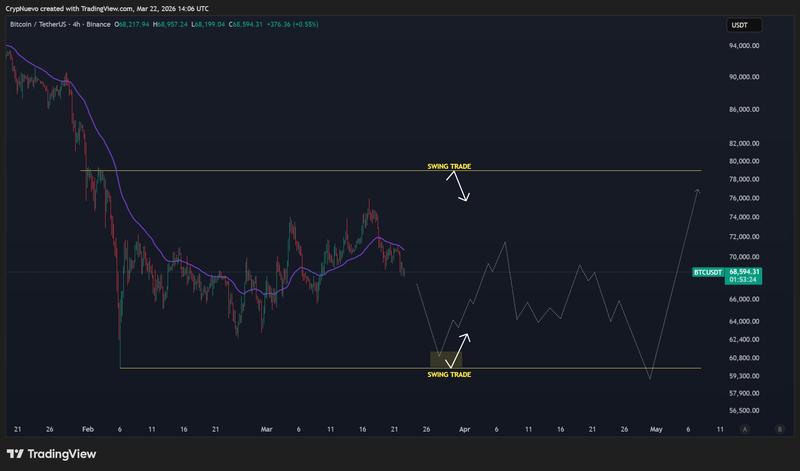
CrypNuevo made reference to Bitcoin's downward spike beneath $60,000 observed during the first week of February.
"In LTF, I'll be favoring a potential price rotation to $65k next week," he continued about low time frames.
"I'd like to position for this around $70k if we see a short-lived push to the upside at the start of the week. But with caution, because acceptance above $71k would invalidate it and I'd long to $73k-$74k."
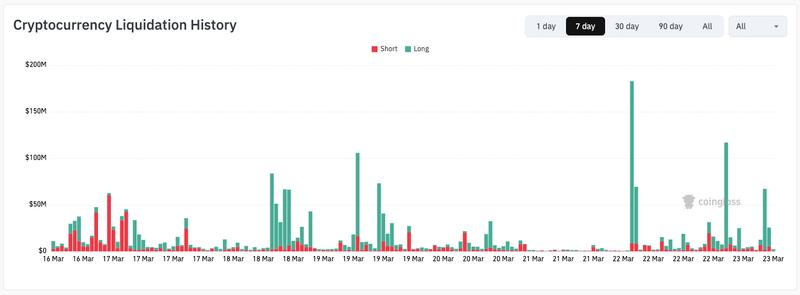
Liquidation volumes remained elevated heading into Monday, with more than $400 million in positions eliminated within a 24-hour period, according to CoinGlass data.
Given liquidity concentration positioned above current price levels, analyst Castillo Trading identified the possibility of a short squeeze event to capture it.
Addressing the most recent price movements, onchain analytics provider CryptoQuant suggested that the weekend's downward volatility represented typical market behavior.
"During weekends, institutional participation declines significantly, and spot-driven demand—especially from ETF flows—effectively pauses. As a result, the market becomes more dependent on derivatives positioning and short-term liquidity conditions," contributor XWIN Research Japan wrote in a "QuickTake" blog post.
"Lower liquidity also amplifies price sensitivity. With thinner order books, relatively small sell orders can trigger larger price movements, often leading to cascading effects such as stop-loss activation or liquidation events."
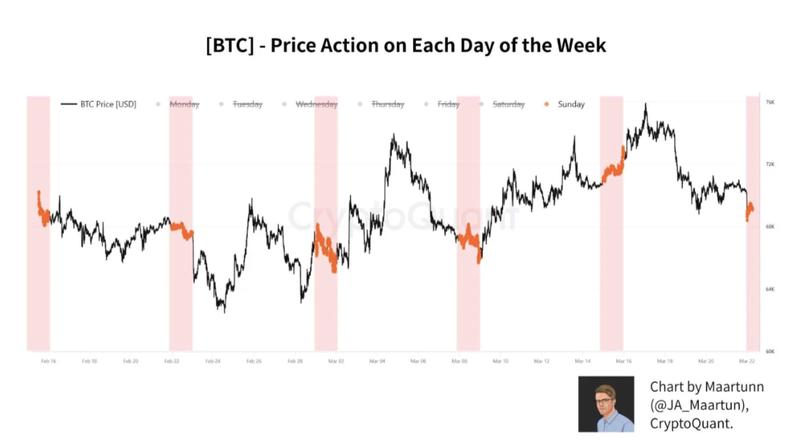
XWIN emphasized that weekend trading activity "should not be interpreted as a signal of trend continuation or reversal."
Market Analysts Monitor Potential January Bear Flag Pattern Repetition
From the perspective of Bitcoin optimists, historical patterns threaten to replicate themselves already during this trading week — and similar to previous instances, bearish forces seem to maintain control.
Apprehension centers around yet another bear flag configuration currently developing on daily timeframe charts.
Within this pattern, a broad downward trajectory is interrupted by a consolidation phase, creating an illusion for some observers that the trend has reversed direction. Price subsequently breaks below the flag's lower boundary and the downtrend resumes toward fresh lows.
As previously documented by Cointelegraph, market participants have repeatedly cautioned about a second bear flag formation and its potential implications following the completion of the initial pattern in January.
"It looks almost exactly the same. Bear Flag Breakdown & Retest with low volume on the upward move," trader Roman told X followers last week after BTC/USD hit six-week highs of $76,000.
Following the weekend session, trader Jelle advanced the analysis further, indicating that price had potentially already violated support boundaries.
"Not a great way to start the week if you're a bull. Consolidate here for a day or two and those untapped lows look ripe for the taking," he warned.
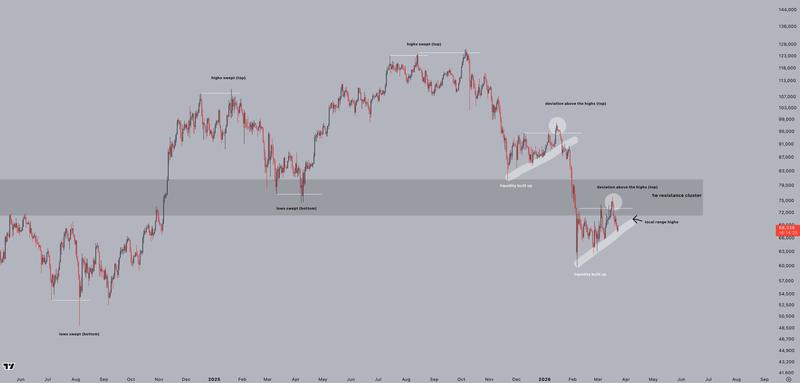
During Saturday's session, Keith Alan, cofounder of trading resource Material Indicators, proposed that the measured move target from the bear-flag breakdown pattern could extend below $50,000.
Gold Crosses Bear Market Threshold Amid Iranian Oil Crisis
The deteriorating global energy situation centered on Middle Eastern developments is already extracting a renewed cost from both risk assets and traditional safe-haven investments this week.
Asian equity markets experienced substantial declines during their initial trading session, while precious metals including gold and silver faced significant selling pressure. Bitcoin accompanied them, reaching two-week low levels into Sunday's weekly closure.
Providing analysis, trading resource The Kobeissi Letter even raised the possibility that the gold downside movement could indicate forced liquidation of a significant market participant.
"The sporadic moves in price could signal that a potential large player in the space is being liquidated," it told X followers.
Kobeissi noted that ascending US 10-year treasury note yields were "beginning to weigh on various asset classes."
"Combine this with headline fatigue and 'pockets' of illiquidity in the market, and the massive gaps to both directions are only growing," it added.
"Something big is happening metals markets right now."
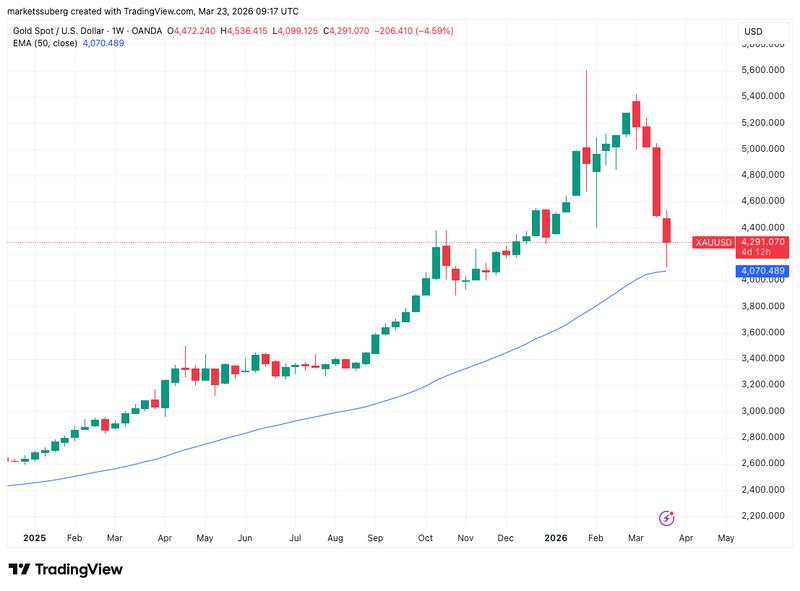
Having declined more than 20% from its record peak, XAU/USD formally crossed into bear-market classification, touching regional lows at $4,099 per ounce — a price point last observed during November 2025.
Crude oil, conversely, continued its efforts to maintain positioning above the $100 threshold as uncertainty regarding shipments through the Strait of Hormuz persisted.
"Oil prices are directly correlated to headline inflation, where a $10 increase per barrel can push inflation higher by 0.20% or more. And even before the outbreak of conflict in the Middle East, there are growing signs that inflation is already inflecting higher," it noted.
Hope Persists for Risk Assets Despite Federal Reserve Hawkishness
The current trading week offers limited major inflation data releases, with unemployment claims and S&P Flash Purchasing Managers Index (PMI) figures commanding primary attention.
Cryptocurrency markets have demonstrated responsiveness to PMI publication events during recent months, with US manufacturing sector finally exhibiting expansion following multiple years of contraction.
Simultaneously, challenges stemming from the Iranian conflict situation continue accumulating, as evidenced by the hawkish positioning from the US Federal Reserve during last week's policy meeting.
Following the decision to maintain interest rates at current levels, Chair Jerome Powell indicated that any policy loosening would now be contingent upon "progress" being achieved on inflation reduction.
"As a result, the market is quickly repricing the outlook for rate cuts," Mosaic Asset Company commented.
"While market-implied odds don't point to another rate cut for over a year, another key indicator is suggesting that rate hikes could be in store."
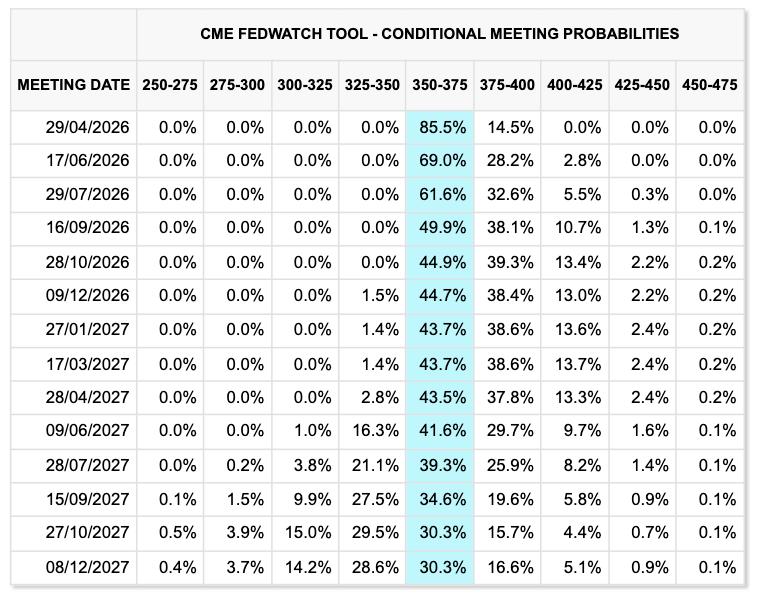
The cautious approach emerged despite deteriorating US labor-market indicators — traditionally a catalyst for reconsidering restrictive monetary policy frameworks.
A potentially favorable development, nevertheless, could materialize for risk assets through the repetition of historical market patterns. As documented by Cointelegraph, cryptocurrency's positive correlation with equities has recently intensified.
"Conditions across breadth and sentiment are evolving to support a rally in the S&P 500. At the same time, historic precedent for market movements around major geopolitical events also hint that a rebound could be in store for the stock market," Mosaic continued.
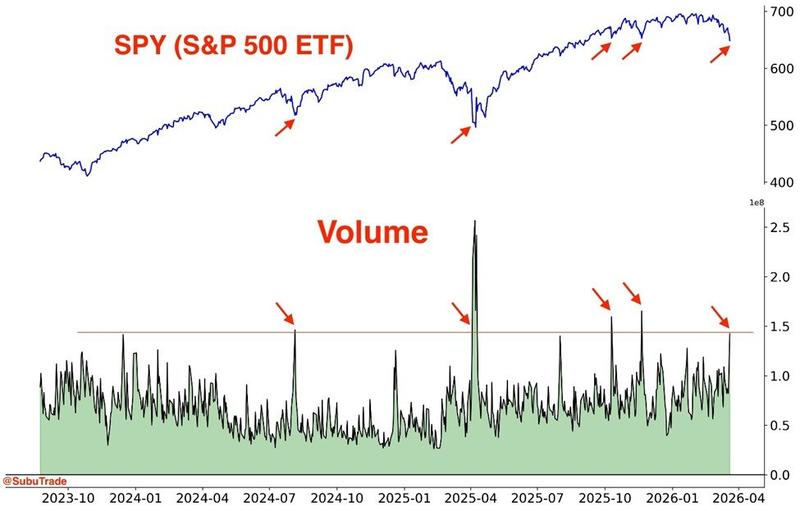
Kobeissi offered comparable perspectives, highlighting "skyrocketing" trading volumes across equity markets and last week's massive options expiration event freeing substantial capital.
"Friday's volume was also amplified by ~$5.7 trillion in options tied to US stocks, indexes, and ETFs expiring in the largest March triple-witching in at least 30 years," it wrote on X.
"The massive volume of expired options has released billions in capital, which could drive significant market swings this week. Brace for more market volatility."
Bitcoin Long-Term Holders Execute Loss-Taking Transactions
Bitcoin long-term holders (LTHs) are experiencing stress at present price levels — independent of a potential retest of range floor levels.
CryptoQuant research identifies "capitulation" indicators from the Spent Output Profit Ratio (SOPR) metric, which determines whether coins transferred onchain are executing at elevated or reduced prices relative to their prior transaction.
SOPR measurements beneath 1 indicate that the monitored supply — specifically that held by LTHs — is collectively transferring at a realized loss.
"On March 11, the Bitcoin Long-Term Holder SOPR dropped to 0.64, meaning long-term holders were selling their coins at a 36% loss relative to their cost basis. This is one of the most extreme LTH capitulation readings in recent months," contributor The Enigma Trader commented.
"A value this far below 1.0 indicates that even patient, conviction holders were being shaken out, a sign of genuine fear in the market."
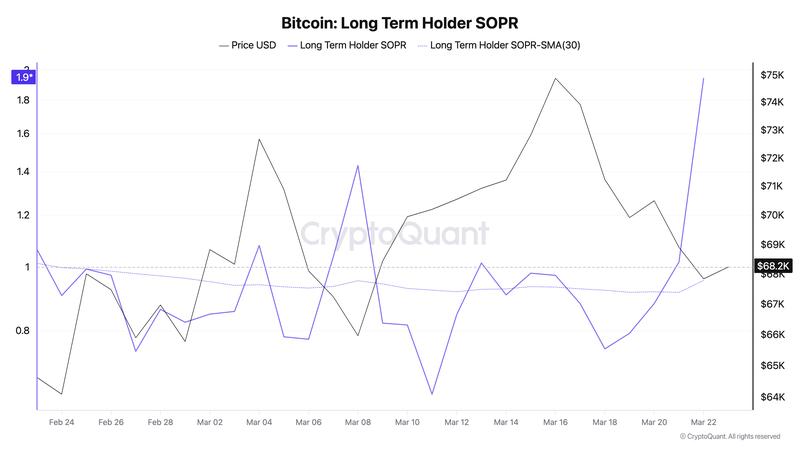
The 30-day moving average calculation of LTH-SOPR continues registering below 1 — even as substantial quantities of BTC exit exchange platforms in what may represent an emerging accumulation pattern.
"One possible interpretation: while long-term holders were capitulating between March 10–20, a separate cohort was quietly absorbing supply and moving coins off exchanges," it continued.
"Distribution and accumulation happening simultaneously, a classic phase transition setup."