
Blockchain Association Files Supreme Court Brief Supporting Custodia's Federal Reserve Challenge
Industry advocacy group contends the Federal Reserve lacks unlimited authority to reject master account applications from state-chartered banks meeting eligibility requirements.
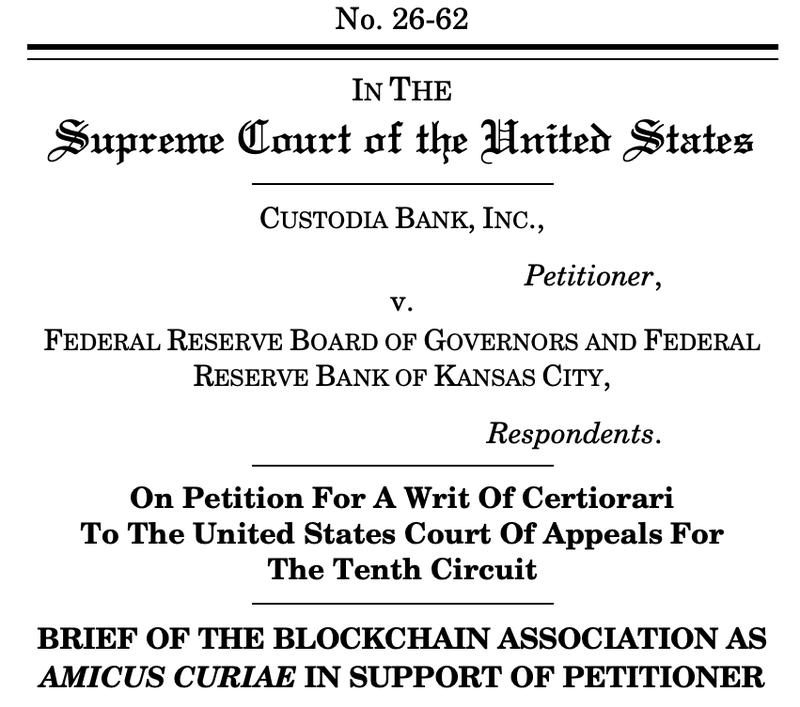
The Blockchain Association has petitioned the US Supreme Court to review Custodia Bank's legal fight against the Federal Reserve following the central bank's rejection of the institution's master account request, a decision that prevents the digital asset-oriented bank from obtaining direct connectivity to the Fed's payment infrastructure.
Through an amicus brief submitted on Wednesday, the advocacy organization contended that existing federal statutes mandate the central bank to provide payment services to qualified nonmember banking institutions and that the Fed lacks sweeping authority to refuse such access.
According to the association, the appellate court's ruling essentially grants the Fed absolute authority over state-chartered banking institutions by permitting it to deny critical services necessary for independent operations. The group further connected Custodia's legal battle to purported crypto debanking practices under what critics call "Operation Choke Point 2.0," contending that federal banking regulators actively discouraged financial institutions from providing services to the digital currency sector.
Custodia, a Wyoming-chartered financial institution specializing in digital assets, submitted its application for a Fed master account in 2020, pursuing direct connectivity to the central bank's payment infrastructure without depending on an intermediary financial institution.
The Federal Reserve Bank of Kansas City rejected Custodia's master account application in 2023, and the Tenth Circuit Court of Appeals subsequently determined that the regional Fed bank possessed the authority to decline its application. In March, the appeals court voted 7-3 against reconsidering the case, making the Supreme Court Custodia's final remaining option for judicial review.
The Blockchain Association contended the Tenth Circuit construed the Fed's statutory authority excessively broadly, creating the possibility for it to refuse payment-system connectivity to qualified state-chartered banking institutions that serve the cryptocurrency sector.
Crypto companies push deeper into US banking
Custodia's legal challenge unfolds as additional crypto firms are securing enhanced access to the US banking infrastructure, including federal banking charters and, in at least one instance, direct connectivity to Federal Reserve payment systems.
In March, Kraken Financial became the inaugural crypto banking division to obtain a limited-purpose master account from the Federal Reserve Bank of Kansas City, providing it with direct connectivity to Fedwire. The authorization stands in stark contrast to Custodia's denial by the identical regional Fed bank in 2023.
In April, Coinbase obtained conditional authorization from the Office of the Comptroller of the Currency (OCC) to create a national trust company, placing its custody operations under federal regulatory supervision without granting it authority to accept retail deposits or function as a commercial banking institution.
Circle obtained final OCC authorization for its national trust bank in July, while Kraken parent Payward submitted its own national trust company charter application the subsequent month. The OCC also conditionally authorized national trust bank applications from Ripple, BitGo, Fidelity Digital Assets and Paxos in December.
The movement has encountered opposition from traditional banking organizations. The Independent Community Bankers of America challenged Coinbase's authorization in April, contending that cryptocurrency firms are pursuing the advantages of bank charters without accepting the comprehensive regulatory requirements imposed on traditional banking institutions.