Bitcoin's 'Sell in May' Pattern During Midterm Years Sparks Analyst Debate
Historical data reveals May has been problematic for Bitcoin prices during US midterm election cycles, prompting experts to discuss whether the pattern might repeat in 2026.

Market experts in the cryptocurrency space remain split on the possibility of a significant Bitcoin price correction occurring in May, mirroring a trend observed during the previous two bear cycles that aligned with United States midterm election years.
During May 2018, the price of Bitcoin plummeted from approximately $10,000 down to around $7,000 by month's end. A similar pattern emerged in May 2022, when the cryptocurrency experienced a decline of nearly 30%, dropping from roughly $40,000 to $28,500, with further deterioration in June pushing it down to $20,000.
Given that 2026 represents another bear market cycle occurring alongside a United States midterm election, worries have surfaced that history might repeat itself.
"The most brutal pattern in Bitcoin history. Nobody wants to hear this. But the pattern is perfect. Mid-term election years. Bitcoin dumps. Every time," crypto analyst Merlijn Enkelaar said on Sunday.
According to Enkelaar, a comparable downward movement might drive Bitcoin valuations down to $33,000 notwithstanding progress on crucial legislation like the CLARITY Act, favorable cryptocurrency attitudes from the Trump administration, and possible commercial agreements between the United States and China.
Joao Wedson, founder and CEO of Alphractal, also said Sunday that there would be a higher probability of a new capitulation phase if Bitcoin remains under $78,000, with bears "showing signs of strength."
At the time of writing, Bitcoin was changing hands at approximately $76,900, reflecting a 5.6% decrease across the previous seven-day period.
Previous crashes weren't triggered by the calendar, expert contends
Jeff Ko, chief analyst at the CoinEx exchange, told Cointelegraph on Monday that midterm election years have coincided with major Bitcoin bear markets, "so some traders may be tempted to frame 2026 as another 'sell in May' setup."
Nevertheless, underlying that historical seasonal pattern were more tangible macroeconomic catalysts, including the Mt. Gox fallout, China's initial coin offering ban, Federal Reserve monetary tightening, and the Terra/FTX implosions, he said.
"The calendar didn't cause those drawdowns — specific shocks did."
According to Ko, he doesn't anticipate BTC replicating the 70% to 80% price corrections witnessed in previous market cycles due to fundamental shifts in market infrastructure.
"Spot ETFs, corporate treasury adoption, and the CLARITY Act moving through Congress have meaningfully broadened and institutionalized the buyer base compared with past cycles," he added.
"In my view, a move toward the mid-$60k or high-$50k range could be defensible under a macro shock or a significant ETF outflow cascade. But a move back to $33k would likely require something genuinely systemic to break, rather than simply a repeat of historical seasonality."
Critical support threshold must be maintained
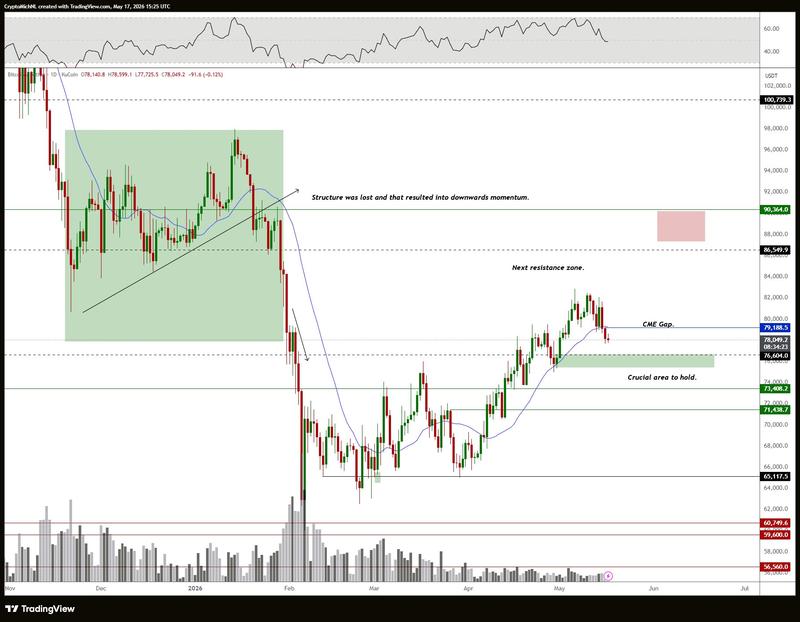
MN Fund founder Michaël van de Poppe was also bullish, saying on X Sunday that the current Bitcoin price action "doesn't shout for new lows" but is "consolidating after a run of 40%."
Nevertheless, a crucial support threshold currently acting as a barrier against a more substantial decline exists around the $76,000 zone, he warned.
"If that level is lost, I would assume that the markets will see a further downward fall towards lower boundaries," he said.