
Bitcoin's Era of Explosive Rallies Ends Thanks to Wall Street: Markus Thielen of 10x
Markus Thielen projects Bitcoin will hit $90,000 before year-end, raises doubts about genuine institutional demand for ETFs, and argues Ethereum needs to deliver better value to token holders.

The era of Bitcoin experiencing multiple consecutive days of dramatic double-digit percentage gains has come to an end, as institutional Wall Street participants and profit-seeking whales transform the cryptocurrency market, says Markus Thielen, founder of 10x Research.
According to Thielen, who appeared on the most recent episode of Cointelegraph's Trade Secrets, the practice of institutional market participants selling call options following price rallies has diminished the likelihood of the explosive price movements that characterized Bitcoin in previous years.
Thielen also authored Crypto Titans, which chronicles the cryptocurrency industry's history. During the writing process, he observed a pattern where each market cycle featured distinct groups of individuals marketing cryptocurrency to potential investors.
"Every cycle had actually different promoters, and different promoters bring in different investors," he says.
In the current cycle, these promoters originate from Wall Street, where market participants base their trading decisions on macroeconomic data releases and policy decisions from the Federal Reserve. According to Thielen, he anticipates Bitcoin experiencing rapid price appreciation following major news announcements, then entering periods of sideways price movement until the subsequent significant macroeconomic event occurs.
Who's really buying Bitcoin?
According to Thielen's analysis, market-making firms represent approximately half of the $60 billion in cumulative net inflows into spot Bitcoin exchange-traded funds that he examined. These market makers acquire ETF shares primarily as a hedging mechanism for their derivatives positions, meaning these holdings don't necessarily indicate bullish sentiment on Bitcoin's future price trajectory.
"So in the end it was not outright buying," he says.
His calculation is based on an examination of Form 13F regulatory filings, which require investment managers to disclose specific securities holdings under their management.
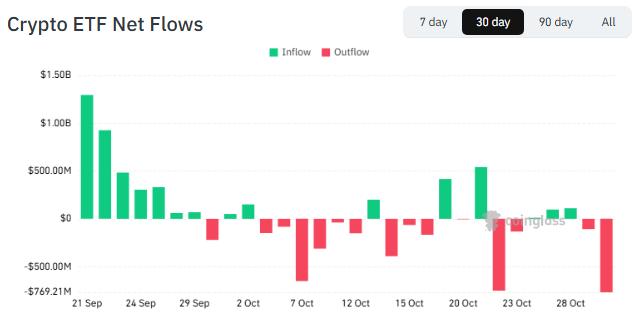
According to Thielen, the initial capital flowing into Bitcoin ETFs also consisted of retail investors accessing the products through institutional intermediaries and corporate structures. In some cases, these investors purchased shares at significant premiums relative to the net asset value of the cryptocurrency holdings.
"I would still think the institutions could come. I would still think that some of the sovereign wealth funds could come," Thielen says.
Bitcoin could reach $90,000 by year-end
Despite these concerns, Thielen maintains his projection that Bitcoin will climb to $90,000 before the calendar year concludes. However, he suggests a temporary decline into the mid-to-high $70,000 price range might occur before that happens.
Bitcoin has already experienced trading within that anticipated range, declining to approximately $76,100 this past Friday in the aftermath of the $6.3 billion security breach at Binance. According to data from Coinglass, BTC closed October with a 7.3% monthly decline.
Thielen draws parallels between the recent price recovery and the early months of 2023, when Bitcoin climbed from approximately $20,000 to reach $30,000. He notes that the skepticism surrounding this year's price recovery mirrors past investor behavior, as market participants continuously search for the next pullback and optimal entry opportunity.
"I think everybody sort of missed it. So everybody wants to buy again."
Whether BTC successfully returns to the $90,000 level may depend significantly on the Federal Reserve's decisions regarding additional interest rate increases. In September, the central bank implemented a quarter-percentage-point rate hike, bringing its benchmark rate to a target range between 3.75% and 4%.
During last Wednesday's meeting, the Fed maintained rates at their current level in a divided decision, with two policymakers supporting an additional quarter-point increase. The accompanying policy statement acknowledged that inflation remains elevated, signaling that additional rate hikes remain under consideration.
Thielen forecasts one more rate increase arriving by December, to be followed by a more measured stance on subsequent rate hikes that could provide favorable conditions for Bitcoin to rally as the year concludes.
Ethereum needs to show holders the money
Thielen anticipates Bitcoin will deliver stronger performance compared to Ether, arguing that an excessive portion of value generated by Ethereum network activity flows to layer-2 scaling solutions.
"I look at it more as like a valuable utility, but nobody wants to pay for it."
Reducing transaction costs for these layer-2 networks has been an intentional component of Ethereum's roadmap and development strategy. However, the resulting cheaper transactions may complicate the value proposition for investors considering ETH as an investment.
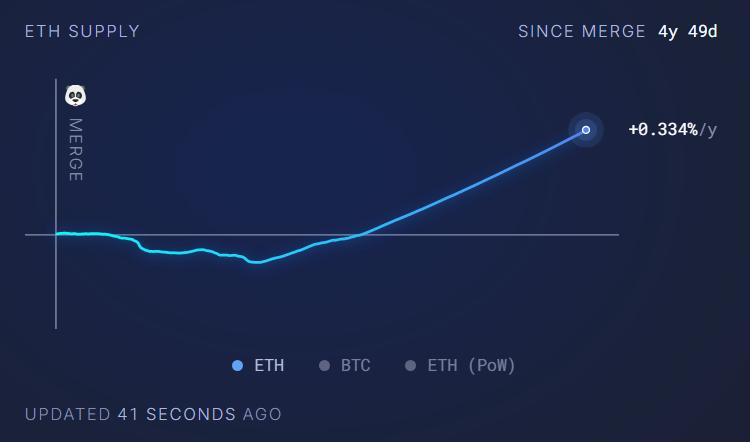
The Ethereum network burns the base fees that users pay for transactions, permanently eliminating those tokens from the circulating supply. When the quantity of ETH burned surpasses the new ETH distributed to network validators, the total supply contracts. Reduced transaction fees can result in less ETH being destroyed through this mechanism.
Thielen, who acknowledges maintaining a bearish stance on Ether for over twelve months, uses a highway analogy to illustrate Ethereum's challenge.
"Everybody wants the highway to be empty so you can go fast, and the roads need to be super, super clean and fixed and everything, but nobody wants to pay for it," he says.
He highlights Hyperliquid as a demonstration of how transaction activity can drive token buybacks. The decentralized perpetual futures exchange's assistance fund takes trading fee revenue and converts it into HYPE tokens, which are subsequently burned.
When it comes to Ethereum, he advocates for establishing a more direct relationship between network utilization and tangible financial returns for token holders.