
Bitcoin's 2024 Halving Cycle Shows 'Significant' Weakness Compared to Historical Patterns: Expert
Each successive Bitcoin halving event has brought diminished volatility and reduced gains, though Galaxy's Alex Thorn suggests these emerging patterns might be temporary.
According to Alex Thorn, head of firmwide research at Galaxy investment firm, the present Bitcoin (BTC) market cycle is performing "dramatically" worse when compared to the preceding three market cycles.
In his analysis, Thorn examined price movements following the April 2024 Bitcoin halving against the cycles that began in 2012, 2016, and 2020. His findings reveal that the present cycle exhibits notably reduced volatility and considerably smaller gains. The peak price exceeding $125,000 reached on Oct. 5, 2025, represented merely a 97% increase from the approximate $63,000 price level at the time of the 2024 halving.
During the 2012 halving cycle, BTC's value surged approximately 9,294%, ultimately hitting a peak around $1,163. The 2016 halving cycle witnessed an increase of roughly 2,950%, with prices climbing to approximately $19,891. Meanwhile, the 2020 halving resulted in a price appreciation of around 761%.
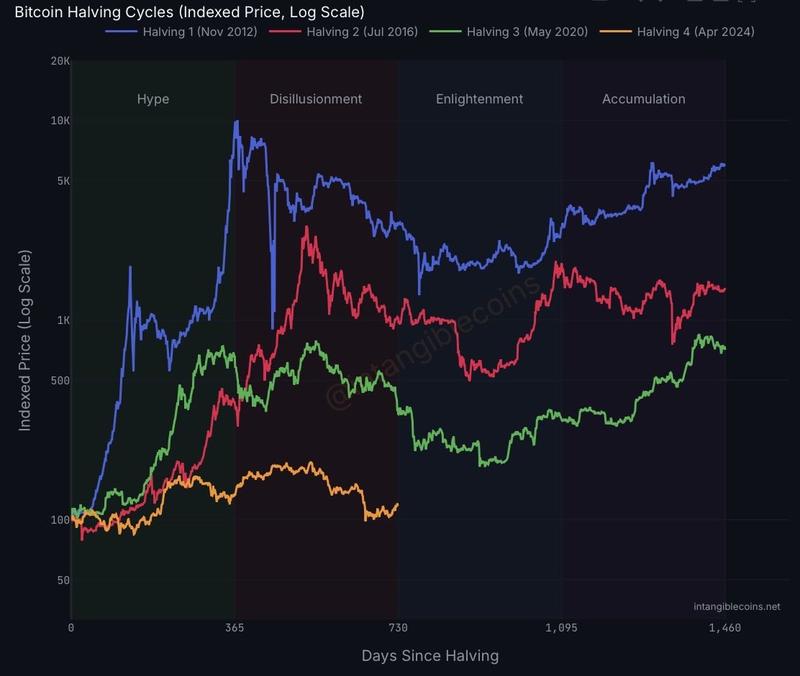
In a post shared on X, Thorn stated that "Cycle four is dramatically underperforming prior cycles," while posing the question: "Is this the new normal, or is it the new normal until it isn't?"
The progressive reduction in volatility observed across each subsequent BTC halving cycle indicates that conventional market patterns are evolving, and that Bitcoin's valuation may increasingly be shaped by alternative factors beyond the halving event or the theoretical four-year market cycle.
The 30-day Bitcoin Volatility Index experienced a spike reaching 9.64% on April 2, 2020, but during the present cycle, it has failed to exceed 3.11%, a level that was last touched on Aug. 24, 2024. According to data from Bitbo, the most recent 30-day reading for this volatility metric stands at 1.75%.
Critics say current cycle performance ignores the premature all-time high before 2024's halving
During March 2024, BTC achieved what represented an all-time high at that point, surpassing the $70,000 threshold — a full month ahead of the April 2024 halving event.
The catalyst that drove this price surge was predominantly the approval of spot Bitcoin exchange-traded funds (ETFs) in the United States, which occurred in January 2024.
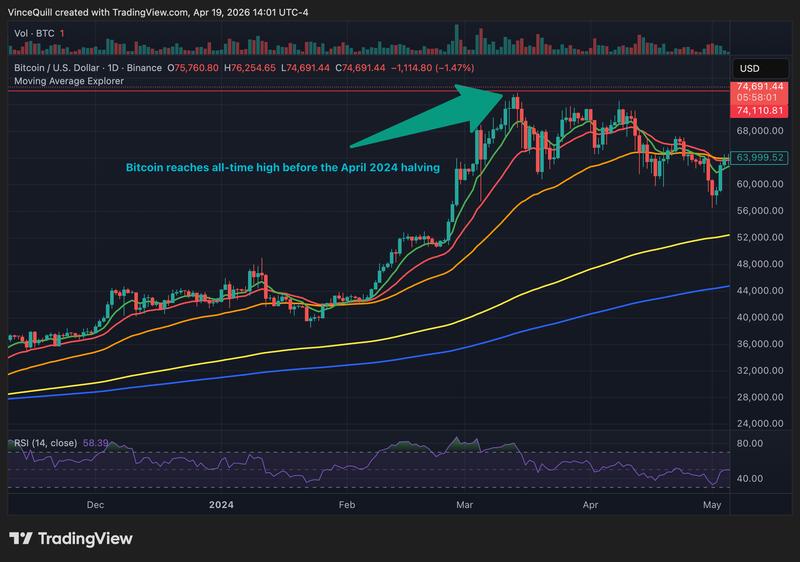
Critics of Thorn's assessment pointed out that this unprecedented occurrence of BTC establishing a fresh all-time high ahead of the halving event has distorted the price performance metrics for the current cycle.
According to research from Fidelity Digital Assets, Bitcoin drawdowns have similarly become less dramatic as volatility has decreased over time.
Zack Wainwright, a research analyst at Fidelity Digital Assets, noted that historical Bitcoin bear markets have experienced price declines ranging between 80% and 90%.
By contrast, Bitcoin's descent to $60,000 from its all-time peak above $125,000 constitutes a drop of slightly more than 50%, as highlighted in Fidelity's research findings.
During March, Jan van Eck, the CEO of asset management firm VanEck, expressed his view that BTC is approaching a bottom and that he anticipates the price will start climbing steadily once more throughout 2026.
According to the most recent data from TradingView, the largest cryptocurrency by market capitalization was changing hands at approximately $74,703, representing an increase of nearly 5% over the preceding seven-day period.