
Bitcoin Retail Participation Plunges 73% While Futures Markets See Over $2B in Selling: Bearish Trend Emerging?
Bitcoin deposits from retail traders on Binance have hit record lows following BTC's drop to $76,000, signaling a dramatic decline in trader sentiment.

The participation of retail investors in Bitcoin (BTC) on Binance has dropped to unprecedented lows. Monthly retail BTC deposits on the exchange currently hover around 314 BTC in 2026, representing a dramatic decrease from the approximately 1,200 BTC level seen during March 2024.
The resurgence of Bitcoin in May has also encountered headwinds as spot market inflows on Binance have diminished, with 30-day net demand expansion declining by 73% throughout the last three-week period.
Retail Bitcoin traders withdraw from market
According to CryptoQuant analyst Darkfost, retail Bitcoin deposits to Binance have stayed close to all-time low levels. This indicator monitors BTC transfers from wallets containing fewer than 1 BTC, which serves as a widely recognized proxy for retail investor participation.
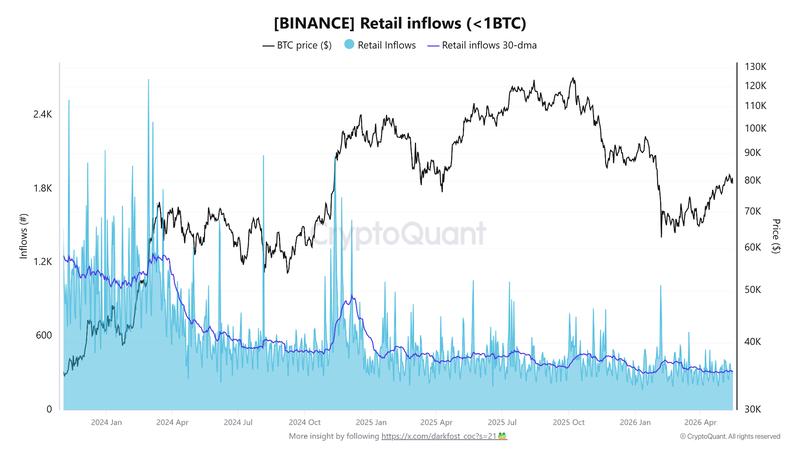
The current monthly average for retail BTC deposits on Binance sits at merely 314 BTC. This metric registered approximately 1,800 BTC throughout the 2022 bear market phase and hovered around 1,200 BTC when Bitcoin reached its March 2024 local peak near $75,000. Previous market cycles demonstrated significantly higher retail engagement, with deposit volumes reaching a high of roughly 5,400 BTC in 2018 and approximately 2,600 BTC during 2021.
According to Darkfost, a portion of this transformation can likely be attributed to investors gravitating toward spot Bitcoin exchange-traded funds (ETFs) instead of maintaining direct custody of BTC on cryptocurrency exchanges.
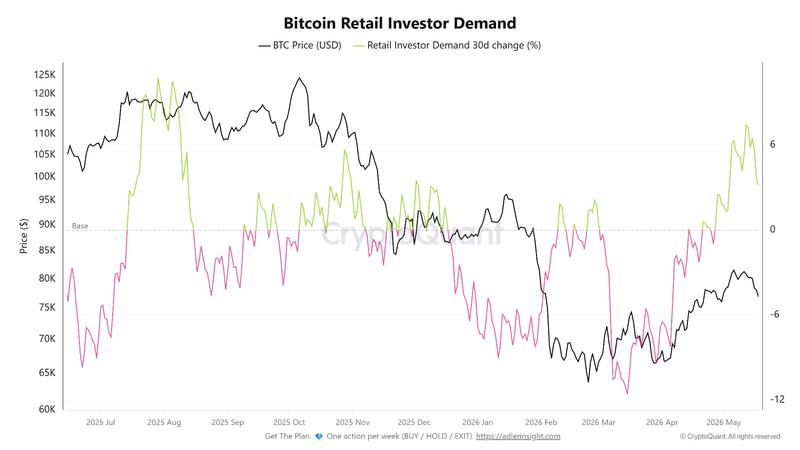
Additional data from CryptoQuant revealed a cooling trend in retail demand expansion. The 30-day variation in retail investor participation fell to 3.12% compared to 7.39% recorded the previous week. That prior measurement represented the most robust retail demand growth observed since August 2025, during which Bitcoin was trading around $115,000. This downward movement suggests diminished spot market involvement following a temporary surge in purchasing activity.
Spot BTC demand trails futures market positioning
Cryptocurrency analyst Amr Taha noted that Binance experienced two significant surges in Bitcoin taker sell volume throughout the recent price decline. The initial spike approached approximately $1.5 billion on May 15. A subsequent wave exceeded $1.1 billion as Bitcoin dropped beneath the $77,000 threshold.
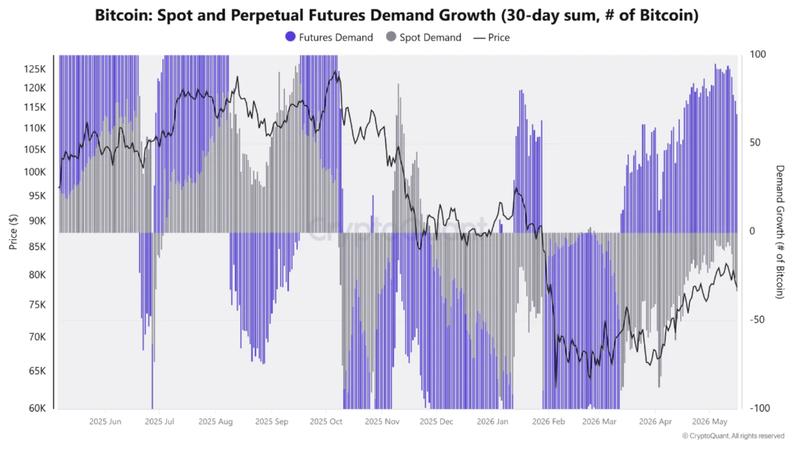
Market analyst Crazzyblockk highlighted that one crucial indicator currently absent from Bitcoin's recovery phase is equilibrium in spot market demand. Previous price rallies during October 2024, November 2024, and May 2025 demonstrated that both spot and futures demand increased in tandem. Spot demand fluctuated between +97,000 BTC and +190,000 BTC throughout those upward price movements, while futures demand grew correspondingly.
The most recent recovery has exhibited a divergent pattern. BTC futures demand has maintained a positive reading of +193,000 BTC across the 30-day period, whereas spot demand has remained in negative territory at -28,000 BTC and has persisted below zero for 65 consecutive days. The aggregate 30-day demand growth has also contracted from 232,000 BTC in early May down to 62,000 BTC by May 16, representing a 73% reduction.
Crazzyblockk further highlighted a significant transformation in Binance's futures market dominance during the previous month. Binance had historically maintained control of 40%-44% of worldwide USDT-margined futures trading volume spanning from October 2024 through March 2026.
During May 2026, Binance's market share declined to 21.1% while OKX's portion increased to 26.3%, representing the first instance of exchange leadership reversal throughout this market cycle.