
Bitcoin Reclaims Critical Bear Market Indicator for First Time Since Late 2025: This Week's Five Key Developments
For the first time since November 2025, Bitcoin has closed a weekly candle above the 50-week exponential moving average, with markets focused on the upcoming Jackson Hole economic symposium.

As the final week of August commences, Bitcoin (BTC) trades near its strongest price levels since the middle of May, with its bear-market recovery approaching a pivotal juncture.
Key points:
- For the first time since early November 2025, Bitcoin has achieved a weekly candle closure above the 50-week exponential moving average (EMA).
- With its strongest August performance in nearly ten years, BTC/USD has restored multiple investor groups to profitability, even as fresh capital enters the market at the $73,000 price point.
- Federal Reserve chair Kevin Warsh takes center stage before the Jackson Hole symposium begins.
- Wednesday will bring the release of US PCE data while markets digest the impact of last week's US Treasury debt buyback announcement.
- Exchange-traded products see renewed capital influx as Bitcoin ETF netflows reached $1.9 billion during the previous week.
Bitcoin barely manages weekly closure above crucial resistance level
Last week saw Bitcoin climb to $79,550, marking its strongest performance since the beginning of May as a five-day surge delivered gains reaching 27%. According to TradingView data, BTC/USD finished the week at $77,727 on Bitstamp. This represented a successful recovery of the 50-week exponential moving average (EMA), an important resistance trendline presently positioned at $77,752.
Market participants commonly reference the 50-week EMA when analyzing Bitcoin during bear market cycles. The most recent weekly candle closure above this significant resistance level occurred in November 2025. Throughout previous bear market periods, BTC has repeatedly retested the 50-week EMA prior to capitulating toward its final macro price bottoms. This historical pattern has left certain traders skeptical about the sustainability of the previous week's robust upward movement.
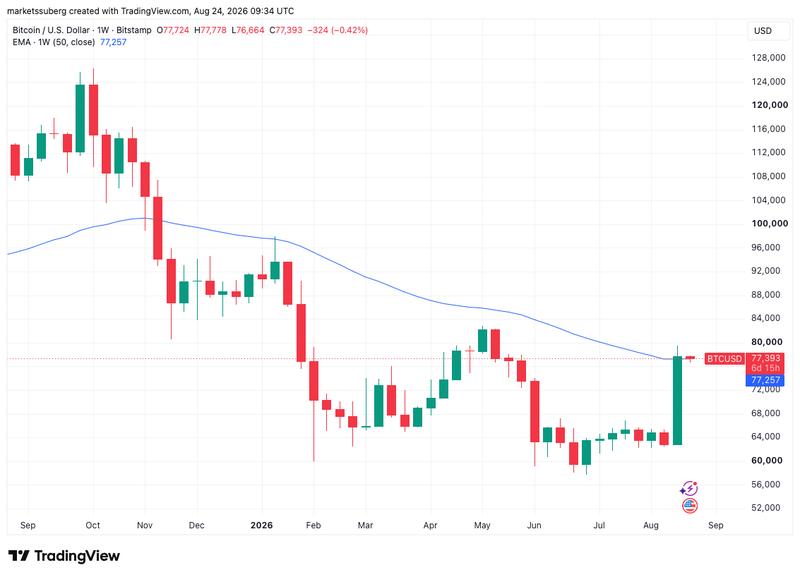
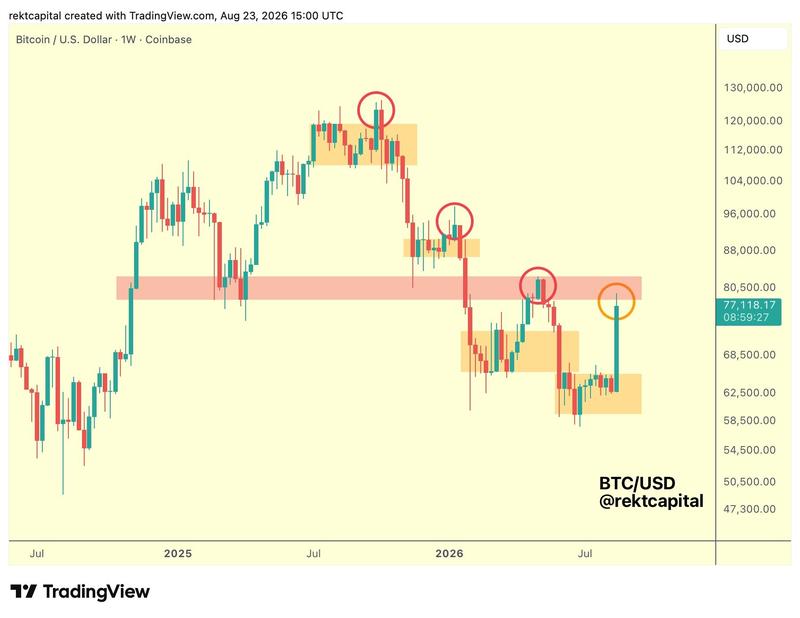
Before the weekly close materialized, cryptocurrency trader and market analyst Rekt Capital issued a warning that the 50-week EMA represented just one element of concern, with the broader $80,000 zone presenting substantial resistance for bullish momentum to penetrate, particularly given that price action has peaked at lower levels thus far.
"Each Bear Market Relief Rally thus far would retrace sharply in the week following a strong breakout rally. Next weeks will be crucial. But maybe even already next week we'll know whether Bitcoin can sustain these highs or not."
A supplementary chart presented what Rekt Capital later described as a sequence of macro lower highs, which could potentially strengthen the bear market narrative despite the recent upward price strength.
Previously, Cointelegraph documented trader expectations regarding 2026 unfolding similarly to historical bear markets, with 2022 displaying the strongest parallels in terms of cyclical timing.
"If history repeats, Bitcoin will try to get as close as possible to ~$93,000 in 2027. But first, Bitcoin needs to fully confirm its Bear Market bottom and fully confirm a break of the Macro Downtrend."
Rekt Capital
Bitcoin positioned for strongest August performance in nine years
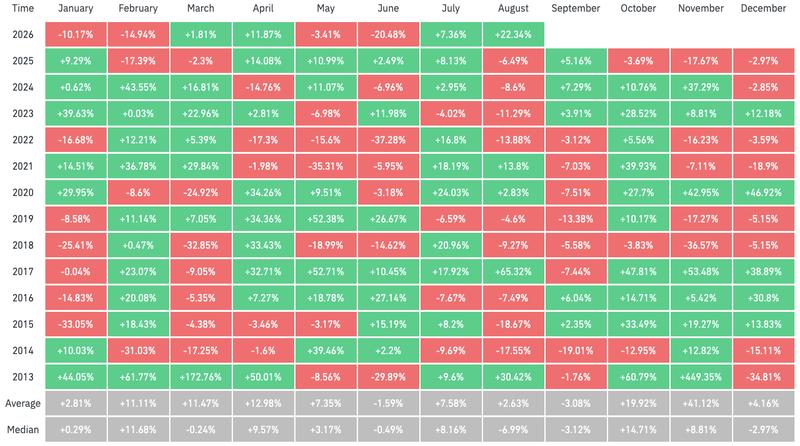
Throughout the weekend, Bitcoin entered a consolidation phase, with the price hovering around $77,500 at the moment of publication, maintaining a month-to-date increase of 22% to deliver its strongest August results since 2017, according to CoinGlass data.
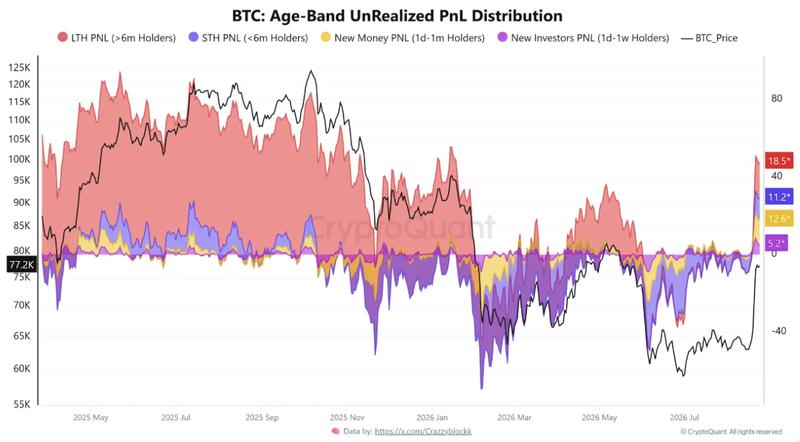
The upward trajectory enabled the weekly candle to recapture multiple significant price levels, including the combined cost basis for short-term holders (STHs) — defined as wallets containing a UTXO for fewer than 155 days — positioned at $68,700. Blockchain analytics provider CryptoQuant subsequently determined STH net profitability at marginally above 11%.
"At the same time, Long-Term Holder profitability moved from approximately breakeven to +18.5%, while New Money profitability rose from -1.4% to +12.7%."
CryptoQuant
When analyzing the cost basis across all UTXOs, CryptoQuant observed that what they term "new money" currently maintains a breakeven threshold at $73,000, positioned above both the STH and LTH cost basis levels, thereby reducing the available margin for downside cushioning should BTC/USD experience a reversal while seeking fresh support at lower price points.
"That makes the 68K-73K region the key area to watch. Holding above it would suggest that the profitability reset is becoming structurally durable. Losing it would quickly push a large portion of recent buyers back into loss."
Federal Reserve's Warsh under scrutiny at Jackson Hole gathering
Market attention converges on the Federal Reserve and chair Kevin Warsh throughout this week as the annual Jackson Hole economic symposium commences.
The gathering, which attracts central banking officials from more than 70 nations, will showcase Warsh's inaugural keynote address as Fed chair and marks his first public commentary since the press briefing following the July Federal Open Market Committee (FOMC) session.
Warsh has sustained a reserved approach regarding financial policy communications, particularly concerning prospective interest-rate adjustments — a subject matter to which cryptocurrency and risk assets demonstrate considerable sensitivity. While recent inflation metrics have supported expectations for policy accommodation moving forward, the persistent risk of oil-price escalation stemming from the US-Iran conflict has maintained market caution.
The most current data available from CME Group's FedWatch Tool indicates 63.1% probability that rates will remain at their present 3.50-3.75% range following the September FOMC gathering.
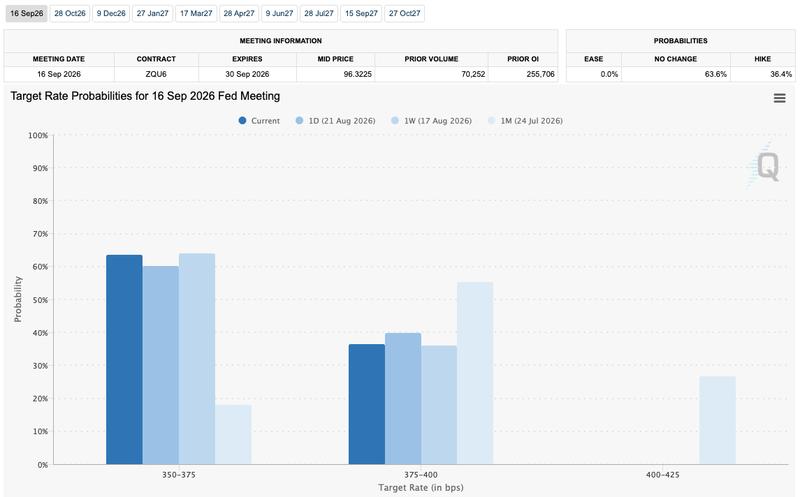
In commentary provided to CNBC during the previous week, Thierry Wizman, who serves as global foreign exchange and rates strategist at Macquarie Group, cautioned that Warsh must now balance the Treasury's influence against his agenda to diminish the Fed's market intervention.
"Were Warsh to signal that he would stay 'dovish' indefinitely, it could be self-defeating for him and the Treasury, since inflation breakevens would rise further, perhaps undoing the stability in the nominal long-term yields that [Treasury Secretary] Scott Bessent is trying to achieve."
Thierry Wizman
A fund manager survey conducted by Bank of America, referenced by Barchart among other sources, yielded 72% probability that no rate increases will materialize prior to the US midterm elections scheduled for November. Regarding policy outlook, consensus gravitates toward a "no landing" scenario throughout the coming 12 months — characterized by recession avoidance alongside robust economic growth and minimal unemployment levels.
Yield curve control speculation resurfaces following Treasury debt action
Setting aside geopolitical considerations, a Treasury Department decision last week to expand its debt buyback purchases to at least double their previous size, reaching $4 billion per operation, emerged as the primary market catalyst. This announcement triggered a Bitcoin short squeeze that proceeded to eliminate a record-breaking $3.1 billion worth of cryptocurrency short positions across a two-day period.
The magnitude of the market response generated speculation that Bitcoin was once more anticipating shifts in the global liquidity environment amid escalating government debt financing costs worldwide.
"The intervention ignited a move in assets sensitive to the outlook for liquidity, including gold and Bitcoin. That hints at market concerns over currency debasement should measures like quantitative easing make a return to contain interest rates."
Mosaic Asset Company, The Market Mosaic
Mosaic contended that the intervention represents not simply a liquidity adjustment but rather a variant of yield curve control (YCC), with short-duration bonds issued to finance the expanded buyback program. Cryptocurrency market observers have maintained long-standing expectations that YCC implementation becomes virtually inevitable to avert government insolvency.
"YCC is the end game. When it is finally implicitly or explicitly declared, it's game over for the value of the USD vs. gold and more importantly Bitcoin. YCC is how we get to $1 million Bitcoin and $10,000 to $20,000 gold."
Arthur Hayes, former CEO of BitMEX
The day preceding Warsh's scheduled appearance, however, delivers an important US macroeconomic data release with potential to influence overall market sentiment.
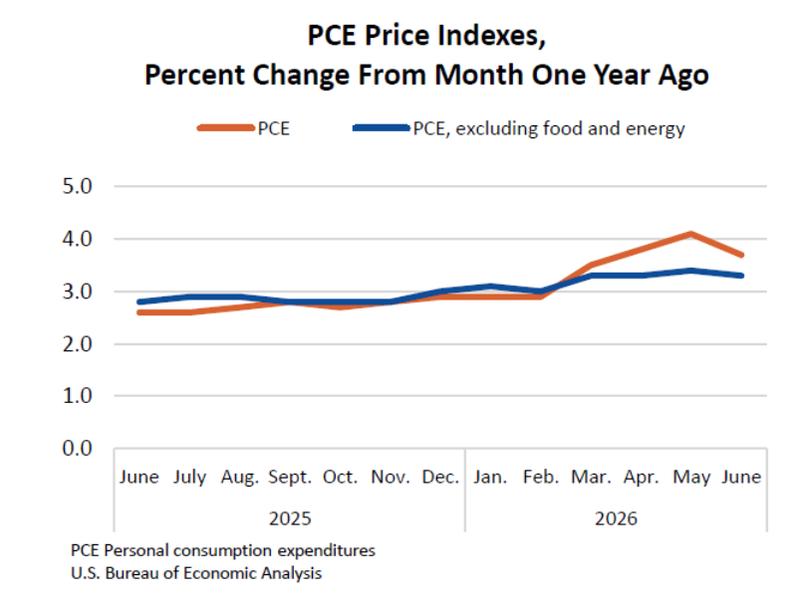
The July Personal Consumption Expenditures (PCE) index reading, scheduled for Wednesday release, represents the Federal Reserve's "preferred" inflation measurement. The June reading marked its first month-over-month decline since 2020.
Market consensus surrounding the forthcoming print anticipates a 0.1% monthly gain, with the year-over-year increase moderating further to 3.6% compared with June's 3.7% reading.
Bitcoin ETFs register most substantial inflows over 10-month period
Cryptocurrency fund flow patterns continue demonstrating significant responsiveness to price volatility, with the previous week's inflows to US spot Bitcoin exchange-traded funds (ETFs) establishing new benchmarks.
According to data compiled by Farside Investors, a UK-based investment firm, the ETF collective absorbed $1.9 billion throughout the week's five trading sessions — representing the most robust weekly accumulation since October 2025, when Bitcoin achieved its most recent all-time peak of $126,200.
Thursday delivered exceptionally strong results as BTC/USD pushed gains past the $70,000 threshold, with BlackRock's offering, the iShares Bitcoin Trust (IBIT), recording net inflows exceeding half a billion dollars.
"We saw net inflows on every trading day last week, which suggests renewed investor interest in Bitcoin. The question now is whether that momentum will hold. After such a strong move in Bitcoin, some profit-taking wouldn't be surprising."
Gracie Lin, CEO of OKX SG
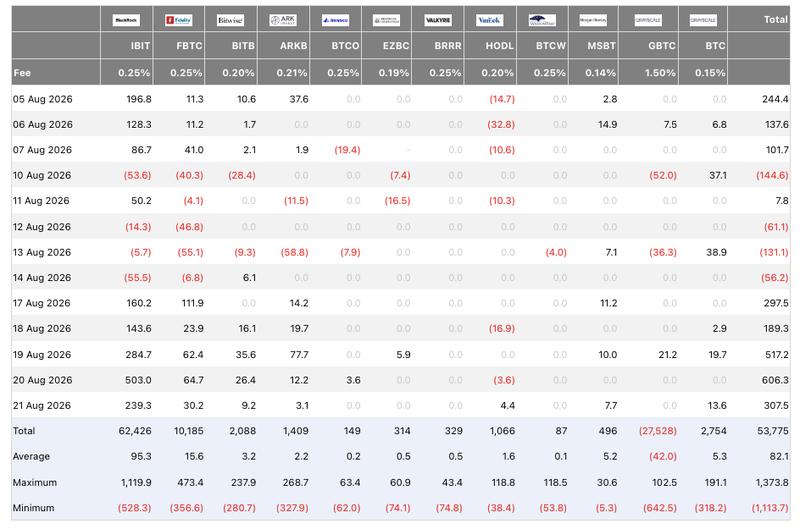
These outcomes stand in stark contrast to activity observed merely two months earlier, with June experiencing unprecedented net outflows surpassing $4.5 billion. By the conclusion of the previous week, cumulative August inflows totaled $2.38 billion, establishing a fresh year-to-date high-water mark.