
Bitcoin Price Drops Despite Kevin Warsh's Pro-Crypto Stance as New Fed Chairman
Market concerns over a potential December interest rate increase are mounting as short-term bond yields surge and Warsh's previous hawkish stance resurfaces, potentially derailing Bitcoin's upward momentum.
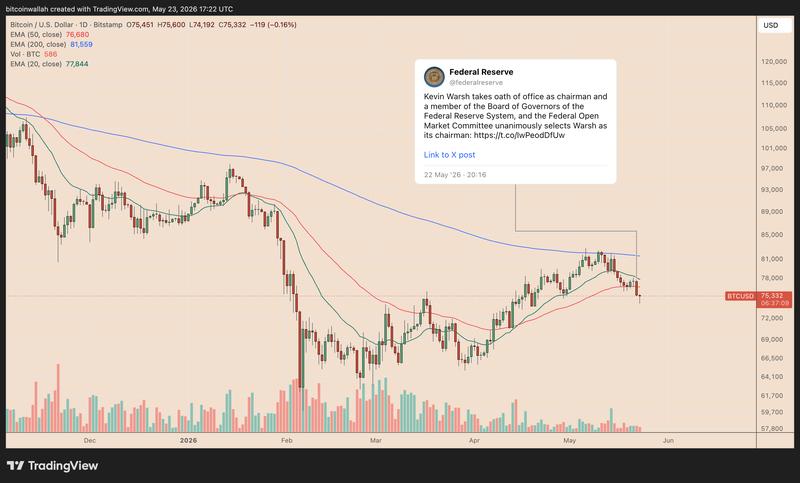
On Saturday, Bitcoin (BTC) dropped to $74,190, marking its weakest price point in over a month, even though Kevin Warsh, known for his pro-cryptocurrency views, had been inaugurated as Federal Reserve chairman just one day prior.
Main points to consider:
- Increasing probability of a 2026 rate increase is creating downward pressure on Bitcoin prices.
- Historically, Bitcoin has faced challenges during periods when Federal Reserve leadership undergoes transition.
What's behind Bitcoin's decline with a crypto-friendly Fed chair in place?
The decline in Bitcoin's value occurred alongside a rise in the 2-year US Treasury yield, which reached 4.14%, representing its peak since February 2025.
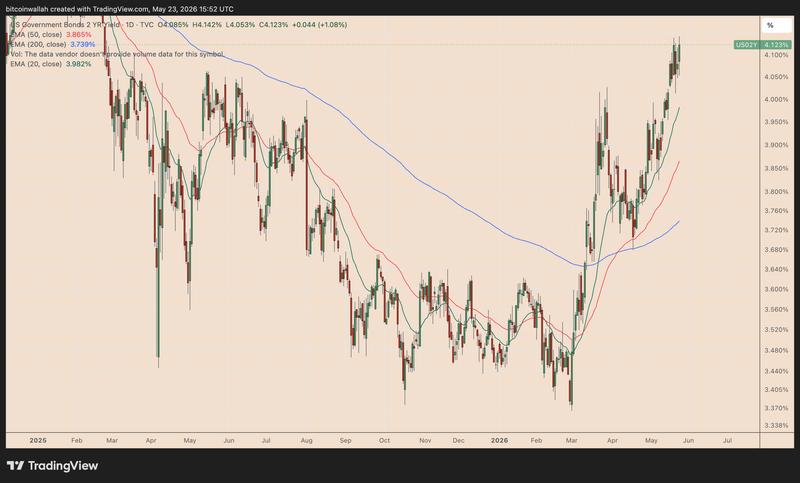
The yield on 2-year Treasury bonds serves as a key indicator of market expectations for the federal funds rate's short-term trajectory. Its climb beyond the Federal Reserve's present target range of 3.50%–3.75% indicates that market participants are no longer anticipating rapid monetary easing under Warsh's leadership.
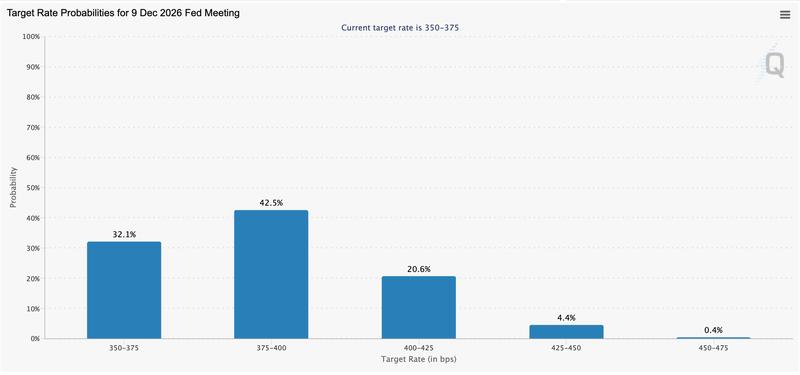
According to CME data, market participants currently anticipate the Fed will maintain rates at their current level throughout the majority of 2026, with futures markets indicating the possibility of a 25 basis point increase coming in December.
Historical data spanning the last three decades reveals that the Fed has generally implemented rate increases when the 2-year Treasury yield exceeded the federal funds rate, as this divergence indicated markets were anticipating more restrictive monetary policy, based on data from BCA Research.
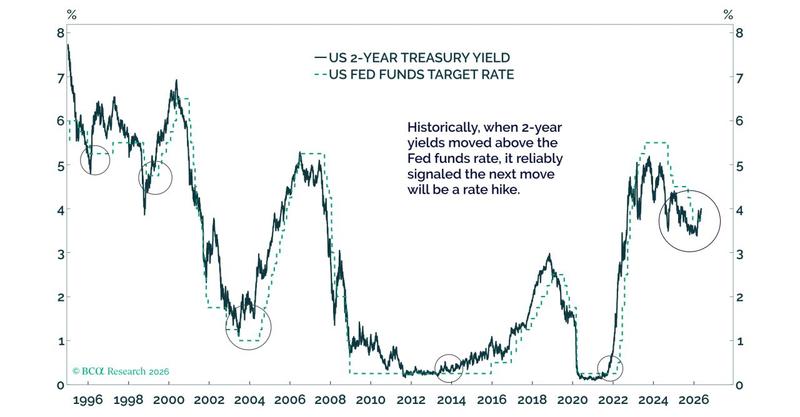
On the flip side, when the 2-year yield dropped beneath the Fed funds rate, it frequently indicated market expectations for upcoming rate reductions.
This kind of development undermines the optimistic outlook for BTC, which generally thrives in environments characterized by declining yields, reduced real interest rates, and more accommodative liquidity conditions.
Warsh has established himself as "a known inflation hawk"
Previously, Warsh has expressed positive views regarding Bitcoin, voiced criticism of central bank digital currency initiatives, and supported expanding the role of private-sector innovation in finance. From the perspective of cryptocurrency traders, these positions align with several bullish indicators.
However, when examined through the lens of monetary policy, Warsh could still present obstacles to the bullish Bitcoin thesis, as noted by analyst Crypto Patel.
In a post published on Saturday, Patel highlighted that Warsh has earned a reputation as "a known inflation hawk," rather than a dovish policymaker, further explaining that a challenging macroeconomic environment, which includes inflation risks stemming from the Iran conflict and pressures in the labor market, could prevent him from implementing rate cuts.
Crypto-friendly on regulation is NOT the same as dovish on rates.
Fed leadership transitions coincide with Bitcoin underperformance
Additional cause for concern emerges from Bitcoin's historical performance patterns during transitions in Federal Reserve leadership.
In a Saturday analysis, analyst Lucky pointed out that BTC has experienced difficulties during prior chairperson transitions: the cryptocurrency declined 84% following Janet Yellen's assumption of the role in January 2014, dropped 73% after Jerome Powell's inauguration in February 2018, and decreased 60% after Powell commenced his second term in May 2022.
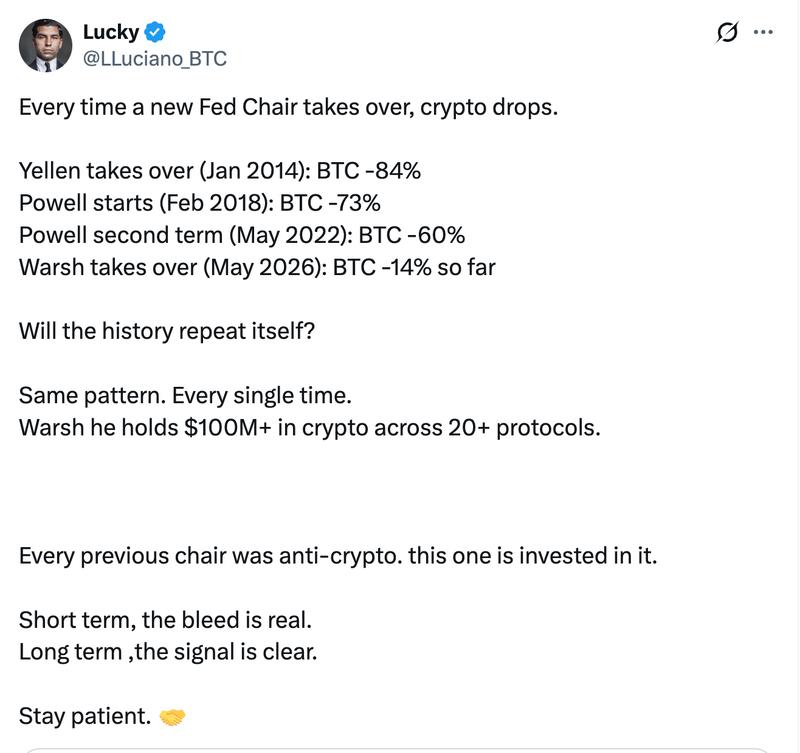
The appointment of Warsh has thus far aligned with a significant decline in BTC value, indicating that traders may once again be reducing their risk exposure while awaiting clearer policy direction from the incoming Fed chairman.