
Bitcoin Holders Face Greatest Threat in France: 90 Violent Incidents Within Seven Months
In a seven-month period, French law enforcement documented 90 cryptocurrency-related incidents including kidnappings, extortion attempts, threats and armed robberies. Why has France become such a dangerous destination for crypto owners?
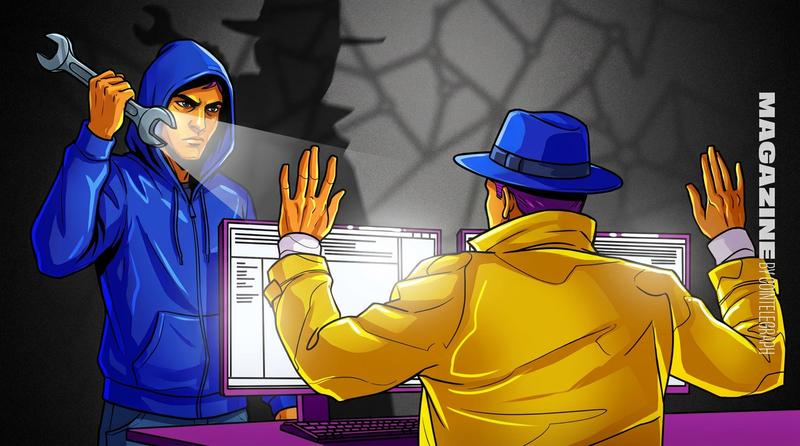
Over a span of slightly more than seven months, French law enforcement has documented 90 incidents involving kidnappings, abductions, extortion schemes, threatening behavior, and violent robbery connected to cryptocurrency holdings.
These statistics, shared with Cointelegraph by France's Interior Ministry, cover the period starting Jan. 1 through mid-August 2026. Law enforcement officials additionally documented 223 arrests, with 126 individuals being sent to prison between January and July.
These numbers translate to a fresh incident occurring every two and a half days, though no official year-over-year data exists to determine whether the situation has suddenly deteriorated: "Statistics for these categories from 2025 are unavailable, since event tracking commenced on Jan. 1, 2026," the ministry states.
The newly released data becomes even more alarming when compared with other publicly available records of physical world attacks.
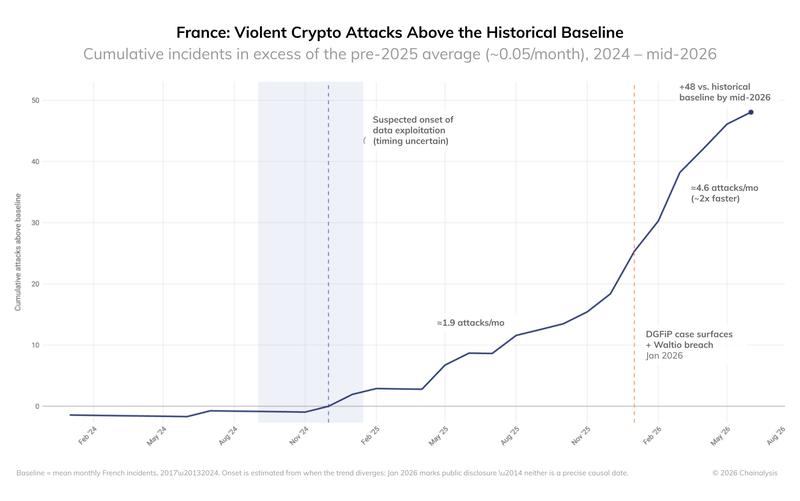
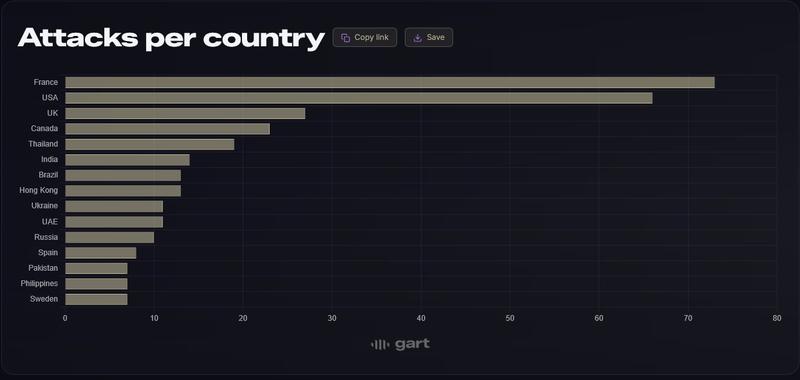
Through mid-2026, Chainalysis identified 30 publicly reported violent cryptocurrency-related incidents in France, though they acknowledged the actual magnitude was "almost certainly larger." Gart.io, a security company, has documented 73 attacks within France during the current year, positioning France at the top of the list, surpassing the USA with 66 physical attacks, and the UK with 27.
The increase in physical assaults — commonly referred to as "wrench attacks" — targeting cryptocurrency owners in France suggests something more significant than a series of random, unconnected events. Compromised personal information may be the root cause.
So, why France?
Wrench attacks are hardly a recent development. Jameson Lopp, a Bitcoin security advocate, maintains an extensive database of documented physical attacks that has recorded 365 incidents spanning 60 countries from 2014 through 2026, with France leading the rankings.
What appears to be unprecedented, though, is the velocity at which violent cryptocurrency-related crimes are proliferating across the nation. The attacks have expanded beyond Paris to locations such as Strasbourg, Marseille, Grenoble, Toulouse and Nantes, based on Chainalysis research.
The perpetrators aren't going after cryptocurrency-wealthy tourists, and among victims whose residency status is known, 93% were French.
Eric Jardine, head researcher at Chainalysis, informs Cointelegraph that the spike is "very likely" attributable to a "significant data breach."
These sort of breaches expose more than financial information; they reveal who holds crypto, where they live, and how to find them.
This makes physical violence against cryptocurrency holders especially dangerous because the attacks can be planned long before an aggressor appears wielding a wrench and demanding your seed phrase or a cryptocurrency transfer. The perpetrators must first identify who possesses assets worth taking, their residential location and methods to access them.
According to Jardine, the compromise of the French tax authority in 2024, during which a tax official operating in the Paris region "leaked PII, financial and crypto holding information on French taxpayers," could have served as the catalyst. Data from Chainalysis indicates attacks intensified starting in late November of that year.
Chainalysis further highlights an additional incident from January 2026, when Waltio, a cryptocurrency tax reporting company, revealed a data breach impacting approximately 50,000 users, generating additional valuable intelligence for attackers to identify their marks.
Francis Pouliot, founder of Bull Bitcoin, a Canadian Bitcoin exchange, has continuously criticized Europe's DAC8 crypto reporting regulations in France, which broaden tax reporting and information-sharing mandates for cryptocurrency users throughout the European Union.
"DAC8 has transformed the concept of Know Your Customer into Kill Your Customer," he said, along with describing France as the "crypto kidnapping capital of the world."
When the target isn't the Bitcoiner
Based on Chainalysis analysis, one of the most significant shifts may involve the identity of attack victims. On a global scale, family members and acquaintances represented approximately 25% to 30% of violent cryptocurrency incidents by early 2026, whereas in France, this proportion exceeded 40%.
In May 2026, six men allegedly attempted to kidnap the wife of Sébastien Borget, The Sandbox co-founder, from their residence in Villenoy, France, with one perpetrator disguising himself as a delivery driver to convince her to open the gate.
In August, a couple residing in rural France allegedly suffered three distinct home invasion attempts after purchasing a property formerly inhabited by cryptocurrency millionaires, following the leak of the prior owners' tax records and address onto the dark web.
A comparable strategy was employed in 2025, when a crypto entrepreneur's father was kidnapped in Paris and detained for two days, with the abductors allegedly severing part of his finger and mailing it to his son while demanding $5.6 million in cryptocurrency.
Jardine indicates that targeting family members and associates "suggests criminals are doing reconnaissance before they act," whether through "monitoring social media, analyzing blockchain data, using leaked information, or receiving tips from insiders."
This reverses the conventional understanding of a crypto target, given that the individual possessing the wallet may not be the individual confronting the attacker.
French law enforcement is responding by classifying the attacks as organized criminal activity, coordinating investigations through JUNALCO, the nation's specialized organized crime jurisdiction.
The $5 wrench conundrum
The majority of cryptocurrency holders have mastered protecting their seed phrases, configuring hardware wallets, testing their environments and avoiding clicking on phishing links.
Although these precautions remain essential, none of them offer protection if a criminal already possesses knowledge of their identity, residential address and confirmation that they possess something valuable to steal in the first place.
Cryptographic security can safeguard a wallet, but it cannot deter an attacker with a $5 wrench.