
Bitcoin Breaks Crucial 2.5-Year Weekly Pattern: Has BTC Reached Its Peak?
A pivotal moving average was breached by Bitcoin's weekly close, terminating a trend that persisted for 30 months and potentially indicating further downside price action ahead.

For the first time since October 2023, Bitcoin (BTC) has registered a weekly candle closure beneath its 200-period exponential moving average (EMA). This weekly close brought an end to a technical upward trajectory that had persisted for 882 days.
This transition in market structure brings renewed attention to BTC's onchain cost-basis metrics and the historical relationship between the cryptocurrency and this critical moving average throughout previous market cycles, establishing a wider context for potential recovery based on historical patterns.
Bitcoin's weekly trend could transform into overhead resistance
The 200-week EMA serves as a tracker of Bitcoin's extended-term trajectory and has historically delineated growth phases from more substantial corrective intervals. Examining the weekly chart reveals that BTC settled beneath this average in the vicinity of $67,628, concluding a support phase that commenced in late 2023.
Cryptocurrency analyst Rekt Capital highlighted this development, remarking,
"This technically means that the EMA has been lost as support and that price could turn it into resistance on any upcoming recovery."
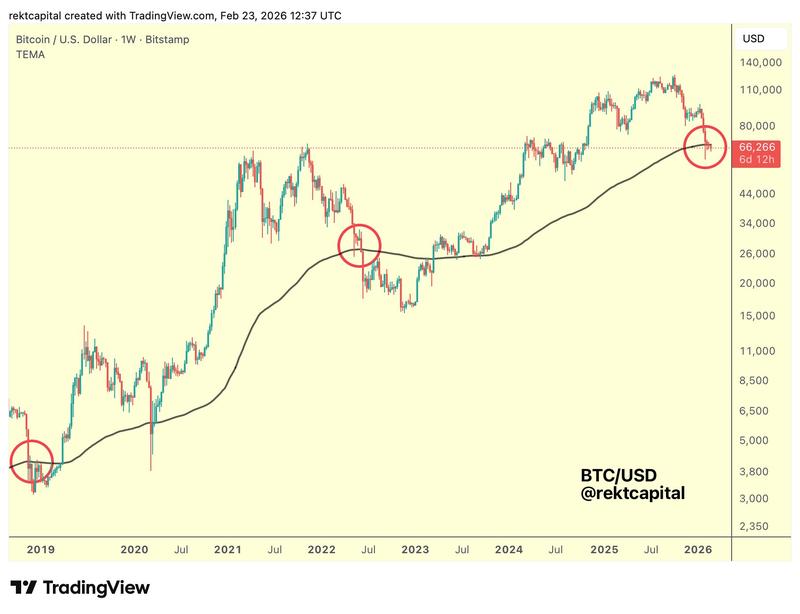
Historical market cycles demonstrate that recovering the 200-weekly EMA has consistently demanded considerable time. Back in 2018, Bitcoin remained beneath this threshold for approximately 14 weeks prior to successfully reclaiming it.
Throughout the March 2020 liquidity crisis triggered by Covid, the restoration process spanned roughly eight weeks. In 2022, BTC spent close to 30 weeks trading underneath this average. When examining these occurrences collectively, the mean duration spent below the 200-weekly EMA approximates 17 to 18 weeks.
Technical momentum indicators similarly demonstrate a slowdown in extended-timeframe investor engagement. During last week, Bitcoin researcher Axel Adler Jr. observed that entity-adjusted liveliness reached its zenith in December 2025 following BTC's achievement of an all-time peak near $126,000 in October.
The liveliness measurement calculates the proportion of coin days destroyed relative to coin days created, with adjustments made for internal transfers. This indicator has subsequently dropped beneath both its 30-day and 90-day moving averages, though the 90-day continues to sit above the 365-day at 0.02622. Comparable downward shifts in 2020 and 2022 came before prolonged accumulation periods spanning one to two years.
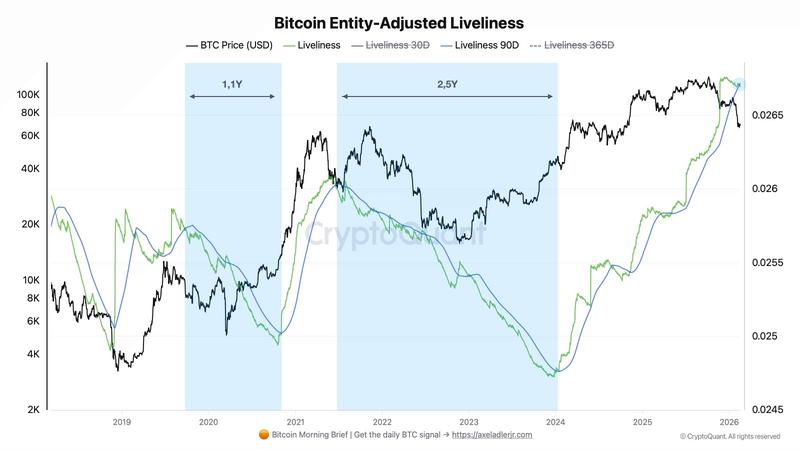
When the liveliness metric experiences a sustained downward trajectory, it generally indicates diminished spending behavior and decelerated capital movement, circumstances that could extend the duration necessary for BTC to reconstruct its position and successfully recapture the 200-weekly EMA.
Demand zone delineated by BTC realized price bands
The realized price of Bitcoin, positioned near $55,000, represents the mean onchain acquisition cost for all existing coins. The shifted realized price, hovering near $42,000, extrapolates this measurement forward and has historically identified the more pronounced value regions throughout market corrections.
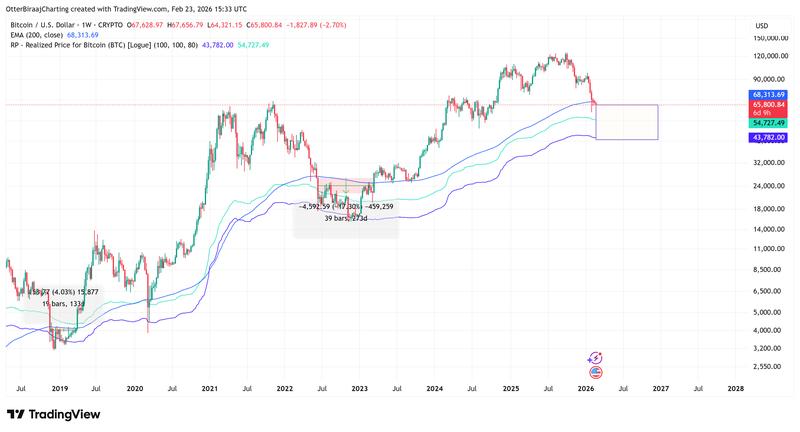
As BTC currently trades within the range bounded by the 200-weekly EMA and the realized price band cluster, this territory has historically functioned as an extended accumulation area since 2015. Earlier market cycles exhibit consolidation timeframes of six to eight months surrounding these price levels prior to broader upward momentum continuation.
Successfully reclaiming the 200-weekly EMA would restore price action above a crucial extended-term trend marker. Should this fail to materialize, attention remains concentrated on the $55,000 realized price and the lower shifted band in the vicinity of $42,000 as probable zones of liquidity aggregation.