
Binance Chief Executive Suggests Potential Lawsuit Following Iranian Sanctions Coverage
Reports emerged Monday from two prominent media organizations alleging that Binance terminated or put on leave staff members who were part of a probe examining cryptocurrency transfers to entities in Iran.
Richard Teng, the Chief Executive Officer of Binance, turned to social media platforms on Tuesday to denounce what he characterized as "inaccurate reporting" by the Wall Street Journal concerning internal investigators at the cryptocurrency platform discovering $1.7 billion worth of digital currencies being transferred to entities based in Iran.
Through a post on X published Tuesday, Teng stated that the Monday article included "defamatory claims," and referenced a communication from Binance's legal counsel "demanding immediate corrections and a full retraction of these false statements."
"Your Article is false, seriously misleading to your readers, and defamatory of our client," said the letter to WSJ editor-in-chief Emma Tucker from lawyers at Withers Bergman. "Our client has written to you directly seeking correction of the major matters of significant concern and we call upon you to act responsibly, and to remove your Article pending this correction, thus potentially avoiding the need for any further action."
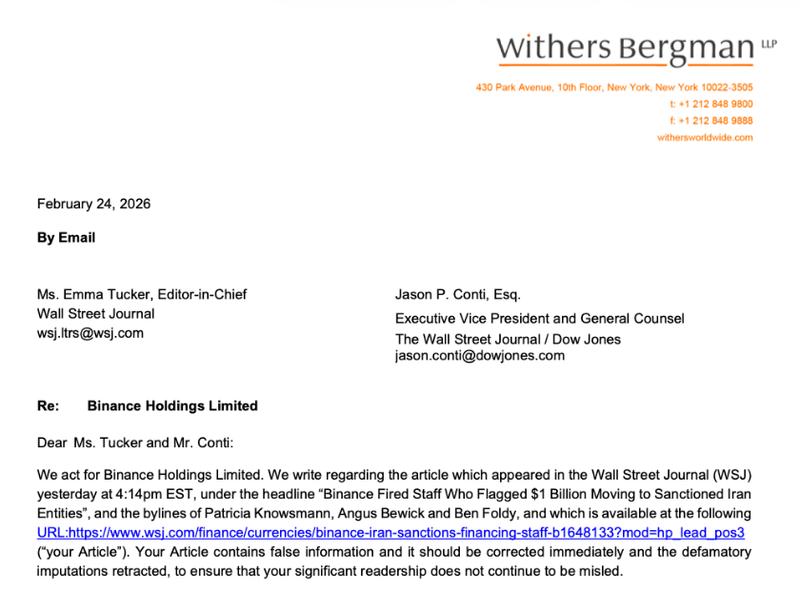
The piece, authored by journalists Patricia Kowsmann, Angus Berwick, and Ben Foldy, alleged that executives at Binance dismissed internal compliance investigators who had reported that the platform enabled $1 billion in cryptocurrency transactions to a "network funding Iran-backed terror groups."
An article published by the New York Times on the identical day presented comparable allegations, stating that the compliance investigators, four of whom faced termination or suspension, had discovered that "$1.7 billion had flowed from two Binance accounts to Iranian entities with links to terrorist groups, a possible violation of global sanctions."
Based on statements from Binance's legal representatives, the WSJ journalists did not accurately incorporate the cryptocurrency exchange's answers to inquiries for the piece, asserting that the media outlet had an "agenda already set." Teng directed his followers to examine a blog post published Sunday detailing the platform's compliance program.
A comparable piece was published by Fortune on Feb. 13 presenting assertions about breaches of Iranian sanctions and Binance's termination of five staff members who were part of the compliance investigation. Both the cryptocurrency platform and Teng disputed the article's claims, describing the allegations as "categorically false."
Former CEO gets closer to Trump-backed company after pardon
During the previous week, Changpeng Zhao, the former Chief Executive Officer of Binance who came before Teng in that role, delivered remarks at a cryptocurrency conference arranged by World Liberty Financial, an enterprise supported by US President Donald Trump and his sons. Coverage from the conference indicated that Zhao declared that Binance.US, the independent American division of the cryptocurrency platform, sought to "do much more business in the US."
Zhao completed a four-month incarceration period after reaching a 2023 settlement with United States regulatory authorities, in which he resigned from his position as Chief Executive Officer and consented to enter a guilty plea to one criminal count connected to Binance's failure to establish an effective Anti-Money Laundering program. The cryptocurrency exchange paid $4.3 billion in fines as part of the settlement agreement, and Trump subsequently granted a presidential pardon for Zhao.