
Artemis II splashdown draws attention from prediction market traders
NASA's 10-day mission involving a flyby of the Moon is scheduled to conclude with a Pacific Ocean splashdown on Friday night.

Traders on Kalshi, a prediction markets platform, are leveraging the site's event contracts to place wagers on the results of the Artemis II mission, which represents NASA's first crewed voyage to the Moon in over half a century.
By Friday, numerous event contracts concerning a Moon landing had become accessible on both the Kalshi and Polymarket platforms, though a significant number of traders were placing bets on the specific language that would be used during NASA's press conference after the splashdown event.
Event contracts related to the mission had accumulated slightly more than $4,000 in trading volume, with Kalshi participants predicting that NASA representatives will use terms such as "president" or "prime minister," "radiation," and "damage" when discussing the lunar mission.
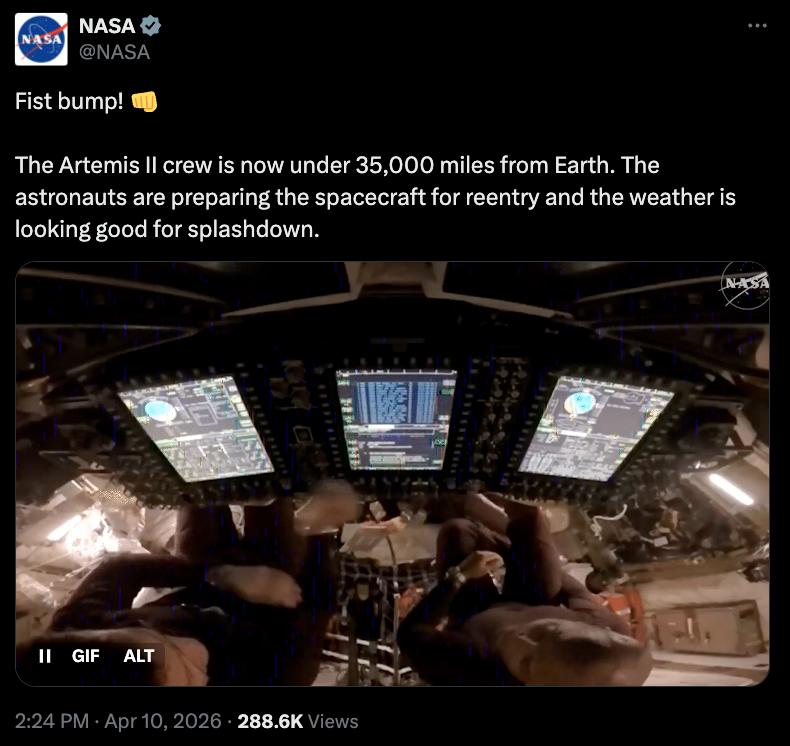
The Orion spacecraft carrying out the Artemis II mission is projected to make its return to Earth at approximately 12:07 am UTC on Saturday, after its launch from Florida on April 1 and successful completion of a lunar flyby with four crew members aboard. The NASA mission came after its Artemis I in 2022, which sent an unmanned vessel into orbit around the Moon, and comes before its planned lunar surface landing in 2028.
The practice of taking positions in event contracts on prediction markets has generated controversy due to platforms such as Polymarket permitting traders to wager on outcomes of events connected to the US-Israeli war against Iran. Certain wagers, which several lawmakers have characterized as suspicious based on when they were placed, have led to demands for legislative action to tackle potential insider trading on prediction markets.
Kalshi made available an event contract for a crewed Moon landing by NASA, showing a 63% probability before 2030 and a 41% probability before 2029.
Company plans to mine Bitcoin from Earth orbit
In March, Starcloud, an orbital data center company backed by Nvidia, revealed its intentions to mine Bitcoin (BTC) from space after launching a spacecraft into Earth orbit. The company's CEO, Philip Johnston, explained in an interview that the strategy would employ solar panels and application-specific integrated circuit (ASIC) miners within its orbital data centers.