Anchorage Digital introduces institutional staking for TRX on Tron network
Financial institutions now have access to stake TRX natively through Anchorage's custody solution, marking the firm's enhanced integration with a major USDT settlement blockchain.

Anchorage Digital, a provider of digital asset custody services, has rolled out native staking functionality for TRX to its institutional clientele, broadening its integration with the Tron blockchain network in response to increasing demand for regulated staking service access.
This development builds upon Anchorage's existing Tron support following the introduction of institutional-grade custody for TRX, Tron's native digital asset, during earlier months of this year. The platform's clients now have the capability to stake TRX tokens directly through the company's custody infrastructure or via the Porto self-custody wallet solution, enabling them to generate protocol-based rewards for contributing to blockchain security while maintaining assets within their established custody framework.
According to Anchorage, the strategic expansion is driven by rising institutional appetite for participation in the Tron ecosystem, which ranks among the most significant networks for USDt (USDT) settlement activity. Company data indicates that Tron facilitated approximately $2 trillion in USDT transfer volume throughout the first quarter of 2026 while maintaining an average of 10.9 million transactions daily and 3.2 million active wallet addresses. Transparency reports from Tether reveal that close to $90 billion worth of USDT is presently in circulation on the network.
The introduction of Tron support comes on the heels of Anchorage's wider push to expand institutional staking offerings. During November, the firm formed a collaboration with Figment to incorporate HYPE staking capabilities, thereby extending custody-integrated staking support to encompass the Hyperliquid ecosystem.
Institutional platforms expand beyond custody
Providers of institutional cryptocurrency infrastructure have progressively broadened their service offerings beyond custody alone, incorporating staking functionalities as investors pursue regulated pathways to generate yields on their digital asset holdings.
During October 2025, Coinbase partnered with Figment to enhance their institutional staking collaboration, providing Coinbase Prime users with the ability to stake proof-of-stake digital assets including Solana (SOL), Avalanche (AVAX), Sui (SUI) and Aptos (APT) without removing them from custody. A four-month period later, Ripple brought Figment and Securosys into its institutional custody infrastructure, empowering banks and custodial firms to deliver staking services while avoiding the need to manage their own validator infrastructure.
Investment management firms have similarly pursued integrated custody and staking solutions. During February, BitGo enhanced its collaborative relationship with 21shares to deliver regulated custody and staking capabilities for the company's US exchange-traded funds and international exchange-traded products via its regulated entities in the United States and Europe.
Corporate cryptocurrency treasury operations have embraced this movement as well. Bitmine introduced its MAVAN staking platform during March, having originally developed the validator infrastructure to manage its proprietary Ether treasury before subsequently making it available to outside institutions and custodial services.
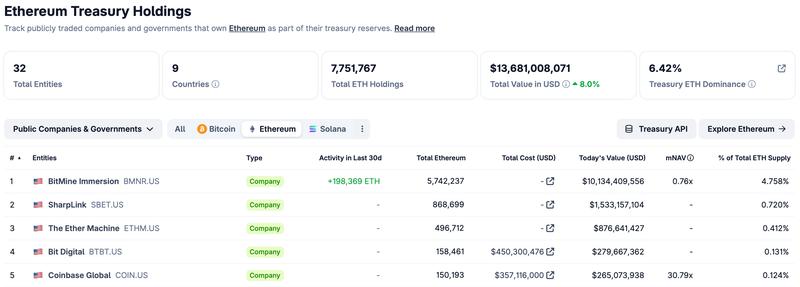
This Monday, Bitmine disclosed that it maintains 5.77 million ETH, accounting for roughly 4.8% of Ether's aggregate supply, and has placed 4.92 million ETH into staking through MAVAN.