
Anchorage Digital endorses Treasury's GENIUS Act AML framework, calls for enhanced secondary market sanctions guidance
In a formal comment submission, the crypto bank contends that stablecoin issuers operating under regulation require more explicit compliance guidelines to mitigate sanction-related exposure from secondary-market transactions.

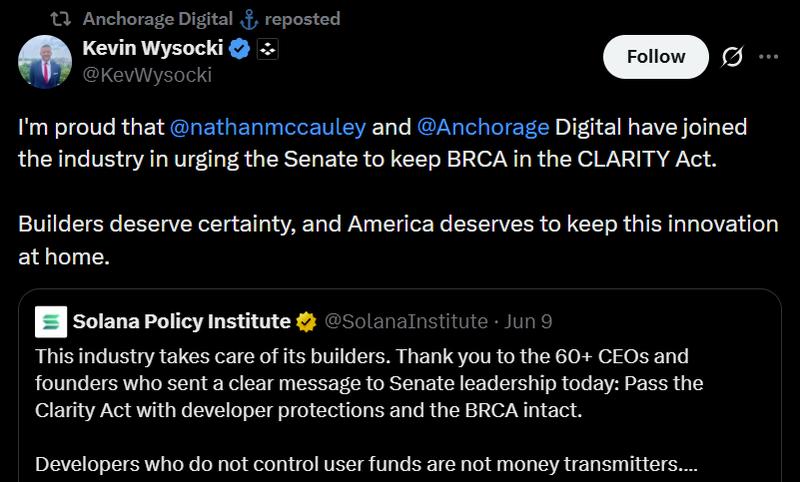
In a formal public comment submission, Anchorage Digital—a federally chartered cryptocurrency banking institution and provider of stablecoin infrastructure—has voiced its backing for the United States Treasury Department's draft Anti-Money Laundering (AML) and sanctions regulatory framework pertaining to the GENIUS Act, contending that the proposed regulations effectively balance compliance requirements with fostering innovation.
According to the letter made public on Wednesday, Anchorage Digital expressed that the proposed regulatory framework properly assigns AML responsibilities to licensed stablecoin issuers, while simultaneously calling on Treasury officials to provide additional clarification regarding secondary-market sanctions exposure, company-wide AML compliance programs, and correspondent banking account obligations.
In particular, Anchorage Digital contended that stablecoin issuers should not be held to strict liability standards for their inability to independently detect sanctioned entities conducting transactions on secondary marketplaces through the issuers' smart contract infrastructure.
A final rule that is clear and workable gives regulated institutions the certainty they need to build, and strengthens U.S. leadership in the next generation of payments and settlement infrastructure,
Anchorage
The commentary responds to Treasury Department regulations put forward in April that would designate payment stablecoin issuers as financial institutions under Bank Secrecy Act provisions, thereby subjecting these entities to AML obligations, customer due diligence protocols, and suspicious activity reporting mandates.
The regulatory proposal, which was released jointly by the Financial Crimes Enforcement Network (FinCEN) alongside Treasury's Office of Foreign Assets Control (OFAC), would establish alignment between stablecoin issuers and current United States anti-money laundering and sanctions compliance frameworks while implementing additional monitoring and recordkeeping responsibilities.
Industry groups push for broader sanctions carveouts
Endorsement of the proposed regulatory framework has not been consistent throughout the cryptocurrency sector.
The advocacy organizations representing cryptocurrency derivatives exchange Hyperliquid and venture capital firm Paradigm have recently filed their own comment submission requesting enhanced clarification regarding secondary-market compliance obligations, mirroring Anchorage's apprehensions while adopting a more skeptical perspective on the overall proposal.
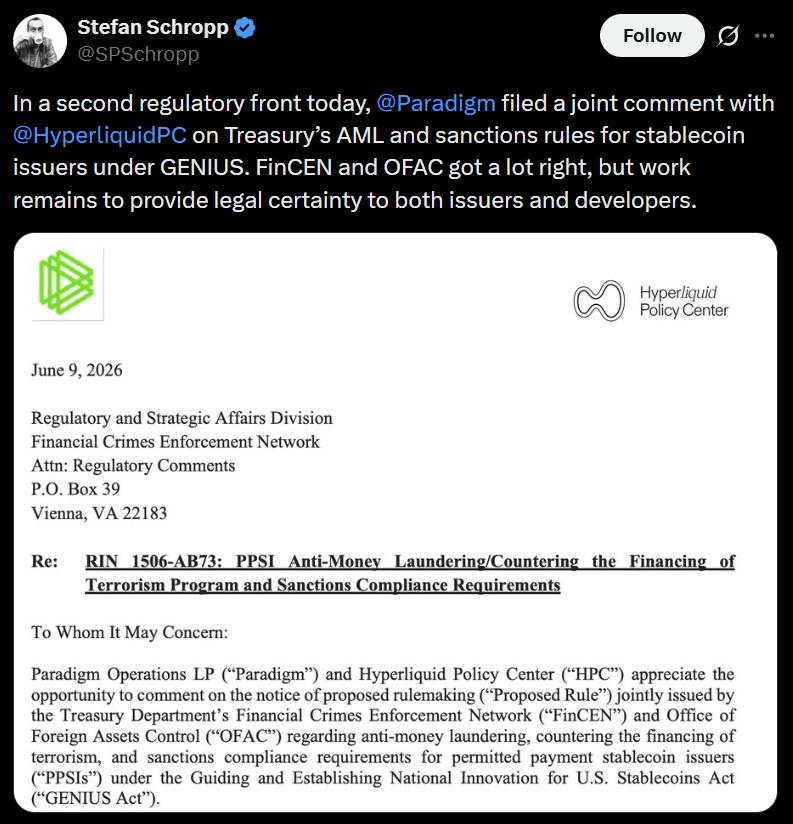
These organizations contended that the existing regulatory framework has the potential to place sanctions compliance obligations on issuers even in circumstances where they maintain no direct business relationship with or operational visibility into end users conducting transactions on secondary marketplaces.
OFAC sweeps secondary market activity into the issuer's compliance perimeter, treating smart contract interactions as an ongoing "provision of services" that carries sanctions liability regardless of whether the issuer has any relationship with, or visibility into, the transacting parties,
Hyperliquid and Paradigm