
Analyst identifies crucial Bitcoin resistance that could signal bear market conclusion
BTC's failure to breach the 200-day EMA echoes historical selloffs of 25% and 36%, raising concerns about a potential decline to $60,000.

After surging approximately 40% from the lows recorded in February, Bitcoin (BTC) has returned to a pivotal resistance area that may determine whether bears maintain control or the downtrend finally concludes.
Key takeaways:
- The cryptocurrency dropped 2.25% to approximately $80,500 following another unsuccessful attempt to surpass its 200-day EMA resistance level.
- Historical rejections at this identical technical indicator have resulted in Bitcoin selloffs measuring 25% and 36%.
Bulls face critical challenge at major trend line
On Monday, the BTC/USD pair traded down 2.25% in the vicinity of $80,500, wiping out gains accumulated during overnight trading as purchasing pressure failed yet again to overcome the 200-day exponential moving average (200-day EMA, blue line) barrier.
This technical indicator has consistently prevented Bitcoin's recovery efforts since November 2025. Following each rejection at the 200-day EMA, the cryptocurrency has experienced sharp corrections of 25% and 36% sequentially, establishing an average decline approximating 30%.
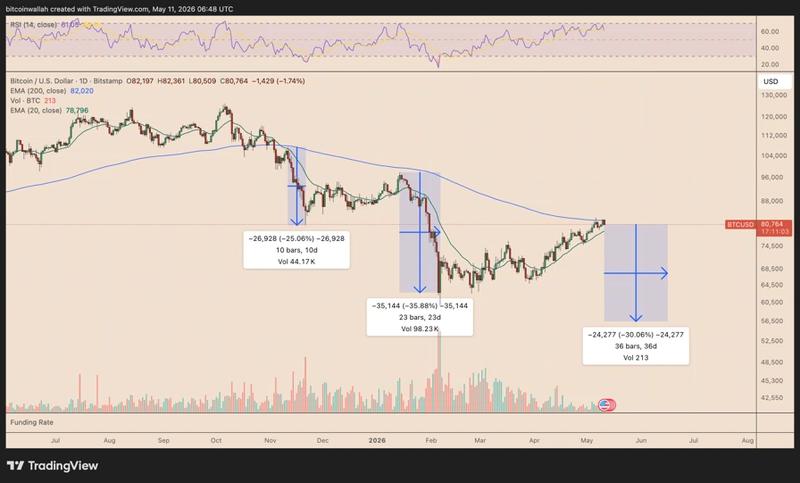
According to analyst Brett in his Monday commentary, successfully penetrating above the 200-day EMA, presently positioned around $82,580, would potentially represent "the end of the bears." However, considering Bitcoin's current pullback momentum, the likelihood of BTC experiencing additional downward pressure in upcoming trading sessions appears elevated.
Should BTC replicate its typical 30% correction from the 200-day EMA rejection area, the price could descend toward $56,600 from its present position.
Long-term support analysis points to $56,000 base
The $56,600 price point demonstrates strong alignment with Bitcoin's wider macroeconomic support territory.
An innovative Bitcoin Lifetime Support Model, brought to attention by analyst PlanC, establishes BTC's extended-term upper support zone in the vicinity of $57,110. The model's lower support boundary was positioned approximately at the $46,760 threshold.
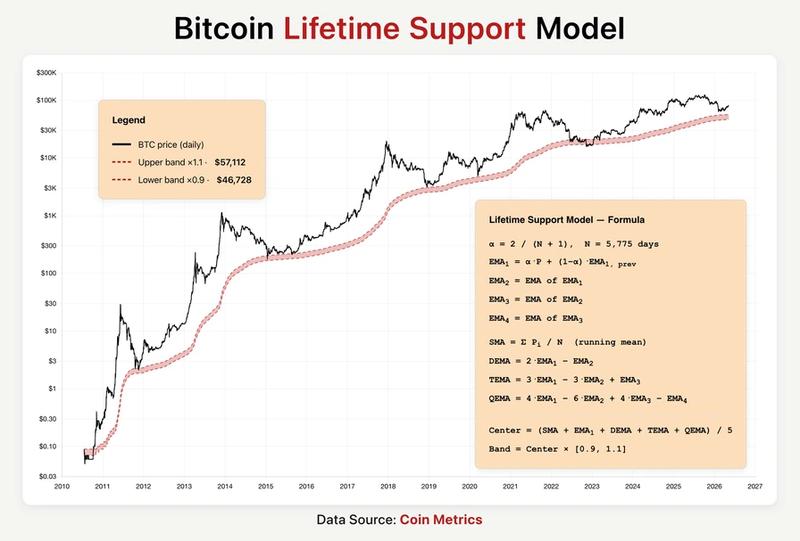
This analytical framework calculates Bitcoin's lifetime simple moving average alongside its single-, double-, triple- and quadruple-EMAs, subsequently creating a 10% band surrounding the calculated average.
Looking at historical patterns, comparable lifetime support territories have functioned as macro bear-market bottoms. This indicates Bitcoin's short-term technical configuration maintains a bearish bias, though a downturn approaching the mid-$50,000 range would still position BTC within proximity of a significant long-term support zone.
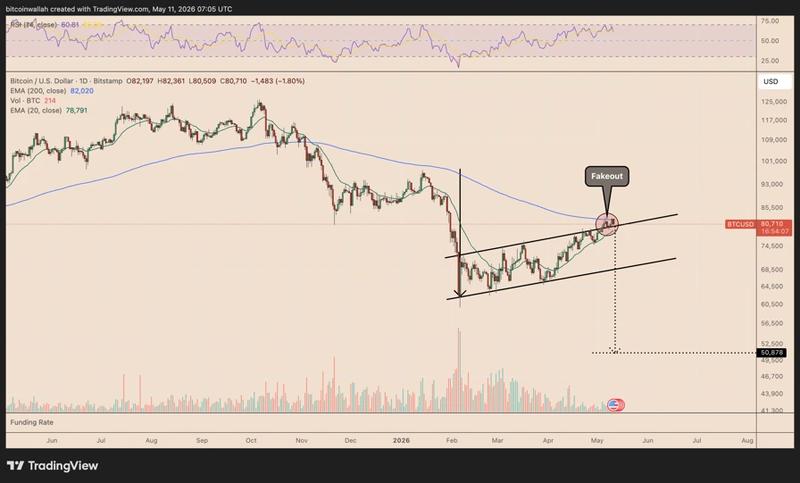
An outstanding bear flag formation in Bitcoin's chart structure also suggests a possible descent beneath $60,000 during the forthcoming weeks, as illustrated in the chart below.
Recent recovery pattern echoes previous cycle lows
Notwithstanding the short-term bearish technical configuration, Bitcoin's recent recovery following a test of the 200-week simple moving average (200-week SMA, blue line) is generating a historically constructive signal.
BTC rallied more than 38% subsequent to testing the 200-week SMA in the vicinity of $61,000. This critical blue level demonstrates close correlation with significant cycle bottoms observed in 2018 and throughout the March 2020 market collapse.
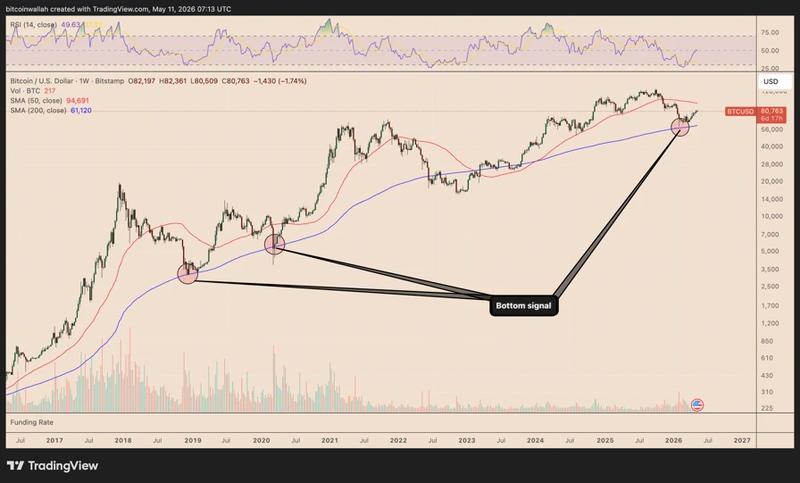
During both previous occurrences, Bitcoin temporarily declined toward or beneath the 200-week SMA threshold before initiating a sustained upward movement directed toward the 50-week SMA (red).
Should this historical pattern continue to develop, Bitcoin's subsequent upside objective could materialize around $94,700, representing approximately 17% upside from current trading levels. Such an advance could lend credence to Brett's assessment that the bear market may be approaching its conclusion.
The optimistic perspective receives additional support from robust fundamental indicators, including intensive whale accumulation activity that has recently absorbed approximately 500% of Bitcoin's freshly minted supply.