
AI's threat to DeFi: Examining the Claude Mythos narrative beyond the headlines
Fears surrounding Claude Mythos and AI-powered attacks targeting DeFi protocols have intensified. Yet these same artificial intelligence capabilities remain equally accessible to defensive security professionals, not exclusively to malicious actors.

Claude Mythos and DeFi: Real threat or overblown fear?
Following Anthropic's unveiling of Claude Mythos-class models representing its cutting-edge AI architecture for cybersecurity applications, cryptocurrency communities responded with their characteristic blend of enthusiasm and skepticism. Among the releases was Claude Fable 5, classified as a Mythos-class model designed for widespread deployment, though availability was subsequently halted following directives from the United States government.
Anxiety within the decentralized finance (DeFi) ecosystem proved understandable. Should artificial intelligence capabilities accelerate software vulnerability discovery while requiring minimal human intervention, malicious actors might leverage these tools to identify protocol weaknesses ahead of defensive teams implementing patches.
While such worries might appear exaggerated, their foundation rests on genuine technological evolution. Artificial intelligence capabilities have advanced substantially in code examination, flaw identification and security team assistance. Simultaneously, DeFi continues attracting substantial attacker interest given its frequently transparent codebase, protocols managing substantial capital reserves and numerous experimental or insufficiently tested implementations.
The central inquiry concerns whether Claude Mythos alongside comparable technologies represents genuine danger to DeFi, or if the sector overstates contemporary AI capabilities.
Reality occupies territory between marketing excitement and existential concern.
What is Claude Mythos?
Claude Mythos represents Anthropic's cutting-edge artificial intelligence architecture focused on cybersecurity applications. Distinct from multipurpose AI assistants capable of generating code or clarifying technical subjects, Mythos received specialized design for sophisticated security operations.
Anthropic chose restricted distribution rather than broad public availability for this model. Based on company statements, Mythos demonstrated notable advances in vulnerability research capabilities, exploit examination and sophisticated cybersecurity analysis relative to previous iterations.
These abilities attracted immediate attention because vulnerability identification holds tremendous value across both cybersecurity and cryptocurrency domains.
Where security professionals might invest weeks examining code for minor weaknesses, AI-powered reduction of that timeframe to mere hours, or potentially less, could fundamentally alter defensive security dynamics.
This potential transformation accounts for substantial apprehension throughout cryptocurrency communities.
Why Claude Mythos matters to DeFi
DeFi platforms have hemorrhaged billions through hacking incidents, exploitations and protocol malfunctions throughout recent years. These concerns carry historical precedent.
Flash-loan manipulations, cross-chain bridge compromises, governance exploitations and smart contract vulnerabilities have demonstrated that even professionally audited protocols retain security gaps.
Contrasting with conventional software architectures, DeFi protocols frequently govern substantial financial reserves through smart contract mechanisms. Vulnerabilities extend beyond mere information exposure. They potentially enable attackers to rapidly transfer funds without authorization.
This dynamic renders DeFi particularly appealing to hostile entities.
The open-source philosophy adopted by numerous blockchain initiatives introduces additional exposure. While their code remains accessible for security team examination, identical access extends to potential attackers.
Historically, discovering sophisticated vulnerabilities demanded extensive technical expertise. Security analysts required comprehensive understanding of programming languages, blockchain infrastructure, cryptographic principles and exploitation methodologies.
AI fundamentally alters this landscape.
Rather than manually scrutinizing extensive codebases, analysts can deploy AI assistants to identify concerning patterns, condense complex architectures and highlight potential attack vectors.
These capabilities form the foundation of Claude Mythos-related concerns.
Did you know? In some controlled security competitions, AI systems have identified software vulnerabilities in minutes that would normally take human researchers several hours, or even days, to find.
Can AI really find vulnerabilities in DeFi protocols?
The straightforward response proves affirmative. AI architectures have already demonstrated capability for identifying specific software vulnerability categories.
Research from Anthropic alongside additional scientific organizations confirms that sophisticated models can examine code repositories, evaluate security assumptions and occasionally discover issues overlooked by human analysts.
Smart contracts prove particularly amenable to such analysis given their typical public availability and implementation in structured languages including Solidity.
AI architectures can rapidly process thousands of contracts, recognize recurring patterns and search for established vulnerability types.
Domains where AI demonstrates increasing utility encompass:
- Reviewing audit reports
- Identifying unsafe coding practices
- Comparing protocol upgrades
- Detecting permission errors
- Modeling possible exploit paths
- Analyzing interactions between smart contracts
AI functions as a capability amplifier for security researchers. Operations previously requiring complete expert teams could progressively become manageable by smaller security professional groups employing advanced AI technologies.
This represents substantive transformation, transcending mere promotional messaging.
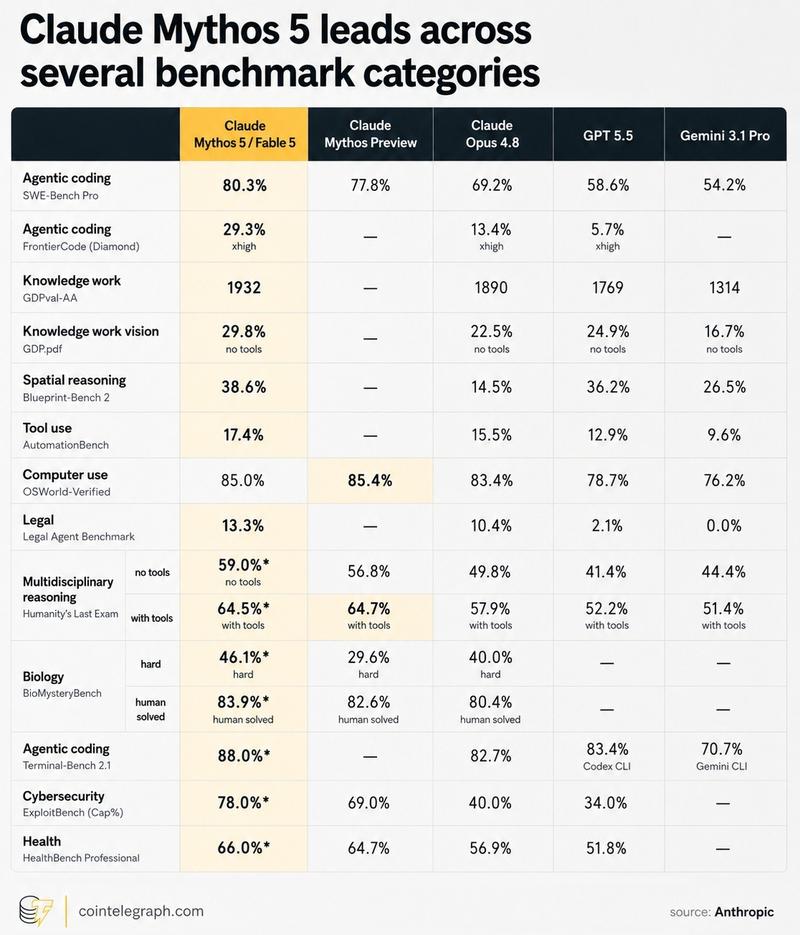
The table below shows how Claude Mythos compares with other models:
Why AI threats to DeFi may be exaggerated
Despite these technological progressions, substantial distinction exists between vulnerability identification and actual fund theft. Numerous cryptocurrency attacks involve considerably more than simple flaw recognition.
Attackers frequently require capabilities to:
- Understand complex protocol mechanics
- Bring in significant capital
- Coordinate multiple transactions
- Exploit market conditions
- Manipulate liquidity
- Navigate governance systems
- Avoid detection
Even when vulnerabilities exist, converting them into profitable attacks frequently demands meticulous planning and precise implementation.
Operational environments prove vastly more intricate than controlled coding evaluations.
Contemporary AI architectures also face limitations. They can generate incorrect conclusions, overlook critical elements or pursue flawed analytical approaches. Security professionals frequently observe that AI tools yield valuable observations alongside numerous spurious alerts.
An AI platform might identify 10 potential vulnerabilities, yet merely one proves legitimate. This distinction matters because experienced human judgment remains indispensable.
Claude Mythos could accelerate vulnerability discovery, yet it cannot eliminate requirements for seasoned security expertise.
Did you know? Many DeFi protocols publish their code online. This gives both security teams and AI tools more real-world financial software to review than in traditional banking systems.
The defensive side of AI in DeFi
A significant weakness in arguments suggesting AI will compromise DeFi involves the presumption that exclusively attackers benefit from these capabilities. Security organizations possess identical access.
Security firms have begun integrating AI into their examination workflows. Developers increasingly employ AI-assisted code verification. Bug researchers can similarly utilize AI for identifying issues before hostile discovery.
Eventually, AI may become standard protocol security infrastructure.
This evolution could manifest as:
- Every code update goes through AI-assisted review
- AI agents continuously monitor deployed contracts
- Automated systems look for unusual on-chain activity
- Possible vulnerabilities are flagged before deployment
Under such circumstances, AI could reinforce DeFi security rather than undermining it.
The technology itself remains fundamentally neutral. Its consequences depend on comparative effectiveness between attackers and defenders.
When AI attacks meet AI defenses
A more grounded perspective anticipates scenarios where AI architectures confront each other directly. This dynamic would accelerate security operations across both offensive and defensive dimensions.
Attackers will deploy increasingly sophisticated models for vulnerability discovery and attack orchestration. Security organizations will employ comparable tools for threat surveillance, code quality enhancement and accelerated response capabilities.
This dynamic already characterizes traditional cybersecurity landscapes, where offensive and defensive technologies evolve in tandem.
DeFi could emerge as the next significant arena for this competition. The probable outcome avoids sector-wide catastrophe. Instead, DeFi may transition into periods characterized by accelerated security enhancement and adaptation.
Projects demonstrating sluggish vulnerability identification and code maintenance could face elevated risk profiles. Organizations adopting AI-supported protective measures may achieve unprecedented robustness.
Did you know? Several major crypto losses have come from compromised private keys, social engineering attacks or governance manipulation rather than flaws in smart contract code itself.
Assessing protocol vulnerabilities
Risk distribution across DeFi remains uneven. Smaller initiatives with constrained security resources typically face maximum exposure.
Several categories demonstrate particular vulnerability:
- Fast deployment schedules: Projects that prioritize quick launches over careful testing may leave structural flaws in place.
- Copied codebases: Many protocols reuse or slightly modify existing code. Advanced AI tools can compare these systems quickly and expose inherited flaws.
- Weak audit coverage: Projects with little or no third-party review are less prepared for advanced attacks.
- Legacy smart contracts: Older contract designs may rely on assumptions that no longer hold up against modern exploit methods.
Automated analysis technologies could dramatically compress timeframes required for identifying these vulnerabilities.
What DeFi builders should do now
Claude Mythos delivers a critical message for the industry. DeFi builders should operate under assumptions that attackers potentially already employ automated research capabilities. Security strategies require corresponding advancement.
Fundamental priorities should encompass:
- Expanding automated security testing
- Running continuous, real-time audits
- Adding AI-assisted code analysis to development pipelines
- Increasing bug bounty rewards
- Using formal verification for critical code
- Improving threat monitoring and real-time incident response
Engineering organizations must minimize intervals between vulnerability identification and patch deployment. Within AI-accelerated environments, response velocity becomes equally critical as preventive measures.
A major shift, not DeFi's breaking point
Claude Mythos has demonstrated that automated architectures can execute sophisticated security operations previously requiring specialized expertise. This represents significant transformation for DeFi, where code vulnerabilities can precipitate immediate user fund losses.
Nevertheless, predictions forecasting complete systemic collapse disregard multiple practical considerations. Vulnerability identification provides no guarantee of successful exploitation. Current AI tools continue producing inconsistent results, human supervision remains essential and defensive organizations access identical technology.
The more probable outcome involves security standard evolution, not DeFi disintegration. Automated tools could reduce temporal and financial requirements for vulnerability discovery. This will intensify pressure on development organizations to enhance code quality, accelerate responses and construct more robust security architectures.
Ultimately, these developments constitute cautionary signals, not predetermined conclusions. The future of decentralized infrastructure will not be decided only by what AI can find. It will also depend on whether attackers or defenders use the technology more effectively.