
$1900 Penalties Target Vietnamese Binance & OKX Traders, Chinese Coinbase Access? Asia Roundup
Major penalties announced in Vietnam for retail traders using foreign crypto platforms, South Korea elevates crypto to "national asset" status. Asia Roundup

VIETNAM
Vietnamese authorities target retail traders
Retail cryptocurrency traders in Vietnam are set to face penalties reaching $1900 for conducting transactions on unregistered foreign platforms including Binance, OKX and Bybit, rather than utilizing domestically licensed exchanges.
However, a significant complication exists: Vietnam's Finance Ministry hasn't yet granted any operational licenses for its regulated digital asset marketplace scheduled to commence operations on September 1. That said, five platforms have received preliminary approval.
Local traders who engage in trading cryptocurrency assets reserved exclusively for international investors could face penalties reaching $3800. Cryptocurrency firms that offer or promote services lacking proper licensing, those failing to adequately verify customer identities, or those improperly handling crypto account information, may incur fines up to $7600.
MALAYSIA
Balaji's Network school embroiled in Israeli passport dispute
The utopian Network School project by Balaji Srinivasan located in Forest City, Malaysia finds itself facing criticism following accusations that it has been accommodating Israeli nationals who possess secondary passports.
These allegations originated from an activist organization called Malaysia Protest 4 Palestine, which has claimed the educational institution has transformed into a "gathering place for Israeli entrepreneurs."
While such controversies in other nations might lead to BDS demonstrations or consumer boycotts, Malaysia maintains zero diplomatic ties with Israel, and prohibits Israeli nationals from entering the country entirely.
However, individuals holding dual citizenship with Israeli passports are currently permitted entry... at least for the time being, though the current controversy indicates this specific exemption could be eliminated in the near future.

The situation garnered global media attention following Srinivasan's warning that he would withdraw the Network School along with millions in capital investment from Malaysia.
According to the Immigration Department, their investigation concluded that all 266 foreign nationals possess legitimate documentation, meanwhile the Johor state authorities continue their inquiry to verify adherence to regulations concerning business permits, facility usage and commercial activities.
It's worth noting the irony that the Network School operates on principles of digital network states, which theoretically transcend such mundane real-world conflicts.
JAPAN
Japanese legislature redefines crypto as financial assets
Japan's parliament has enacted amendments to the Financial Instruments and Exchange Act which now categorizes cryptocurrencies as financial assets.
This change shifts cryptocurrency regulations away from the Payment Services Act and introduces both tax advantages and stricter penalties and oversight befitting crypto's elevated position alongside traditional financial instruments.
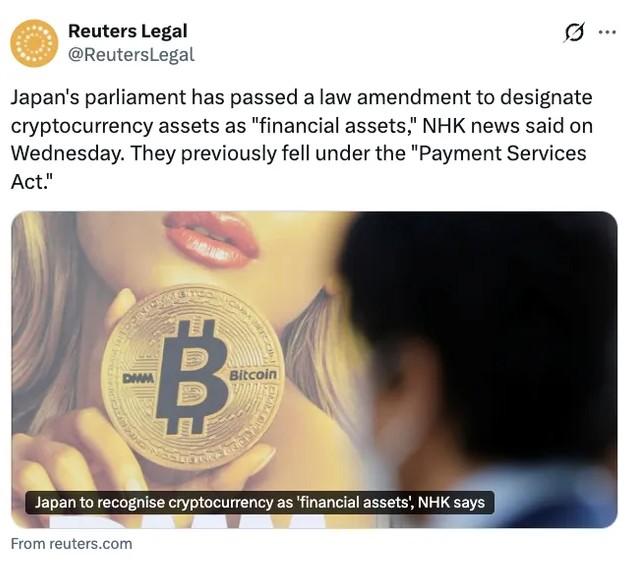
Cryptocurrency platforms operating without proper licensing now face penalties of 10 million yen or imprisonment for 10 years, and a newly implemented prohibition on insider trading in cryptocurrency will be enforced by the Securities and Exchange Surveillance Commission.
On the positive side, existing cryptocurrency tax rates reaching up to 55% will be reduced to around 20%, accompanied by a three year loss carry forward provision... which conveniently aligns with the four-year market cycle.
Regrettably, these updated tax regulations won't take effect until 2028.
SOUTH KOREA
Cryptocurrency included in South Korea's national wealth framework
South Korean officials have put forward plans to revise its national wealth management framework to incorporate crypto and IP within the classification of "national assets."
The Ministry of Economy and Finance revealed plans to overhaul the 1950 State Property Act, renaming it the National Asset Basic Act, potentially making it the world's first sovereign asset management legislation to formally incorporate cryptocurrency.
The current legislation was designed around a property-centric economy which fails to accurately represent the diverse range of assets now held by the government. The updated framework also shifts priorities from asset management toward extracting value from these holdings. Perhaps Korean Government positions on Aave may become reality in the near future.
Additional Korean developments
— The Financial Supervisory Service (FSS) in South Korea has initiated disciplinary actions against Upbit operator Dunamu, following the exchange's $30 million security breach in November. The FSS investigation aimed to establish whether the incident breached the Virtual Asset User Protection Act, though that legislation doesn't currently include provisions for penalizing hacks or technical failures.
— This particular regulatory gap is anticipated to be remedied in the upcoming Digital Asset Basic Act. Lawmakers have finally resumed discussions on the proposed legislation following a four-month hiatus.
— The Financial Services Commission in Korea is broadening consumer compensation programs to include cryptocurrency fraud.
— Weekly transaction volumes across Korea's five largest exchanges have declined by more than half from early June levels to merely 8 trillion won.
— The Bank of Korea plans to broaden its Project Hangang CBDC trial program to include nine banking institutions. The second phase, commencing in September, will additionally incorporate biometric authentication and peer to peer transaction capabilities.
— Representatives from South Korea's National Tax Service have recommended legislative amendments to establish explicit protocols for confiscating self-custody crypto wallets during official inquiries.
— Consensys inadvertently employed a North Korean developer who gained access to Metamask's source code. The company states its investigation found no security vulnerabilities.
CHINA and HONG KONG
Coinbase potentially enabling verification for Chinese residents?
According to Wu Blockchain, Coinbase has begun allowing verification for individuals residing exclusively in China. In the past, Chinese nationals required a Hong Kong residential address, but they can now apparently complete verification using solely a Chinese identification card and mainland address. Nevertheless, China remains absent from Coinbase's official list of supported jurisdictions.
— Hong Kong authorities have greenlit their inaugural crypto-native tokenized fund from Baillie Gifford, enabling accredited investors to maintain direct blockchain-based ownership of fund assets.
INDONESIA
— Bybit is establishing a compliant Indonesian platform, subsequent to its purchase of domestic exchange NOBI. The operation will maintain NOBI's executive leadership team to oversee the Bybit Indonesia venture.