
Wintermute Predicts More Selective Alt Season With Fewer Breakout Tokens
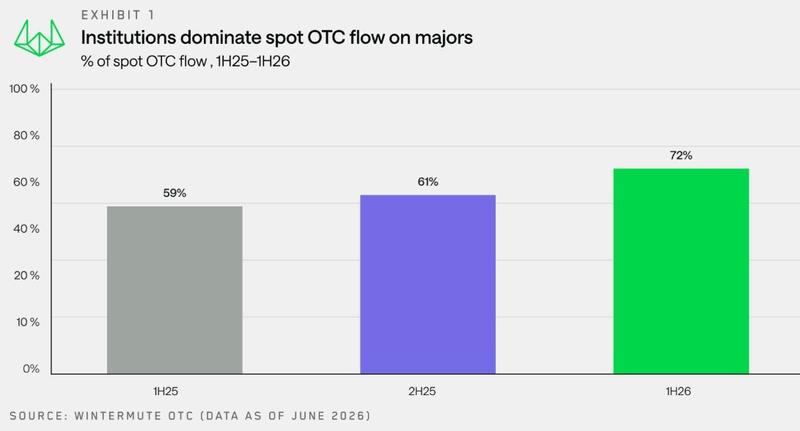
Wintermute's spot OTC flow saw institutional investors comprise 72% of activity during H1 2026, with capital consolidating around a smaller selection of tokens as altcoin rallies grow increasingly discriminating.

The upcoming altcoin season in the cryptocurrency market is likely to yield a smaller number of successful performers as institutional capital becomes increasingly focused on a select group of digital currencies, according to an analysis by crypto market maker Wintermute.
According to Wintermute's over-the-counter (OTC) trading flow analysis covering the first six months of 2026, institutional counterparties were responsible for 72% of spot trading flow across all digital assets on its OTC platform, representing the highest proportion ever recorded. This figure marks an increase from 61% recorded in the latter half of 2025 and 59% during the initial six months of that year.
Given that institutional trading activity is becoming concentrated in a smaller number of tokens and dissipates more rapidly following price spikes, the data indicates that upcoming altcoin market rallies are likely to become more focused and discriminating. According to Wintermute, liquidity is consolidating within the digital assets preferred by institutional players while trading activity across the market's "long tail" continues to diminish.
During the period spanning from the first half of 2024 through the first half of 2026, the count of distinct tokens traded by Wintermute's institutional clients increased by a modest 24%, while retail clients showed a 76% expansion. The company's research also revealed that institutional trading activity following a spike in a token's price and trading volume typically subsided after approximately one day. By comparison, retail trading activity usually stayed elevated for roughly three days.
Altcoin capital was already becoming more concentrated
The data compiled by Wintermute contributes proprietary OTC trading information to mounting evidence suggesting that capital has been consolidating around a more limited selection of alternative cryptocurrencies throughout the broader marketplace.
On June 20, Ki Young Ju, the CEO of CryptoQuant, stated that the conventional pattern of Bitcoin gains rotating into smaller cryptocurrency assets had "basically disappeared." Data from CryptoQuant indicated that trading volume in altcoin pairs denominated in Bitcoin was approaching its lowest point since 2021.
At the same time, the top 10 largest altcoins excluding stablecoins represented approximately 80.5% of the total market capitalization for the non-Bitcoin, non-stablecoin sector.
Kaiko observed a comparable concentration pattern in exchange-based trading activity. During July 2025, the data analytics provider reported that the ten biggest altcoins represented 63% of total altcoin trading volume, an increase from roughly 50% recorded several months prior, as trading activity in smaller tokens declined.
Andrei Grachev, managing partner at DWF Labs, similarly contended that widespread altcoin rallies were being replaced by selective sector-specific movements. On March 15, Grachev stated that an excessive number of tokens were competing for constrained capital resources, while institutional market participants continued to concentrate on Bitcoin, Ether and tokenized real-world assets.