
Proposed Ethereum Staking Cuts Draw Fire from Community Members Fearing Negative Consequences
A new Ethereum proposal seeking to dramatically cut rewards for validators in response to increasing staking participation has ignited controversy, with opponents cautioning it may damage the very mechanisms that have fueled Ethereum's expansion.
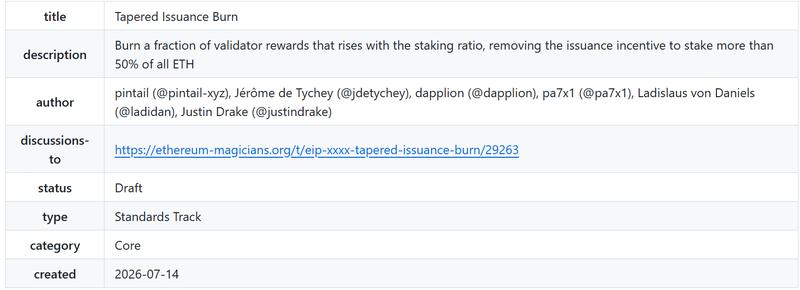
Six Ethereum researchers and developers, among them Justin Drake from the Ethereum Foundation, have jointly introduced a proposal aimed at modifying the network's issuance framework to implement more aggressive cuts to validator rewards as the percentage of staked ETH increases.
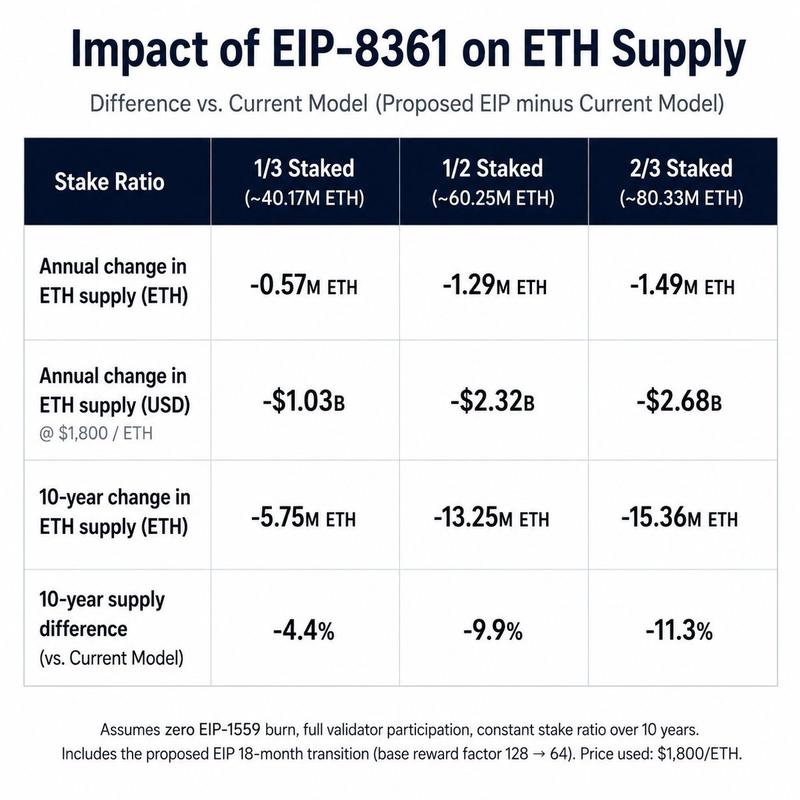
The preliminary proposal, dubbed the Tapered Issuance Burn and tentatively designated as EIP-8363, would eliminate a growing portion of validators' consensus rewards as staked ETH volumes approach a predetermined ceiling of 60.25 million ETH (approximately 50% of ETH's current circulating supply), with the reduction reaching 100% at that threshold. Implementation would occur gradually across an 18-month period.
Jérôme de Tychey, one of the proposal's co-authors, stated the modifications are essential to counter the growing percentage of Ether entering staking, which surpassed 33% in April. The proposal's authors contend that unabated staking expansion risks concentrating ETH holdings among major custodial services and liquid staking platforms, while unlimited issuance undermines Ether's function as a neutral, trustless value storage mechanism.
Ever-growing issuance is a dilution tax on every holder: stake, or be diluted. At high ratios, LSTs and other staking derivatives displace raw ETH as the ecosystem's working money, thus swapping the most neutral, trustless asset for intermediated claims on issuers.
The draft has generated significant pushback from various stakeholders including developers, stakers and DeFi project founders, who caution that implementing such reward reductions might eliminate independent solo validators ahead of affecting larger institutional players, diminish institutional appetite for ETH investments, and destabilize DeFi protocols designed around staking yield mechanisms.
While EIP-8363 is still in its early draft phase, its release merely two days prior to a submission deadline for proposals intended for Ethereum's Hegotá upgrade has additionally sparked questions about whether sufficient time exists to properly evaluate the ramifications on Ethereum's overall tokenomics.
The rationale behind EIP-8363's issuance reduction plan
Those behind the proposal maintain that the existing reward curve ensures staking returns never fall beneath 1.5% even in a hypothetical scenario where all ETH tokens are being staked.
The incentive to stake never switches off. Where does it stop? It doesn't.
Jérôme de Tychey
Without implementing changes, the most extreme scenario could result in over 55% of Ethereum's total supply being locked into staking contracts by 2028, according to his projections.
Maximal neutrality & minimal dilution: those are the two fundamentals of a store of value. This EIP not only hardens both, it sets a bar no other blockchain clears.
Under the suggested policy framework, issuance would reach its maximum of 0.5% of total ETH supply annually at peak levels (when roughly 20% of ETH is staked), then gradually decrease toward zero as the staking ratio approaches the 60.25 million ETH cap.
ETH supply growth will be bounded and more predictable. Combined with the EIP-1559 and Blob burn, the supply will more often decrease. Ethereum, the most mature of all the protocols, with a sustainable security budget, will also be the least dilutive of all protocols.
Jérôme de Tychey
Opposition argues the proposal penalizes Ethereum's success
Stani Kulechov, founder of Aave, expressed concerns that cutting staking rewards would reduce institutional interest in ETH and decrease borrowing volume throughout the DeFi ecosystem, maintaining the proposal "doesn't achieve the outcome it tries to achieve and is actually hurtful for Ethereum."
An additional concern raised is that the proposal would disproportionately affect solo validators given their typically higher operational costs relative to returns and greater vulnerability to reward fluctuations, potentially resulting in increased validator centralization.
This will self evidently push out solo stakers who aren't subsidized by the EF or others. It will essentially guarantee that the only ones staking are large centralized entities with zero cost of capital where users passively hold their ETH.
Mike Silagadze, CEO of Ether.Fi
De Tychey challenged this perspective, posting on the Ethereum Magicians forum that participants using large staking service providers must pay service fees, rendering those platforms less appealing as reward levels decline, although he conceded the research surrounding this topic remains under debate.
Additional critics highlighted the apparently compressed timeline available for reviewing the proposal, though this concern seems to stem from misunderstanding regarding the approaching Aug. 6 deadline.
This clearly doesn't leave adequate time for community review of a monetary policy change of this magnitude.
Greg Koumoutsos, co-author of EIP-8148 and EIP-8205
Current status of the proposal moving forward
The Tapered Issuance Burn proposal has not received approval, been scheduled for implementation, or been incorporated into Hegotá.
Although an Aug. 6 deadline exists in relation to this proposal, that deadline specifically applies to pull requests suggesting additional EIPs for consideration in Hegotá, rather than serving as a final decision point for which proposals will ultimately be incorporated.
Trent Van Epps, an Ethereum community organizer, indicated the selection process could extend through Nov. 8, and that the Hegotá upgrade will likely deploy to mainnet during the second quarter of 2027.