
Nigeria's President Issues Executive Directive on Cryptocurrency Oversight and Taxation
Through an executive directive, the West African nation has created a virtual asset regulatory council while resolving the previously scattered approach to cryptocurrency oversight for improved enforcement and monitoring.

Nigeria's President Bola Ahmed Tinubu has taken steps to tackle what his administration characterized as the scattered nature of virtual asset oversight in the country.
Bayo Onanuga, who serves as special adviser to the Nigerian president, announced that the executive directive signed this past Friday is designed to "harmonize the regulation of virtual assets, strengthen cooperation among the nation's financial, revenue and capital markets agencies, protect citizens from fraud, and safeguard the integrity of the financial system while enabling responsible innovation."
The directive additionally creates a council for virtual assets that will be led by several of the country's senior financial regulatory officials to oversee relevant policy matters, while Nigeria's taxation authority is set to revise its approach to digital asset policies.
According to Onanuga, "[t]he order does not create a new regulator or transfer powers between agencies." He explained that "Each institution retains its full statutory mandate and independence, and the framework coordinates their work rather than replacing it. To provide certainty for operators and protection for the public, registration will follow the nature of the activity and the asset involved [...] This closes the gaps through which unregistered operators have previously escaped oversight."
The West African nation has experienced some of the most robust expansion in virtual asset usage across Africa, encompassing both digital currencies and stablecoins. Based on data from an International Monetary Fund (IMF) report published in June, Nigeria represented approximately 60% of stablecoin transfers within the sub-Saharan African region from 2019 onwards and recorded roughly $59 billion in cryptocurrency inflows during the period spanning July 2023 through June 2024.
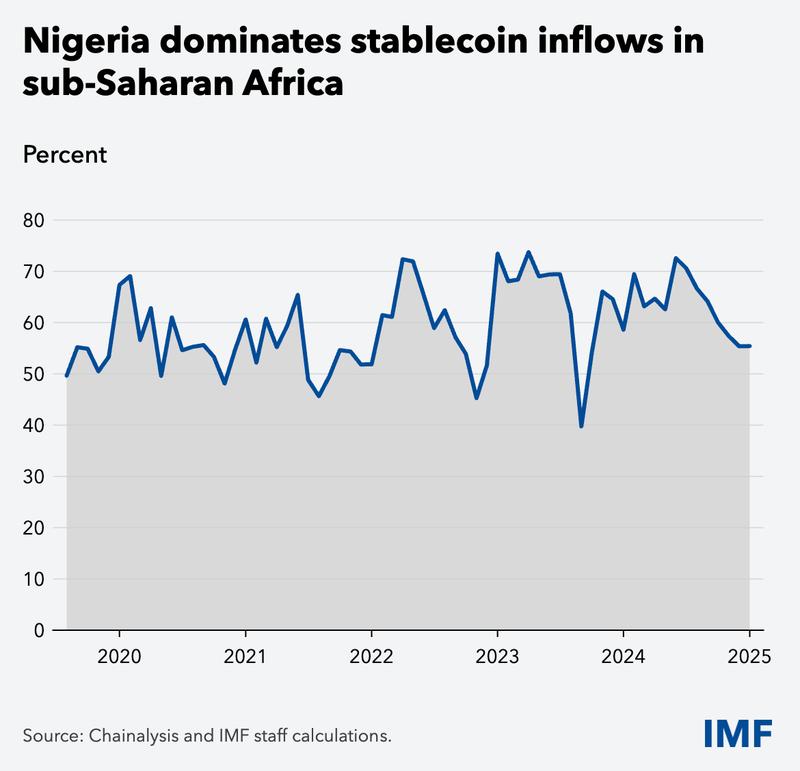
Regarding Nigeria's stablecoin uptake, the IMF stated: "The policy challenge is to narrow the gap that made the workaround [in cross-border payments] attractive, while ensuring that new risks remain contained." The international financial institution added, "That requires a clear strategy: open to innovation but anchored in sound macroeconomic policy and effective regulation."
Nigerian tax authority revamped digital assets approach
Although the executive directive indicated that the Nigerian Revenue Service, the nation's tax collection authority, would release further information regarding the implications for taxpayers, the organization had previously unveiled policy modifications.
Back in January, government officials announced that pursuant to the Nigeria Tax Administration Act, providers of cryptocurrency services must connect transactions to tax identification numbers and, under certain circumstances, national identification numbers.