
Kalshi prediction markets gain institutional access through Talos integration
Institutional investors can now trade Kalshi's event contracts and crypto perpetual futures through Talos' established trading platform, removing the requirement for additional connections.

Talos, a trading platform designed for institutional cryptocurrency operations, has completed its integration with Kalshi, enabling a curated group of clients to access the prediction market platform's event contracts and cryptocurrency perpetual futures using their existing digital asset infrastructure, removing the requirement for establishing a separate connection point.
The integration from Talos will provide algorithmic order types such as Iceberg, TWAP and POV, alongside multi-leg execution capabilities for perpetual-to-perpetual and perpetual-to-spot spread trading operations. According to the company's announcement, institutional market participants will gain the ability to execute block trades involving Kalshi contracts via its request-for-quote system utilizing participating over-the-counter liquidity providers in the network.
Before 2025 comes to a close, Talos has scheduled the expansion of its dealer software to brokers and trading platforms, enabling these entities to provide Kalshi event contracts directly to their customer base in jurisdictions where regulations permit such activity. The firm also has plans to introduce a unified prediction market data feed designed to standardize events, trades, order books, open interest metrics and implied probabilities across multiple venues.
This integration reduces the operational barriers faced by hedge funds, market makers and other professional trading organizations that currently use Talos to incorporate regulated prediction markets into their portfolio alongside their ongoing cryptocurrency trading operations.
Prediction markets hit record trading volumes
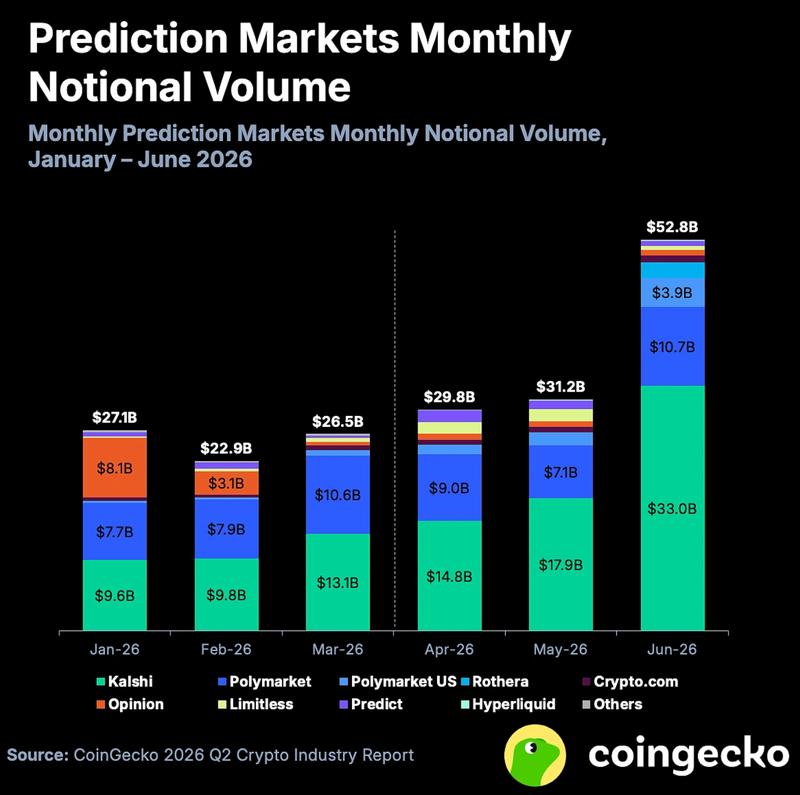
This Talos integration arrives at a time when prediction markets are experiencing unprecedented trading activity levels and expanding institutional participation. A report published by CoinGecko indicates that notional trading volume climbed to $113.8 billion during the second quarter, representing a 48.7% increase compared to the preceding quarter, with June's $52.8 billion in notional volume establishing a new monthly record for the industry.
The dramatic surge was attributed by CoinGecko to an exceptionally busy sports calendar, featuring major events including the UEFA Champions League final, NBA Finals, Stanley Cup, FIFA World Cup and Wimbledon. Sports contracts represented 81% of June trading volume on Polymarket, a significant increase from the 40% share recorded in January.
Kalshi strengthened its position among prediction market platforms, growing its market share to 58.9% compared to 42.4% during the first quarter. The market share held by Polymarket declined to 30.2% from 35.8%, while Rothera, the venture backed by Robinhood and Susquehanna International Group that debuted in May, secured fourth place in June with $2.1 billion in notional trading volume.
Even with the explosive growth, prediction markets are continuing to navigate legal and regulatory challenges. Within the United States, Kalshi finds itself in legal disputes with multiple state regulators concerning whether its sports event contracts should be classified as illegal gambling, a legal battle that numerous legal experts anticipate could eventually advance to the US Supreme Court for final resolution.
The sector is also encountering increased scrutiny regarding potential insider trading activities. During the earlier part of this year, six individuals trading on Polymarket purportedly earned approximately $1 million by placing successful bets on US military strikes against Iran prior to the attacks becoming publicly known information.
In recent days, a White House teleprompter operator was reportedly placed on unpaid leave following allegations of earning more than $100,000 through betting on Kalshi markets connected to President Donald Trump's speeches.