
Jack Dorsey unveils AI-powered workplace blueprint following Block's massive 40% workforce reduction
Following Block's elimination of 4,000 positions in February during its AI transformation, Jack Dorsey has revealed his blueprint for future company operations in a detailed new statement.

Jack Dorsey, co-founder of Block, has unveiled his perspective on tomorrow's workplace environment, one in which artificial intelligence systems would assume responsibilities currently handled by middle management—this revelation comes just weeks following the company's decision to reduce its workforce by approximately 4,000 individuals due to AI implementation.
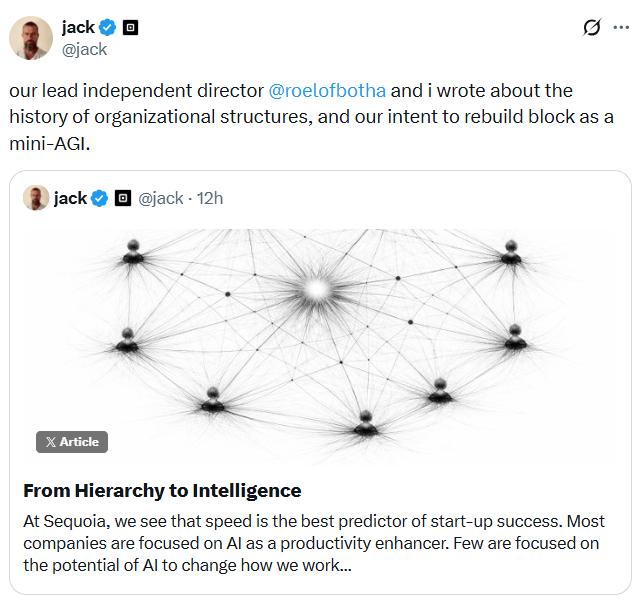
Through a blog post published on Tuesday, Dorsey alongside Roelof Botha, Block's lead independent director, articulated how AI possesses the capability to monitor projects, detect obstacles, delegate tasks and distribute essential information with greater speed than human counterparts, noting that Block has entered the "early stages" of moving toward an operational framework where technology executes these responsibilities.
"We're questioning the underlying assumption: that organizations have to be hierarchically organized with humans as the coordination mechanism," they said.
"Instead, we intend to replace what the hierarchy does. Most companies using AI today are giving everyone a copilot, which makes the existing structure work slightly better without changing it. We're after something different: a company built as an intelligence, or mini-AGI."
Numerous technology corporations have been reducing workforce numbers, pointing to AI as their justification. Block eliminated approximately 40% of its employee base during a significant restructuring initiative in February, a choice Dorsey linked to AI's swift advancement within the organization and the necessity to maintain market competitiveness.
Human workers will remain essential
During March, certain employees who were terminated from Block during February's layoffs were discreetly rehired.
According to Dorsey and Botha, despite AI potentially assuming a substantial position in their proposed organizational framework, human workers will continue to participate in critical business and ethical decision-making processes.
The workforce would undergo reorganization into three distinct categories: "individual contributors," responsible for building and maintaining operating systems, and "directly responsible individuals," assigned to address specific challenges while possessing the autonomy to utilize whatever resources prove necessary.
"Player-coaches" will execute certain managerial responsibilities, including mentorship and support for fellow employees, while simultaneously continuing their hands-on work such as writing code and developing products.
"We believe the pattern behind this, a company organized as an intelligence rather than a hierarchy, is significant enough that it will reshape how companies of all kinds operate over the coming years," Dorsey and Botha said.
Traditional human management creates bottlenecks, according to Dorsey and Botha
The majority of corporations function through hierarchical structures; data moves upward from employees to their managers, then proceeds to executive leadership before flowing back down through the same organizational chain.
According to Dorsey and Botha's assessment, while this framework has demonstrated its effectiveness historically, AI technology can execute these same functions with far superior efficiency and deliver advantages including instantaneous visibility into product performance metrics instead of requiring managers to compile reports and render decisions after delays.
"In a remote-first company where work is already machine-readable, AI can build and maintain that picture continuously. What's being built, what's blocked, where resources are allocated, what's working and what isn't," they said.
"Companies move fast or slow based on information flow. Hierarchy and middle management impede information flow," Dorsey and Botha added. "The question was never whether you needed layers. The question was whether humans were the only option for what those layers do. They aren't anymore."