
Investor warns of concentrated liquidity risks in Latin American stablecoin market
Research examining 494 stablecoin firms in Latin America revealed only 16 companies specializing in wholesale liquidity services, sparking worries about system vulnerabilities during mass withdrawals.

The stablecoin payment infrastructure across Latin America could be reliant on an unusually small number of liquidity providers at its foundation, which might interfere with users' capacity to convert their holdings into local fiat currencies should a major provider experience banking relationship problems, warns Amit Chu, partner at Verda Ventures.
According to a recently released study from cryptocurrency investment firms Varys Capital and Verda Ventures, which utilized data from Verda's Stablescape database, investigators examined 494 regional companies but discovered merely 16 entities whose core operations involve delivering wholesale stablecoin-to-fiat liquidity services, corporate treasury solutions and credit facilities, cautioning that "fragility in the system is concentrated in its thinnest layer."
"There are many sellers of liquidity and very few specialists. What we can't see from public data is how many of them warehouse the currency risk themselves and how many pass it to the same few desks and exchanges. Our view is that it's the second, and that's the fragility the report is pointing at," Chu told Cointelegraph.
The role of stablecoins continues to expand within Latin America's cryptocurrency landscape. Based on a Chainalysis report from September, stablecoins had reached 32.1% of cross-border cryptocurrency value by June 2026, while representing 22.1% of domestic peer-to-peer transactions and 17.6% of individual wallet holdings throughout the region.
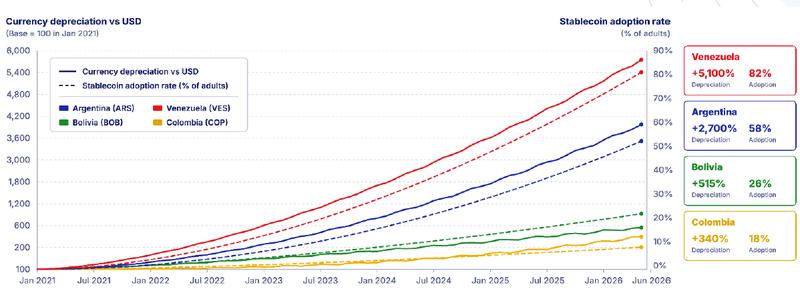
According to Chu, if a major provider experiences disruption, users could find themselves stuck holding stablecoins while encountering elevated costs or significant delays in their attempts to convert these assets into their local currencies.
"The problem would be at the exits. Spreads would widen, cash-outs to local bank accounts would slow or pause, and funds in transit with the failed desk could be stuck," he said.
That said, the study does not quantify the actual level of liquidity concentration present in the market. Chu explained that Stablescape doesn't monitor transaction volumes and fails to offer market share data. While exchanges and payment processors categorized in other sections of the database also offer liquidity services, Chu noted that Verda believes several of them ultimately rely on the same core desks.
According to Chu, regulatory licensing represents the most significant tool for decreasing concentration risks, given that more transparent regulations would facilitate banks' ability to provide services to liquidity providers. He further highlighted local-currency stablecoins as a potential solution, which might enable additional market makers to complete transactions onchain, noting that international trading companies are starting to offer quotes for Latin American currency pairs.
Chu additionally warned against drawing the conclusion that having a limited number of specialized providers automatically indicates a systemic issue.
"Mature FX markets also have far fewer dealers than customer-facing firms. What matters is redundancy and capital," he said.
"Each major currency should have several independent, well-capitalized desks with separate banking relationships, and each wallet should be able to route between multiple players."
Overall, the study characterized Latin America as an expanding market opportunity, especially for companies focused on solving cross-border payment challenges. The research contended that fragmented banking infrastructure and expensive transfer fees generate significant demand for solutions that simplify the process for individuals and enterprises to transfer funds across national borders.