
Hester Peirce Clarifies Limited Scope of Potential Tokenized Securities Exemption
A Superstate executive noted that the more restrictive framework outlined by Hester Peirce would allow decentralized finance to grow while maintaining regulatory standards in conventional capital markets.
Hester Peirce, a Commissioner at the United States Securities and Exchange Commission, has advised the cryptocurrency sector to moderate its expectations regarding a prospective "innovation exemption" that would facilitate tokenized stock trading, following earlier reporting this week on the potential framework's details.
The Commissioner's remarks came in response to a Bloomberg piece published on Monday. Following that report, Brett Redfearn, who serves as president of Securitize, a tokenization platform, voiced his worries, contending that allowing third-party entities to tokenize equities "without an issuer at the table" might create problems related to fragmentation.
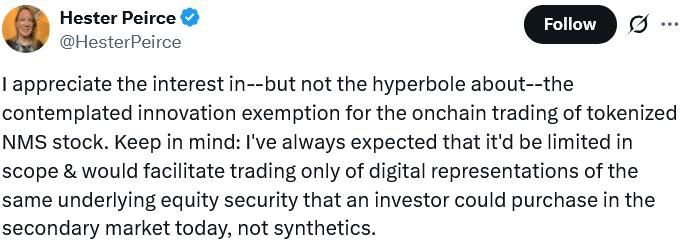
Through a post on X published Thursday, Peirce clarified that her anticipation has consistently been that any such exemption would be "limited in scope" by exclusively allowing "digital representations of the same underlying equity security that an investor could purchase in the secondary market today."
The Commissioner indicated that she does not anticipate synthetic tokens being part of the exemption, a position that would create greater difficulty for third-party entities seeking to offer tokens that track stock prices under the proposed exemption framework.
According to data provided by RWA.xyz, tokenized stocks worth $1.48 billion currently exist onchain, featuring shares connected to stablecoin issuer Circle, Bitcoin buying firm Strategy and Google (GOOG).
Nevertheless, the sector has not experienced the explosive growth that certain financial institutions anticipated, including Citibank and McKinsey & Co, both of which forecasted in 2022 and 2024 that the tokenization industry would reach a trillion-dollar valuation by or prior to 2030.
Peirce's comments cleared the air
The statements from Peirce align with the Bloomberg reporting which indicated that the securities regulatory body is solely contemplating allowing tokens that provide the same advantages as traditional common stock, including voting rights and dividends.
Robert Leshner, who serves as CEO of Superstate, a crypto tokenization platform, stated that this more restrictive methodology would allow decentralized finance and tokenization to expand "without compromising the standards that make the USA the center of capital markets."
Carlos Domingo, the CEO of Securitize, similarly stated that the proposed approach would reduce the danger of ownership fragmentation within the tokenization market.
"This is good, we want to do on-chain trading, but for the right assets, and not to help proliferate those derivatives that are fragmenting the market and introducing additional risks."
According to Bloomberg, the SEC has reportedly consulted with "hundreds of market participants" to gather feedback regarding the optimal way to craft the regulations for tokenized trading.
The specifics have not yet been finalized and remain subject to modification before any exemption is officially implemented, Bloomberg noted in the report, referencing sources with knowledge of the discussions.
Notwithstanding the potential exemption, Bloomberg's reporting indicated that certain SEC officials have expressed opposition to allowing tokenized stock trading.