
Galaxy Digital Commits $5M in Funding to Strengthen Bitcoin Against Quantum Threats
In a strategic move to protect Bitcoin's future security, Galaxy Digital has committed up to $5 million in developer grants focused on quantum-resistant solutions, while simultaneously establishing an expert advisory council to guide quantum-proof migration strategies.

Galaxy Digital has announced a commitment of up to $5 million in grant funding aimed at supporting open-source developers who are working on post-quantum cryptographic solutions for the Bitcoin network.
In addition to the funding announcement, the company has established a quantum advisory council as part of its newly unveiled Bitcoin Quantum Readiness Initiative, which was publicly announced on Tuesday. The advisory council brings together leading experts including Barry Sanders, who serves as both professor and scientific director of Quantum City at the University of Calgary; Damien Bérubé, currently an MIT Sea Grant Knauss fellow; and Eran Tromer, a professor of computer science at Boston University.
The grant funding program will support development efforts across multiple critical areas, including quantum-resistant upgrade proposals, post-quantum cryptographic implementations, Bitcoin signature scheme development, migration tooling for wallets and custodians, and comprehensive formal security audit processes.
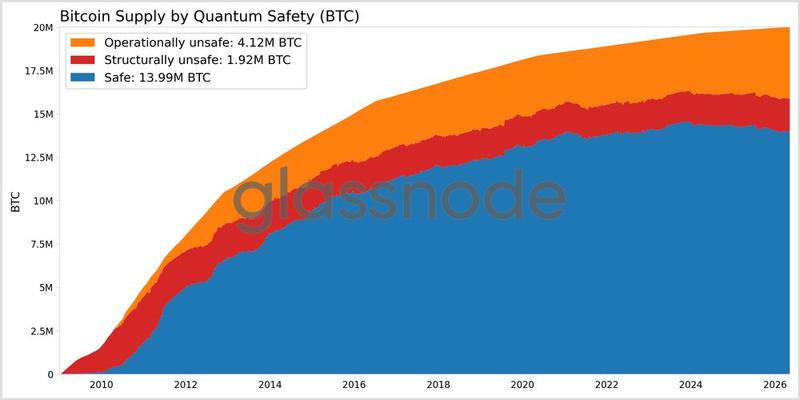
The issue of Bitcoin's vulnerability to quantum computing has emerged as an increasingly pressing concern within the cryptocurrency community, particularly given that approximately 30% of Bitcoin's total supply could potentially be at risk should cryptographically relevant quantum computers become a reality, according to data from analytics provider Glassnode. This vulnerable portion breaks down into 10% of the supply classified as "structurally unsafe" due to the specific output type being used, while an additional 20% is deemed "operationally unsafe" as a result of problematic key or address management practices.
Community split over quantum breakthrough timeline
The question of when practical quantum computing will become a reality continues to generate significant debate and disagreement within the cryptocurrency community.
During November 2025, Adam Back, who serves as CEO of Blockstream, stated his position that Bitcoin faces no meaningful quantum threat for at least the next 20 to 40 years. Back's assessment suggests this timeframe provides the network with sufficient opportunity to implement the post-quantum cryptography standards that have received approval from the US Department of Commerce's National Institute of Standards and Technology (NIST).
NIST released three post-quantum cryptography standards in August 2024, specifically designed for key establishment and digital signature applications. These published standards encompass key exchange mechanisms, digital signature protocols, and hash-based signature algorithms that have the potential to serve as the foundation for future post-quantum migration efforts across various industries, with possible applications in Bitcoin upgrade scenarios.
Blockstream Research published a research paper in December 2025 that put forward a hash-based signature scheme as what they describe as a "promising path for securing Bitcoin in a post-quantum world." The technical proposal outlined in the paper would involve replacing Bitcoin's existing ECDSA and Schnorr signature systems with an alternative scheme that derives its security exclusively from cryptographic hash functions.
A contrasting perspective was offered by wealth management company Bernstein, which stated in a report released in April that Bitcoin has approximately three to five years within which to prepare and implement a post-quantum security upgrade.