Fidelity: Bitcoin's Current Cycle Shows 'Reduced Severity' in Market Corrections
According to Fidelity, the current Bitcoin correction of 50% represents a significantly smaller decline compared to historical cycles, indicating increased market maturity and stronger institutional participation.

The leading cryptocurrency has experienced approximately a 50% correction during the current market cycle, representing a substantially smaller decline compared to earlier cycles, according to Fidelity Digital Assets, which noted this pattern may persist in future cycles.
While Bitcoin's corrections following all-time-high peaks have traditionally ranged between 80% and 90%, the current cycle has witnessed roughly a 50% decline, according to Zack Wainwright, research analyst at Fidelity Digital Assets, who commented on Tuesday.
When examining Bitcoin's price action relative to previous all-time highs, one can observe the "diminishing returns" that have emerged across successive cycles, Wainwright explained.
"Each cycle has been less dramatic to the upside than the previous," Wainwright noted. "Downside risk has been less dramatic in 2026, the current cycle, as well," he further commented.
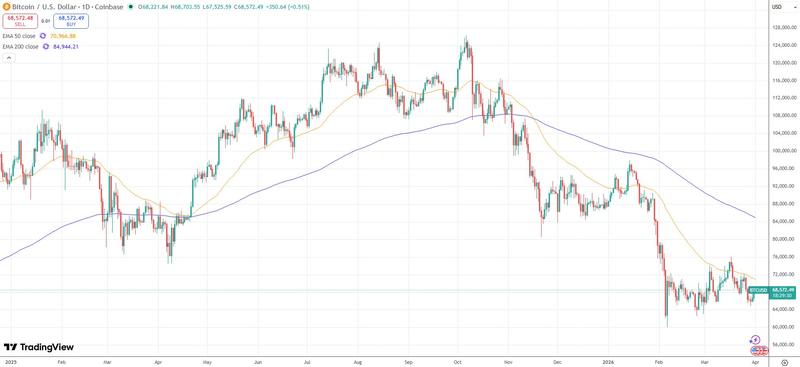
The cryptocurrency reached its present cycle trough at slightly above $60,000 on Feb. 6, representing a 52% drop from its Oct. 6 all-time peak of approximately $126,000, based on TradingView data. The asset currently sits 46% below its high point reached six months earlier.
By contrast, the prior cycle experienced a significantly more severe downturn of 77%, declining from the 2021 peak of $69,000 to a bear market trough slightly under $16,000 in November 2022.
Bitcoin may bottom in late September
The analysis from Fidelity suggesting this Bitcoin cycle exhibits notably less severity compared to previous cycles "indicates a maturing market with reduced volatility and stronger institutional confidence," Nick Ruck, director of LVRG Research, shared with Cointelegraph on Wednesday.
"This shift signals that Bitcoin is changing from a speculative asset toward a more stable store of value, potentially paving the way for greater adoption in the future."
Separately, Alphractal founder Joao Wedson noted on Tuesday that Bitcoin's peak materialized 534 days following the most recent halving, representing a more compressed timeframe than the preceding cycle.
This "decaying pattern" observable across cycles implies the historical trough may materialize between 912 and 922 days following the halving, which "points to a bottom in late September or early October 2026," Wedson stated.
BTC is below key daily moving averages
The cryptocurrency continues to trade beneath the critical 50-day and 200-day exponential moving averages, two important long-term trend indicators.
The asset is currently fluctuating near the 200-week EMA, positioned around $68,000, which has functioned as a critical support level throughout past market corrections.