
Cryptocurrency Regulation Uncertain, BitMEX Announces Closure: Hodler's Digest, July 26
The Clarity Act faces uncertain future despite backing from major financial institutions and law enforcement. BitMEX announces shutdown as cryptocurrency exchange market consolidates.

Regulatory clarity legislation may proceed to voting, but passage remains uncertain
Even though memecoin magnate Donald Trump has consented to an ethics agreement, the Clarity Act continues to struggle as lawmakers face the approaching August recess deadline.
According to Senate Majority Leader John Thune, the legislation currently lacks sufficient support for passage, though he may proceed with a vote regardless to "get Clarity started. We'll see where the votes are."
Trump's ethics agreement would ban all United States government officials from creating or promoting digital assets, though it includes certain provisions favorable to the President that have drawn Democratic criticism, notably that these regulations terminate on his scheduled departure date in 2029.
Additionally, the ethics regulations would be overseen by Trump's appointed Attorney General. Democrats have instead advocated for state-level Attorney Generals to handle enforcement — a proposal Trump appears unlikely to accept given it would empower numerous state AGs with potential prosecutorial authority over him.
While the White House characterized the legislation as the "most comprehensive and wide-ranging ethics provision in history," Democratic Senator Ruben Gallego dismissed it as a "piece of shit" and "not a serious effort."

Discussions continue between parties seeking mutually acceptable terms, though the significant trust deficit makes reaching a compromise particularly challenging.
David Solomon, CEO of Goldman Sachs, acknowledged the bill is "not perfect" yet has endorsed it nevertheless, joined by Fidelity and Charles Schwab, firms that collectively manage trillions in assets.
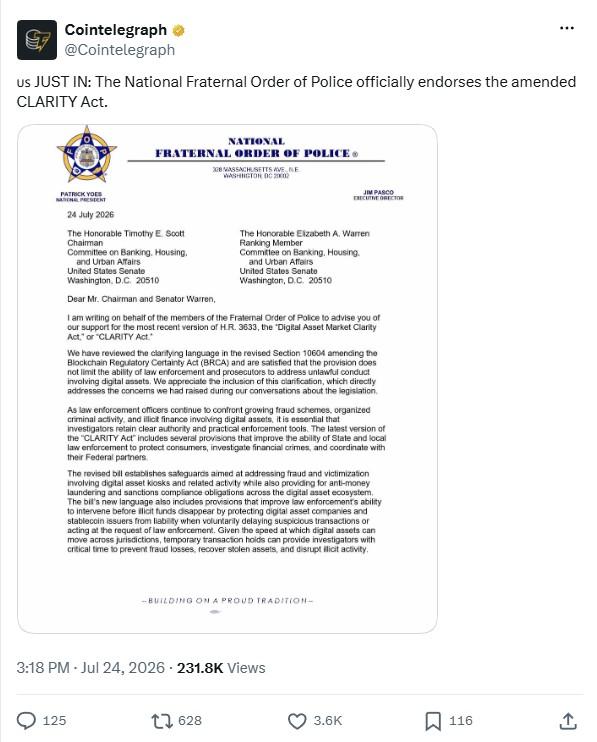
Support has also emerged from law enforcement entities, including The National Fraternal Order of Police, an organization representing hundreds of thousands of officers, which stated the current BRCA version (protecting decentralized protocol developers) would not obstruct money laundering and fraud investigations.
Polymarket odds currently place the probability of the bill's passage this year at 38%.
BitMEX announces closure after eleven-year run as class action lawsuit emerges
BitMEX, a pioneering platform in cryptocurrency derivatives trading, has announced its September shutdown following 11 years of operations.
Established in 2014, BitMEX gained prominence for pioneering 100x leverage perpetual swaps.
Recent years have witnessed dramatic volume declines due to intensifying competition from leading exchanges such as Binance and decentralized platforms like Hyperliquid.
Ki Young Ju, CEO of CryptoQuant, reported that BitMEX's portion of the Bitcoin futures market has declined to merely 0.08%, with approximately $84 million in daily trading volume.
"It was a great exchange that helped shape the industry, and now it is passing the torch to the next generation of exchanges it inspired," Ju said.
Following the announcement, BitMEX's utility token BMEX experienced a dramatic value collapse. Coinciding with this news, a class action lawsuit surfaced alleging the crypto derivatives platform fraudulently orchestrated customer liquidations to appropriate traders' collateral. BitMEX has rejected these accusations and referenced its successful defense against comparable claims previously.
Roshan Dharia, a restructuring adviser, informed Cointelegraph that the exchange's closure demonstrates ongoing industry consolidation.
The top five platforms now control an estimated 80% of global spot volume, leaving mid-tier and regional exchanges with shrinking margins and no viable path to scale... The headwinds are structural, not cyclical.
Emphasizing this trend, BitMart subsequently revealed it would likewise cease operations within the coming months.

S&P introduces blockchain fundamentals index for digital asset tracking
S&P Dow Jones Indices in partnership with Pantera Capital have introduced a digital asset index monitoring major crypto assets — notably excluding Bitcoin and XRP.
The S&P Pantera Digital Asset Index aims to serve as the institutional benchmark crypto index, implementing screening criteria based on minimum protocol revenue, market capitalization, and liquidity thresholds.
At launch, the index featured 18 constituents, with its five largest holdings being Ether (ETH), BNB (BNB), Solana (SOL), TRON (TRX) and Hyperliquid (HYPE), whereas Bitcoin (BTC) and XRP (XRP) represent the largest excluded assets.
This newest index reflects a broader movement across the industry to create institutional-quality benchmarks for digital assets, joining similar offerings including the Nasdaq Crypto Index US ETF, the Franklin Crypto Index ETF and the Coinbase Store of Value Index among others.
Robinhood explores prediction market expansion as regulatory agency issues fresh warning
Robinhood is purportedly in discussions regarding plans to broaden its current prediction markets services with cryptocurrency exchange Crypto.com.
The Wall Street Journal reports that these negotiations involve incorporating yes-or-no event contracts provided by Crypto.com. Robinhood initiated its prediction markets in March 2025, originally facilitated through Kalshi to ensure compliance with US Commodity Futures Trading Commission (CFTC) regulatory requirements.
Last week, Bernstein analysts elevated their Robinhood (HOOD) stock price target to $160 from $130 per share, citing the company's projection for prediction markets and tokenized equities.
Meanwhile, the CFTC, which seeks to establish itself as the primary regulatory body for prediction markets, issued a warning to providers last week, instructing platforms to provide significantly more detailed event contract certifications.
The advisory addresses concerns about the practice of submitting broad, template-style certifications that combine many potential event contract variations into a single certification.
Additionally, Carl Kennedy, a partner at New York law firm Katten Muchin, informed a House Agriculture Committee hearing last week that the CLARITY Act could support the CFTC's endeavors to regulate the "explosive growth of prediction markets."
Balaji's Network School pursues Kazakhstan location following Malaysian complications
Balaji Srinivasan's Network School, a "digital nomads" community, is pursuing a new campus in Kazakhstan after Malaysian authorities revoked the business license for its Forest City campus due to alleged premises-use violations.
Kazakhstan's relevant Minister Zhaslan Madiyev and Srinivasan signed a memorandum of understanding to establish the country's first Network School campus, aligning with Kazakhstan's ambitions to become a digital hub.
The School faced expulsion from Johor in Malaysia following controversy regarding the admission of Israeli dual citizens. Malaysia, a Muslim majority nation, maintains no diplomatic relations with Israel. Despite an investigation clearing the school of visa violations, the Network School received a shutdown order based on alternative grounds.
Haseeb Qureshi, managing partner at Dragonfly Capital, suggested the controversy has confirmed Balaji's Network State thesis.
The whole idea of a network state is taking a dense group of talent and capital, and collectively negotiating with states. The Malaysia drama set up Balaji to negotiate better terms with another state to copy and paste the network there.

Weekly market winners and losers
As the week concludes, Bitcoin (BTC) stands at $65,395, Ether (ETH) trades at $1,958, and XRP (XRP) is valued at $1.11. According to CoinMarketCap, the total market cap reaches $2.24 trillion.
Within the top 100 cryptocurrencies by market capitalization, the week's three leading altcoin gainers are Audiera (BEAT), rising 53%, Shinba Inu (SHIB) with a 29% increase, and Venice Token (VVV), posting a 19% gain.
The week's three worst-performing altcoins are DeXe (DEXE), declining 89%, Midnight (NIGHT), falling 26%, and Pyth Network (PYTH), dropping 10%.
Weekly prediction spotlight
Bitcoin positioned for 'lift' from Hyperliquid, Robinhood integration in upcoming bull market
Bitcoin (BTC) is "finally showing signs of a bottom," according to Matt Hougan, chief investment officer at Bitwise.
Hougan forecasts that traditional finance integrations, especially Hyperliquid and Robinhood, will catalyze the next cryptocurrency bull market, with the resulting momentum expected to "lift" major cryptocurrencies including Bitcoin and Ether.
Hougan contends that crypto is delivering substantial advantages like round-the-clock trading to conventional markets, observing that currently "nearly half the volume on Hyperliquid is in conventional assets like oil, silver, and the S&P 500 [and] it's expanding into spot commodities, prediction markets, and options."
Data from Bitwise also indicates apparent demand for BTC shows reversal signals. This metric calculates the differential between newly-mined BTC and supply that has remained inactive for at least one year.

Weekly FUD highlights
Home invasions emerged as predominant crypto wrench attack method in H1 2026: CertiK
Home invasions emerged as the predominant form of crypto wrench attacks throughout the first half of 2026, escalating to 20 publicly documented incidents from merely one the previous year, according to blockchain security firm CertiK.
CertiK reported Thursday that it confirmed 52 wrench attacks globally during the first half of 2026, representing a 33.3% increase from 39 incidents in the corresponding period of 2025. Kidnapping incidents increased to 16 from 12, whereas robberies decreased from five incidents to one.
CertiK stated that documented financial exposure associated with these attacks reached approximately $124.1 million, up from $10.5 million the previous year.
The surge in home invasions indicates criminals are progressively circumventing digital security measures by physically threatening crypto holders and their family members.
Cybercriminals steal $31.6M through 2 separate crypto bridge attacks occurring within 7-hour period
Cybercriminals extracted more than $31.6 million through two separate crypto bridge exploits occurring just hours apart, targeting bridges managed by decentralized perpetual exchange AFX and Verus Protocol.
Blockaid reports that AFX, a decentralized perpetual exchange operating on Arbitrum, allegedly lost $24.15 million on Wednesday via a hack exploiting one of its cross-chain bridges. Several hours later, Blockaid reported detecting an exploit affecting the Verus Ethereum Bridge that resulted in approximately $7.5 million in stolen cryptocurrency.
"Another bridge, another exploit. Bridges will always be a weak link, until security is upgraded," onchain investigator TheCrypticWolf said in a post on X.
Ethereum ETFs conclude week negatively, breaking 5-day positive inflow pattern
US-listed spot Ethereum exchange-traded funds (ETFs) recorded $70.62 million in net outflows on Friday, terminating a five-day inflow streak.
Ethereum funds experienced $211.25 million in net inflows during the previous five sessions from July 17, according to SoSoValue data. Despite Friday's outflows, they still registered $103.9 million in net inflows for the week ending Friday.
Notwithstanding the outflows, Ethereum ETFs continued their weekly inflow streak for three consecutive weeks and have captured $337.74 million in net inflows throughout July to date.
The Bitcoin ETFs negated earlier weekly gains to conclude with $33.9 million of inflows.