
Crypto Companies Turn to AI Narrative as Justification for Mass Layoffs
Major crypto firms including Coinbase, Block and Crypto.com have pointed to artificial intelligence when announcing recent workforce reductions, but Scale AI's Jason Droege believes firms are using AI as a convenient excuse.

On Tuesday, Coinbase joined a growing list of cryptocurrency firms reducing their headcount, as widespread job eliminations continue across a sector grappling with challenging market conditions and mounting expectations to integrate artificial intelligence into their operations.
In a statement, CEO Brian Armstrong explained the company's decision to leverage AI for restructuring its organizational hierarchy, describing a shift where managers would function more as "player-coaches" than traditional supervisors.
"AI is bringing a profound shift in how companies operate, and we're reshaping Coinbase to lead in this new era. This is a new way of working, and we need to leverage AI across every facet of our jobs," Armstrong said in an email to employees, also shared on X on Tuesday.
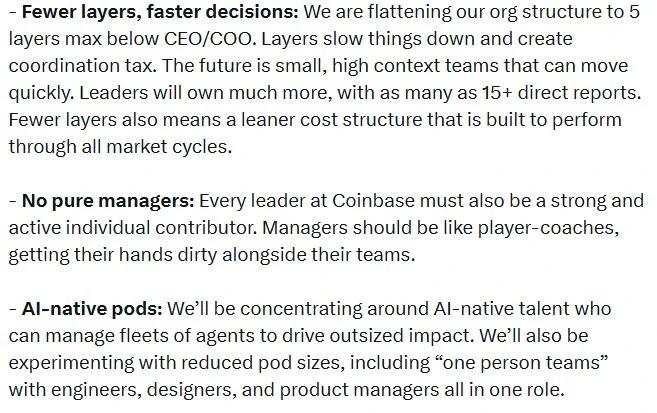
In the months leading up to Coinbase's announcement, both Block and Crypto.com executed comparable workforce reductions, attributing their decisions to efficiency improvements powered by AI that enable smaller teams to accomplish tasks previously requiring significantly larger staff numbers.
The workforce reductions at Coinbase and Crypto.com affected approximately 700 and 180 workers respectively. Meanwhile, Jack Dorsey's Block issued 4,000 pink slips in February to bring the company's total employee count below 6,000.
The cryptocurrency sector has previously endured multiple bear market cycles, with job cuts routinely following market downturns. However, the current round of workforce reductions stands apart as companies frame their restructuring efforts around AI-centric business models rather than mere cost containment.
Coinbase misses Q1 expectation
In regulatory disclosures submitted to the Securities and Exchange Commission on Tuesday, Coinbase revealed that its restructuring initiative is projected to generate expenses reaching $60 million, primarily consisting of severance packages and termination-related benefits.
Clear Street analyst Owen Lau told CNBC that Coinbase wants to "tell investors that management is actively managing the cost base to deliver positive adjusted EBITDA through the cycle."
"The first quarter results are expected to be weak because of the crypto bear market," added Lau.
Coinbase's Thursday earnings report revealed first-quarter performance that fell below market expectations, as declining cryptocurrency valuations significantly impacted spot trading revenue. The company disclosed a net loss of $1.49 per share against $1.41 billion in revenue, falling short of analyst projections while transaction revenue declined amid reduced trading volumes.
The disappointing results extend beyond Coinbase's specific situation, reflecting broader market challenges as Bitcoin declined 21% of its value in Q1. Throughout the broader technology sector, employee numbers that expanded dramatically during the bull market are now being reduced, with company leaders increasingly identifying AI as the primary justification.

The question of whether AI genuinely drives these workforce reductions or merely serves as convenient justification varies depending on perspective. During his appearance at the recent Semafor World Economy conference, Scale AI CEO Jason Droege challenged the notion of AI triggering a "white-collar apocalypse," suggesting numerous companies are exploiting the technology as a smokescreen.
"A lot of the layoffs that are happening right now because of AI, if you really dig in, it's sort of like washing the layoffs. A lot of these companies are saying it's because of AI, but a lot of it is just like rightsizing and they need an excuse."
Jason Droege, Scale AI CEO
AI leads job cut reasoning for second consecutive month
Data from employment tracker Layoffs.fyi indicates the global technology industry experienced its most severe layoff period in 2026 Q1 since 2023 Q1, resulting in more than 81,747 job losses. The month of March witnessed the most significant impact, recording 45,800 layoffs.
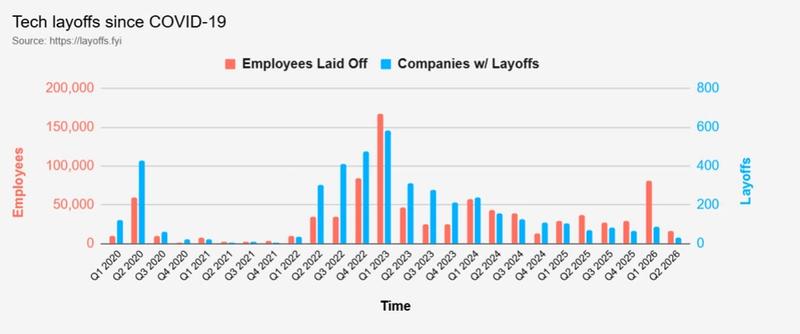
The declining employment trend extended into the opening month of the subsequent quarter. Data released Thursday by outplacement consulting firm Challenger, Gray & Christmas indicates US employers disclosed 83,387 planned job eliminations in April, representing a 30% increase compared to the 60,620 cuts announced in March.
For the second month running, AI topped the list of cited reasons for workforce reductions in April, although it doesn't represent the leading factor for the year-to-date period. Market conditions accounted for 53,058 cuts in the top position, with closings responsible for 52,187 eliminations.
"Technology companies continue to announce large-scale cuts and are leading all industries in layoff announcements. They are also often citing AI spend and innovation. Regardless of whether individual jobs are being replaced by AI, the money for those roles is."
Andy Challenger, chief revenue officer at Challenger, Gray & Christmas
While cryptocurrency markets have consistently demonstrated cyclical patterns, the narrative surrounding the current wave of workforce reductions differs markedly from the previous significant downturn. Throughout the 2022–2023 crypto market collapse, companies primarily responded to plummeting token valuations, the aftermath of FTX's implosion and financial statements weakened by overzealous bull-market recruitment.
In contrast, the current environment sees executives increasingly characterizing layoffs as strategic reorganization connected to AI integration and enhanced operational efficiency.
Leadership at both Dorsey's Block and Armstrong's Coinbase emphasized their companies maintain strong capital positions, characterizing workforce reductions as intentional efforts to streamline corporate hierarchies rather than desperate survival tactics necessitated by financial distress.
Same playbook, new reason
Cryptocurrency market recoveries have historically materialized rapidly, and when upswings occur, companies typically launch aggressive recruitment campaigns to capitalize on bull market conditions. Coinbase has navigated this cycle previously. The exchange eliminated 18% of its workforce in 2022, subsequently engaging in extensive hiring when market valuations recovered.
This cycle, Armstrong is wagering that the AI-integrated operational model eliminates the necessity for such dramatic staffing fluctuations.
Kraken advanced similar arguments in October 2024, when it eliminated 15% of its workforce.
In a blog post, co-CEOs Arjun Sethi and Dave Ripley said the exchange had "fallen into the trap of building organizational layers" and needed to become "leaner and faster" by giving power back to individual contributors over managers.
The messaging parallels Armstrong's and Dorsey's communications. The distinction lies in Kraken's decision not to reference AI.
Streamlined workforces, simplified organizational structures, accelerated decision-making processes. The crypto industry has executed this playbook previously, but artificial intelligence represents the contemporary justification.