
CLARITY Act's Future Uncertain, Bitcoin Eyes $80K: Hodler's Digest for July 19
Trump's ethical controversies cast doubt on the CLARITY Act's passage. Trading volumes in prediction markets reach unprecedented levels, plus additional updates.

Trump's ethical record casts shadow over CLARITY Act
According to Polymarket, the probability of the CLARITY Act becoming law this year stands at merely 40%, following vocal opposition from multiple Democratic Senators including Chris Murphy, Jeff Merkley, and Chris Van Hollen.
The Senate could hold a pivotal vote on the legislation within days, as Senate Majority Leader John Thune has confirmed the vote will take place no later than Aug. 10.
Senator Elizabeth Warren, a Democrat, is working to derail the vote by drawing attention to the substantial profits President Trump has generated from the cryptocurrency sector. Warren has called on Trump to publicly disclose his crypto-related income for the current year, particularly after his 2025 financial disclosure revealed cryptocurrency earnings exceeding one billion dollars in the previous year. This ethical controversy has made Senate Democrats reluctant to back the legislation unless it includes language preventing elected officials from promoting or launching cryptocurrencies.
Summer Mersinger, who leads the Blockchain Association and previously served as a commissioner at the US Commodity Futures Trading Commission, characterized the situation by saying: "Ethics is the big elephant in the room."
"For my members and what we are advocating for on the Hill... look, whatever you decide on ethics, that's really not our concern. That is politics. That's Congress. That's elected officials. But please don't let it kill all the hard work that we put in the rest of the bill."
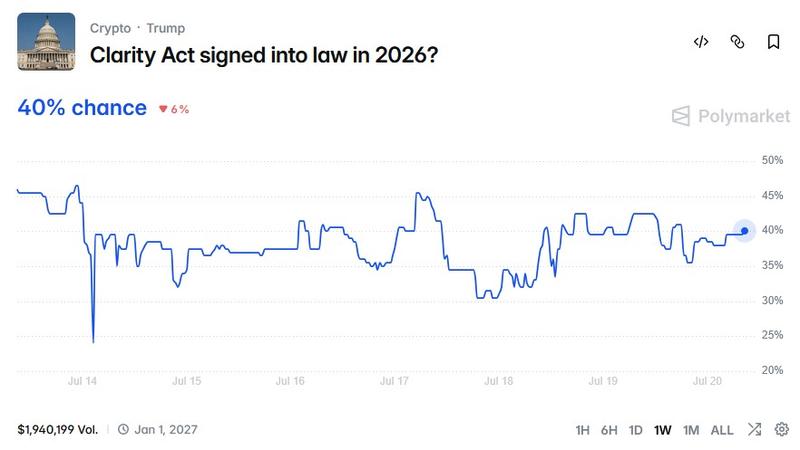
Prediction platforms post historic Q2 trading volume as France bans Polymarket
Digital asset markets remained sluggish throughout the second quarter, with prediction platforms standing out as a notable exception.
Trading volume on spot markets across the ten largest centralized exchanges (CEXs) dropped from $2.7 trillion during the first quarter to merely $1.95 trillion in the second, based on CoinGecko's most recent Crypto Industry Report.
Perpetual contract volume on CEXs similarly decreased by 10% to $12.7 trillion, and the stablecoin sector contracted by 1.6% to $305.1 billion. By contrast, prediction platforms experienced their most successful quarter ever with $113.8 billion in notional trading volume.
The World Cup winner market on Polymarket alone has generated over $3.3 billion in trading activity, while contracts related to the 2028 US presidential election represent some of the platform's most active markets, based on data from Polymarketscan.
In related news, France's National Gambling Authority has just mandated that internet service providers restrict access to Polymarket, classifying prediction markets as unlawful gambling operations.
Access to Polymarket is restricted in 33 nations... though VPN users can circumvent these blocks.
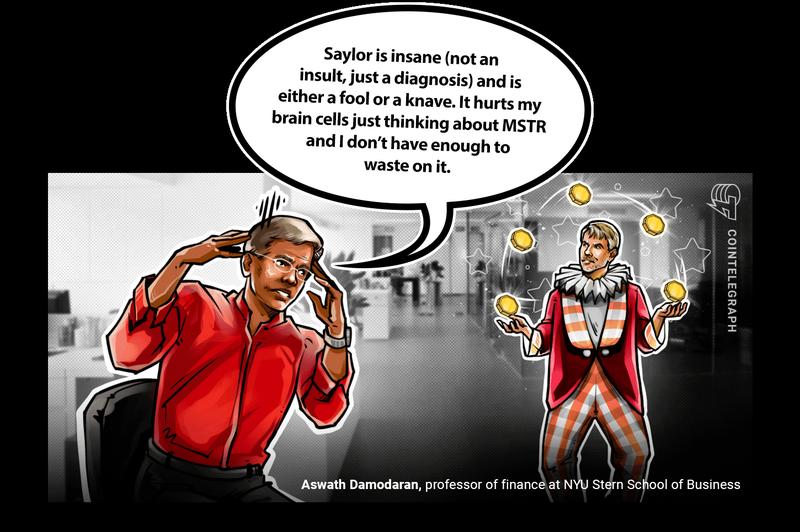
Senators oppose clemency for SBF while FTX distributes additional $900M
The US Senate has passed a resolution expressing opposition to executive clemency for Sam Bankman-Fried, the former chief executive of FTX.
While the resolution lacks the authority to prevent a presidential pardon, it demonstrates bipartisan Senate resistance.
Bankman-Fried received a 25-year federal prison sentence in March 2024 following his conviction on fraud and conspiracy charges related to FTX's 2022 collapse.
Talk of a potential presidential pardon intensified after Bankman-Fried submitted a clemency application to Trump in June 2026.
This past Friday, the FTX Recovery Trust announced it would disburse approximately $900 million to creditors as part of the fifth wave of repayments. The trust has distributed roughly $10 billion in total since the company entered bankruptcy proceedings.
Market cap of tokenized equities reaches unprecedented $2.3B
The worldwide market capitalization of tokenized stocks climbed to an all-time high of $2.3 billion on Wednesday, reflecting growing investor interest in blockchain-based equity instruments.
The Ethereum network commanded the largest market share at 34%, with BNB Chain capturing 30% and the Solana network claiming 23%, according to data shared by aggregator Token Terminal in a Wednesday X post.
The most significant growth originated from Kraken exchange's xStocks, representing $507 million in tokenized stock value, and Binance's bStocks, valued at $334 million. Ondo Finance maintained its position as the dominant tokenized stock issuer with $955 million in onchain equities, based on Token Terminal's data.
The Depository Trust & Clearing Corporation, custodian of $114 trillion in assets, initiated a pilot program for tokenized securities last week in collaboration with over 40 financial institutions.
Robinhood Chain is also positioning itself to become a major player in tokenized stocks, though its current volume remains predominantly driven by memecoin activity.

US and UK moving toward unified stablecoin regulations, while Genius Act implementation details remain unclear
The US Department of the Treasury and HM Treasury in the UK have released four joint recommendations concerning digital assets.
The task force recommended that regulatory bodies explore establishing a private-sector-led group dedicated to "testing of cross-border use cases for tokenized assets" and that financial regulators in the US and the Bank of England develop unified approaches regarding tokenized asset regulation.
The joint statement specified that stablecoins "should be fully backed, on at least a one-to-one basis, by high-quality, liquid assets," consistent with the US law.
In an ironic development, it subsequently emerged that all US regulatory agencies failed to meet Saturday's rulemaking deadline for the GENIUS stablecoin act. While missing the statutory deadline doesn't invalidate the GENIUS Act, it will provide issuers with reduced time to achieve compliance before the regulations take effect in January.

Top Performers and Decliners
As the week concludes, Bitcoin (BTC) trades at $64,620, Ether (ETH) at $1,868 and XRP (XRP) stands at $1.09. The aggregate market cap sits at $2.21 trillion, per CoinMarketCap data.
Within the top 100 cryptocurrencies by market cap, the three leading altcoin gainers for the week are Pump.fun (PUMP) with a 36% increase, Venice Token (VVV) up 10%, and Litecoin (LTC) which gained 7%.
The three worst-performing altcoins of the week are DeXe (DEXE) following a 27% decline, Lighter (LIT) which dropped 17%, and Worldcoin (WRLD) which decreased 14%.
This Week's Price Prediction
Analyst sets new $80K Bitcoin target for August
Bitcoin (BTC) could potentially reach as high as $80,000 by August provided it breaks through nearby resistance levels, according to a fresh prediction. A broader macroeconomic shift may serve as the catalyst to trigger the next upward movement.
Crypto trader and analyst Michaël van de Poppe stated earlier this week that BTC/USD has effectively maintained "crucial" support levels.
"It's holding the crucial level at $61,000 and flipping important MAs for support, indicating that there's more momentum on the horizon," he wrote, referencing moving average trend lines.
"I'm expecting to see a rally to $68,000 in the next 1-2 weeks, followed by a continuation towards $75,000-80,000 in August."
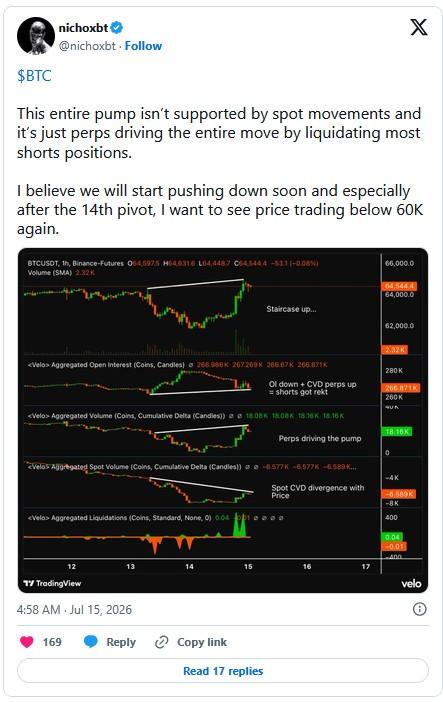
The analysis hasn't gained universal acceptance, with nichoxbt among those who believe the price will retreat below $60,000.
This Week's Leading FUD Stories
Consensys inadvertently contracted North Korean-linked developer
Blockchain firm Consensys unintentionally employed a software developer with connections to North Korea, granting the individual access to certain company systems for approximately one month.
Initially reported on Friday by Drop Site, Consensys contracted a software developer earlier this year through a "reputable third party service provider" who was subsequently found to have associations with the Democratic People's Republic of Korea.
The incident prompted the Metamask developer to temporarily halt product releases, though the company stated that an investigation has "confirmed there was no misappropriation of assets or data, no malicious code deployed, and no impact to user safety and security."
Kaspersky discovers malware framework designed to target crypto investors
Cybersecurity firm Kaspersky has identified a newly discovered malware framework focused on cryptocurrency investors.
Named "OkoBot," the malware launches an infection sequence beginning with social engineering methods like ClickFix, which deceives users into executing malicious commands, or compromised GitHub applications that install a backdoor on infected systems, according to the cybersecurity company's Wednesday report.
A distinct malware campaign attempts to compromise the devices of Web3 developers through fraudulent LinkedIn recruitment offers, according to SlowMist.
Attackers reach out to blockchain developers on LinkedIn, presenting themselves as recruiters. They subsequently send fraudulent GitHub repositories to targets, asserting they contain code requiring evaluation prior to the interview, the security firm stated in a Saturday report.
Base's focus on social applications left it behind in prediction markets and perpetuals: Pollak
Base creator Jesse Pollak acknowledges he is withdrawing from his leadership role at the Base App after conceding he made a "wrong bet" on social applications, allowing the blockchain to lag behind in prediction markets and perpetual futures.
In a Wednesday post to X, Pollak stated he had wagered that creator, content and messaging applications would fuel adoption, but the market "disintegrated completely" instead.
Pollak explained he now understands that financial applications represent the optimal path forward for the network, emphasizing trading, payments and AI agents.
The Base App will now transition back to Coinbase, with oversight provided by crypto influencer and trader Jordan Fish, more commonly recognized on X as "Cobie."