
Bank of Japan Maintains Interest Rates While Intervening to Support Yen Below 160 Level
Japan's central bank keeps interest rates unchanged at three-decade peaks while a suspected currency market intervention pushes the yen stronger, moving it beneath the critical 160 threshold.
The central bank of Japan maintained its benchmark interest rates unchanged at 1.0% during Friday's policy meeting, a decision that followed what appears to have been a substantial intervention in currency markets to support the yen.
Key points:
- Interest rates in Japan remain unchanged at 1.0%, matching what markets had predicted.
- Central banks from both Japan and South Korea are believed to have intervened in currency markets, with the JPY experiencing a sharp 3.5% surge during overnight trading.
- The Bank of Japan issues warnings about potential CPI inflation pressures expected in the latter half of the year.
Yen surges as much as 3.5% with Korea participating in intervention
The Bank of Japan (BoJ) disclosed in its most recent policy statement that there was widespread agreement among its officials to maintain interest rates at their present levels — a decision that financial markets had already priced in beforehand.
"The Bank will encourage the uncollateralized overnight call rate to remain at around 1.0 percent," it confirmed.
The bank's Policy Board saw eight of its nine members supporting the decision to hold rates steady, while Hajime Takata stood alone in advocating for a 0.25% increase.
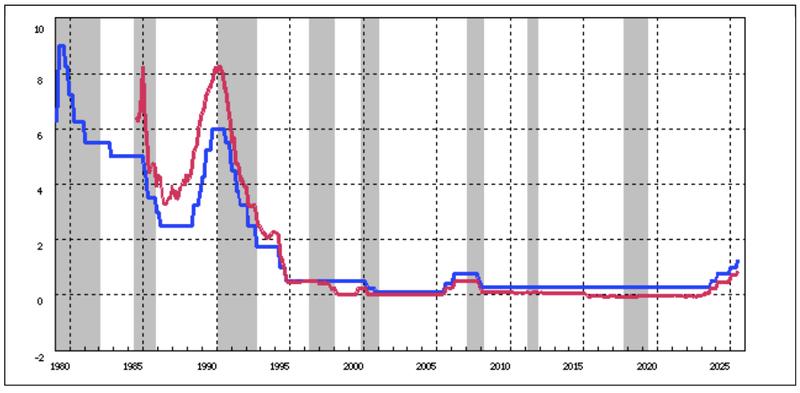
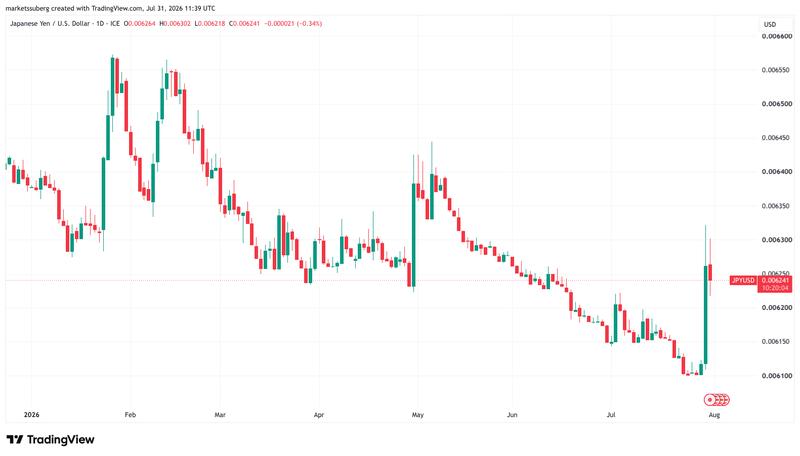
The benchmark interest rate in Japan continues to sit at levels not witnessed since 1995, with the BoJ's policy decision arriving mere hours after the Japanese yen experienced sudden and dramatic price swings. The currency strengthened by up to 3.5% versus the US dollar on Thursday, according to TradingView data, in a movement that market observers have broadly interpreted as evidence of central bank market intervention.
Officials at the BoJ have not issued any formal statements regarding the recent currency movements, which occurred simultaneously with a notable recovery in South Korea's stock market following multiple days of intense selling pressure focused on semiconductor equities. At the time of publication, the Korean won had appreciated by approximately 1% as market reports emerged suggesting coordinated intervention between the BoJ and South Korea's central bank. Market analysts pointed to the "tightly aligned" shared objectives of both nations as enabling this collaborative action.
"The interests of each country aligned. For Korea-Japan cooperation, the won and the yen are so tightly coupled that a joint intervention could double the impact."
Lee Min-hyuk, analyst at KB Kookmin Bank, to Straits Times
The Nikkei newspaper previously reported that the United States had conducted rate checks — a type of preliminary intervention signal that can foreshadow more substantial market operations — while markets were trading on Thursday, leading to market speculation about a potentially coordinated three-nation effort.
"The key signal from last night's move is that MOF remains uncomfortable with excessive yen weakness. The line in the sand is probably better viewed as a zone around 162-165 rather than a specific level."
Masahiko Loo, senior fixed income strategist at State Street Investment Management, to CNBC
BoJ forecasts rising CPI inflation pressures heading into 2026
While the yen retreated from its weakest position versus the dollar since 1986, the BoJ issued cautionary guidance regarding anticipated upward pressure on Consumer Price Index (CPI) inflation in the coming periods.
"The year-on-year rate of increase in the consumer price index [...] is likely to accelerate to a level clearly above 2 percent from the second half of fiscal 2026," it stated in its latest quarterly Outlook for Economic Activity and Prices report.
Beyond increasing prices for durable consumer goods, the report highlighted the "waning of the effects of high crude oil prices" stemming from the current US-Iran conflict and the blockage of the Strait of Hormuz, a crucial oil transportation corridor.
Fluctuations in the Japanese yen have continued to serve as a significant factor for cryptocurrency market participants ever since the "unwinding" of the yen carry trade triggered substantial downward pressure on Bitcoin and altcoin prices during August 2024.
During the early months of this year, Arthur Hayes, former CEO of crypto exchange BitMEX, put forward the theory that the pairing of a weakening yen alongside increasing Japanese bond yields might prompt investors to shift away from their positions in low-yielding US bond holdings. He drew connections between liquidity interventions by central banks and upward movements in cryptocurrency markets.
"This discussion of Japanese financial markets is important because for Bitcoin to exit its sideways funk, it needs a healthy dose of money printing."
Arthur Hayes, in a blog post
In December 2025, Hayes predicted that USD/JPY could rise as high as 200.