Workers Experience 'Brain Fry' from Workplace AI Usage, New Research Reveals
New research indicates that employees utilizing AI tools in the workplace are experiencing a "mental hangover" accompanied by a cognitive "fog" that impairs their ability to concentrate.
Overreliance on and monitoring of artificial intelligence in professional settings is resulting in what has been termed "AI brain fry" among employees, contradicting the technology's promise to reduce workplace stress and burden.
Employees utilizing AI-powered tools have indicated that the technology is "intensifying rather than simplifying work," according to research conducted by Boston Consulting Group and the University of California, published in the Harvard Business Review on Friday.
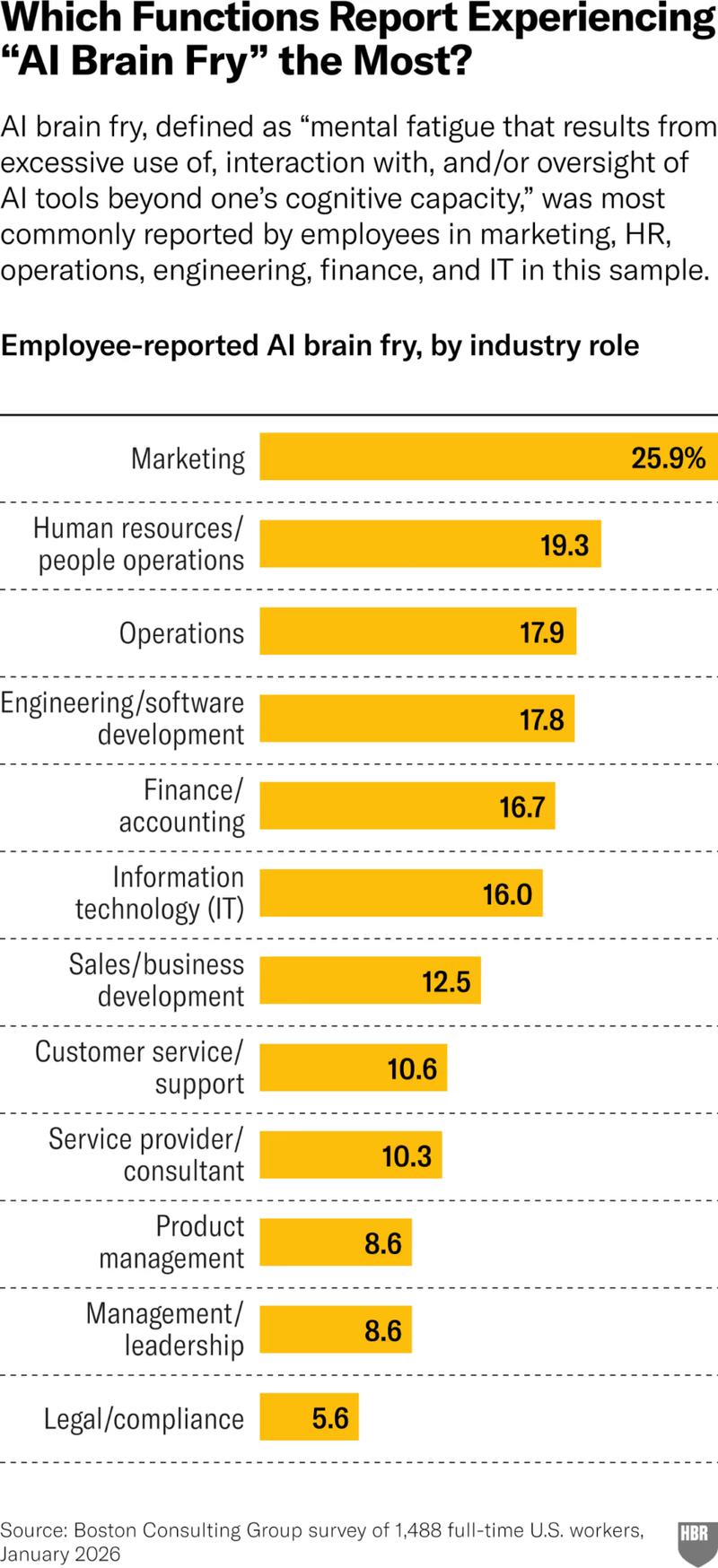
Research involving nearly 1,500 full-time US workers revealed that 14% said they had experienced "mental fatigue that results from excessive use of, interaction with, and/or oversight of AI tools beyond one's cognitive capacity," which the researchers termed "AI brain fry."
Survey participants described experiencing a "mental hangover" accompanied by a "fog" or "buzzing" sensation and an inability to think clearly, as well as headaches, slower decision-making, and difficulty focusing.
Companies developing AI have marketed their products as tools to enhance productivity, enabling workers to delegate portions of their workload, a proposition that certain organizations have adopted and begun tracking AI usage as a key performance indicator.
Brian Armstrong, CEO of cryptocurrency exchange Coinbase, has stated he fired engineers who didn't want to use AI, and established an objective late last year to have AI generate half of the platform's code.
"As enterprises use more multi-agent systems, employees find themselves toggling between more tools," according to the researchers. "Contrary to the promise of having more time to focus on meaningful work, juggling and multitasking can become the definitive features of working with AI."
AI carries "significant costs," but can improve burnout
According to the researchers, this AI-related mental exhaustion "carries significant costs in the form of increased employee errors, decision fatigue, and intention to quit."
Research participants reporting brain fry experienced 33% more decision fatigue compared to those who didn't, which researchers indicated could cost large companies millions of dollars a year. Workers experiencing AI brain fry were also around 40% more likely to have an active intent to quit.
Individuals reporting AI brain fry also self-reported making nearly 40% more major errors than those who did not, with a major error defined as one with "serious consequences, such as those that could affect safety, outcomes, or important decisions."
However, the researchers discovered that the use of AI to replace repetitive and routine tasks decreased burnout, a state of chronic workplace stress that leads to negative feelings about the job and decreased effectiveness.
Survey participants who used AI to reduce time spent on routine and repetitive tasks reported their levels of burnout were 15% lower than those who didn't use AI in such a way.
According to the researchers, company leaders seeking to reduce AI brain fry should "clearly define AI's purpose in the organization" and provide clarity on how workloads will change with the tool.
Organizations should also focus on "measurable outcomes" for AI, since "incentivizing quantity of use will lead to waste, low-quality work, and unnecessary mental strain."