US Basel III Framework Draws Bitcoin Regulatory Criticism from Pierre Rochard
The Bitcoin Bond Company's CEO Pierre Rochard has challenged US banking regulators over their Basel III overhaul, demanding transparency on how financial institutions should handle Bitcoin activities under the proposed framework.

The Bitcoin Bond Company's CEO, Pierre Rochard, has issued a warning to United States banking oversight agencies regarding their comprehensive Basel III capital framework revision, highlighting an important omission concerning the treatment of Bitcoin-related business activities. According to Rochard, this regulatory void has the potential to generate legal complications and influence the capital requirements banks face when dealing with the digital asset.
Through an official comment letter filed on March 29 with the US Federal Reserve, the Federal Deposit Insurance Corporation and the Office of the Comptroller of the Currency, Rochard emphasized that regulatory bodies cannot proceed with finalizing regulations that effectively establish capital treatment standards for Bitcoin (BTC)-related business operations without providing transparent explanations of the underlying framework and supporting evidence for such treatment.
The regulatory agencies' March 19 proposal package, designed to fundamentally restructure the current US banking capital framework, made no reference whatsoever to Bitcoin, cryptocurrency or digital assets. The comprehensive proposal addresses credit risk, market risk, operational risk and counterparty exposures specifically for the nation's largest banking institutions, yet creates ambiguity regarding how current regulatory categories should be applied to BTC holdings, lending operations, custody arrangements and derivative instruments.
This regulatory vacuum carries significant implications because the Basel framework already mandates stringent capital treatment requirements for particular unbacked cryptocurrency exposures, yet the US regulatory proposals fail to specify whether this existing framework will extend to Bitcoin-related business activities. This leaves banking institutions without clarity on the economic viability of custody services, lending programs, derivatives products and direct asset holdings.
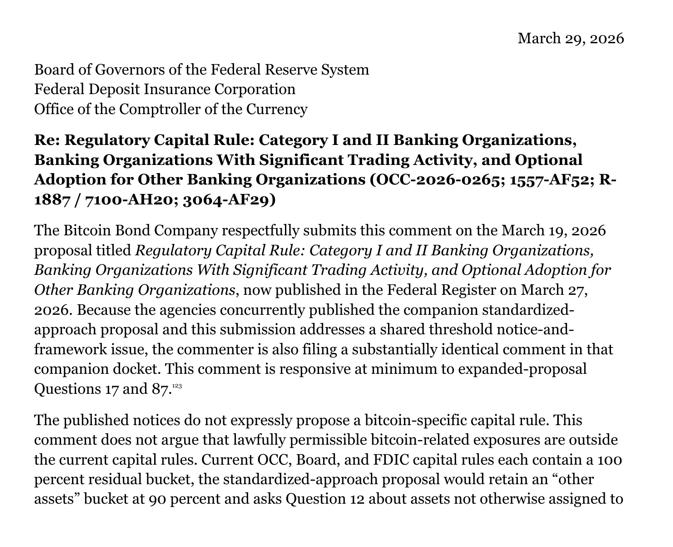
In his submission, Rochard contended that regulatory authorities cannot allow this critical issue to remain ambiguous and warned that a finalized regulation that implicitly establishes (or maintains) capital treatment standards for Bitcoin-related operations without providing explicit rationale could be susceptible to legal challenges.
Rochard presses regulators over Bitcoin treatment
His commentary referenced the Basel Committee's cryptocurrency asset framework, designated as SCO60, which mandates a 1,250% risk weight for unbacked crypto assets including Bitcoin. Rochard stressed that US regulatory agencies must provide clarification on whether they plan to implement this standard in its entirety, selectively apply specific components, or instead depend on pre-existing domestic capital classification systems.
Rochard observed that these same regulatory bodies have provided explicit guidance regarding other categories of digital assets in recent months. On March 5, the agencies released a frequently asked questions document on tokenized securities, specifying that qualifying tokenized securities should typically be subject to identical capital treatment as their traditional non-tokenized equivalents and confirming that the capital framework maintains "technology neutral" principles, thereby offering banks unambiguous direction on this matter. In stark contrast, no equivalent clarification has been provided regarding the appropriate treatment of Bitcoin exposures.
In the absence of such regulatory clarity, banking institutions face the challenge of determining how existing rules should be interpreted and applied to direct Bitcoin asset holdings, Bitcoin-backed lending arrangements, custodial service offerings and derivatives-based exposures, thereby amplifying uncertainty throughout the financial services sector.
Prior to the proposal's public release, certain industry analysts had anticipated that the revised proposal might potentially relax capital requirement standards and create opportunities for enhanced liquidity in Bitcoin-related banking activities.
"The fiat system should stop sabotaging itself. Bitcoin banking rules would improve bank net interest margins and lower interest rates for borrowers."
Pierre Rochard
Cointelegraph contacted Rochard seeking additional commentary on the matter, but did not receive a response prior to the time of publication.