Survey reveals European investors willing to change banks for enhanced cryptocurrency services
New research from Börse Stuttgart Digital reveals 35% of investors across Europe are prepared to migrate to financial institutions offering superior digital asset services, though regulatory challenges persist.

The availability of digital currency services is beginning to shape European investors' decisions when selecting banking providers, though ambiguous regulatory frameworks continue to present obstacles to widespread acceptance, new research indicates.
Research published Tuesday by Börse Stuttgart Digital revealed that 35% of investors across Europe would contemplate moving their accounts to alternative financial institutions if those providers delivered superior cryptocurrency investment opportunities, indicating that digital assets are beginning to play a role in customer banking decisions.
Almost 20% of those surveyed indicated they anticipate their primary banking institution to provide cryptocurrency access within the coming three years, based on the research, which examined approximately 6,000 investors across Germany, Italy, Spain and France. These results indicate that cryptocurrency is gradually becoming integrated into conventional banking services, particularly among investors who are already receptive to digital assets.
However, regulatory frameworks and insufficient education continue to represent the most significant barriers to widespread adoption, with 76% viewing crypto assets as inadequately regulated, while more than 60% express feeling inadequately informed regarding digital assets.
MiCA increased trust in digital assets for nearly half of European investors
Regulation from the European Union seems to be making progress in addressing these concerns. The Markets in Crypto-Assets Regulation (MiCA) from the EU became fully operational for crypto asset service providers on Dec. 30, 2024.
Close to half of the investors who participated in the survey indicated that the MiCA regulatory framework enhanced their confidence in digital assets, rendering them "safer and more attractive."
Trust and clear regulation are essential for the next phase of crypto adoption in Europe. With MiCAR bringing transparency and legal certainty, investors gain the clarity they expect.
Matthias Voelkel, CEO of Börse Stuttgart Group
These findings emerge at a time when conventional financial institutions throughout Europe continue gradually expanding their involvement in cryptocurrency markets. In January 2025, Börse Stuttgart Digital announced it had achieved the distinction of becoming the first German crypto asset service provider to obtain an EU-wide MiCA license via its custody subsidiary, establishing itself as a regulated infrastructure solution for banks, brokers and asset managers.
Spain leads European crypto adoption
Within the countries examined in the survey, Spain demonstrated the most elevated crypto adoption rate with almost 28% of investors currently holding digital assets. Germany secured second position with 25%, Italy came next with 24% and France with 23%.
Among the participants, 25% indicated they had previously invested in cryptocurrency, and 36% stated they are likely to make additional investments within the next five years, demonstrating "sustained interest despite market volatility," the report noted.
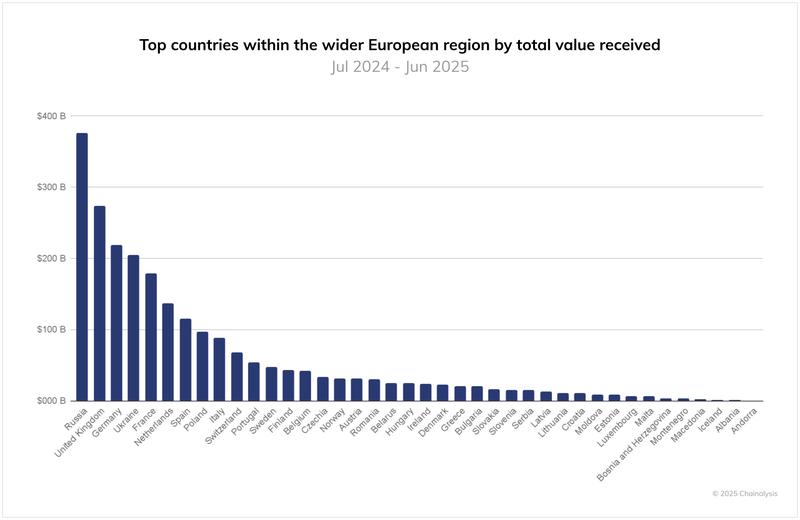
Based on a Chainalysis report released in October 2025, Russia possessed the most substantial crypto market throughout Europe with $376 billion in value received during the period from July 2024 to June 2025, followed by the United Kingdom with $273 billion and Germany with $219 billion.