Stablecoins May Replicate Traditional Financial System Weaknesses, ECB Official Cautions
Isabel Schnabel from the ECB's executive board cautioned that stablecoins might introduce money-market vulnerabilities to tokenized finance while strengthening the US dollar's global position.
Isabel Schnabel, an Executive Board member at the European Central Bank (ECB), has expressed concerns that stablecoins might introduce legacy financial-market weaknesses into the tokenized finance ecosystem, simultaneously bolstering the rationale for central banks to upgrade public money via instruments like the digital euro and tokenized central bank settlement mechanisms.
During a Monday address at the 2026 Bank of Korea International Conference on Central Banks and the Future of Money held in Seoul, Schnabel drew parallels between stablecoins and money market funds, contending that while both represent valuable financial innovation, they simultaneously introduce hazards related to bank disintermediation, potential runs, fire sales and challenges to monetary policy transmission mechanisms.
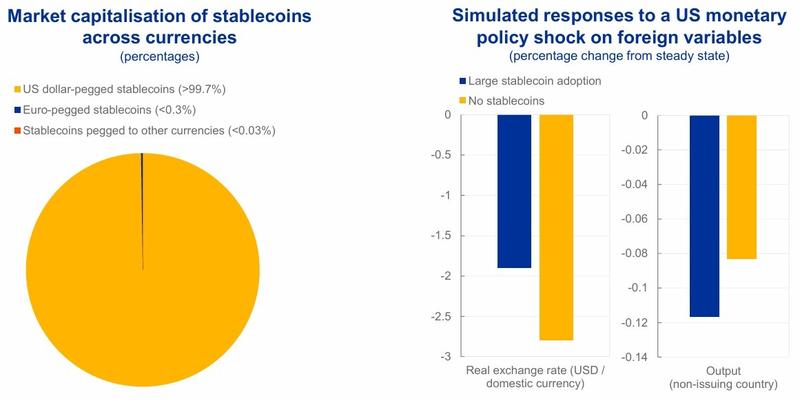
Schnabel further cautioned that stablecoins have the potential to amplify the US dollar's worldwide dominance as tokenized finance evolves. "The growing use of stablecoins may further cement the international dominance of the U.S. dollar," she said, adding that "virtually all stablecoins in circulation are denominated in dollars, with other currencies playing a negligible role."
According to Schnabel, the Eurosystem's strategy encompasses two primary components, which include a retail digital euro alongside tokenized wholesale central bank money. Last March, the ECB presented its Appia roadmap designed for Europe's tokenized financial markets, featuring Pontes which will deliver a distributed ledger technology settlement bridge connecting to the Eurosystem's TARGET services, with a planned launch scheduled for the third quarter of 2026.
Schnabel maintained that central banks must embrace rather than oppose innovation, while simultaneously modernizing public money through initiatives such as the digital euro and tokenized wholesale central bank settlement, thereby safeguarding financial stability and maintaining monetary control.
Central banks cannot remain passive observers of these developments. Private forms of money, once widely adopted, can shape the financial system in ways that can be difficult to reverse.
According to her assessment, the appropriate response involves not resisting innovation but rather guaranteeing its development occurs within a framework that maintains stability, monetary control and confidence in the currency.
MiCA review sharpens stablecoin debate
This address reinforces ongoing ECB communications suggesting Europe should not respond to dollar-denominated stablecoins merely by encouraging euro-denominated alternatives.
Speaking on May 8, ECB President Christine Lagarde stated that stablecoins do not represent Europe's optimal pathway for enhancing the euro's international standing, proposing instead that Europe should develop tokenized settlement infrastructure supported by central bank money.
This discussion is taking place as the European Commission conducts its review of the European Union's Markets in Crypto-Assets Regulation (MiCA), with a public consultation period remaining open until Aug. 31 to assess whether modifications to the bloc's cryptocurrency regulations are warranted.
Cryptocurrency exchange Coinbase has leveraged this review process to advocate for a more competitive EU cryptocurrency regulatory framework. In a blog post published Monday, Katie Harries, Coinbase's director and head of policy for Europe and the Americas, suggested that MiCA should adjust stablecoin regulations concerning reserves, rewards and multi-issuance, while providing clarification on how regulated crypto firms can facilitate access to decentralized finance and global liquidity.
Harries further contended that permitting additional reserves held in high-quality sovereign assets and allowing non-interest incentives, including cashback and loyalty points, might enhance the competitiveness of euro stablecoins.
The ECB, however, has adopted a more conservative stance. On May 23, the ECB alerted EU finance ministers that relaxing stablecoin regulations might undermine bank lending capacity and create complications for monetary policy implementation, even as policymakers continue debating whether Europe faces the risk of lagging behind dollar-backed tokens.