Stablecoin payments could surge to $262B by 2033 driven by AI-powered microbusinesses: Swyftx report
A new Swyftx analysis projects that microbusinesses powered by AI technology may drive $262 billion in yearly stablecoin transaction volume within the next decade.

Stablecoin transaction volumes stand to receive a substantial boost from microbusinesses powered by artificial intelligence, driven by expansion in the worldwide gig and freelance payment sector, according to findings from Australian cryptocurrency exchange Swyftx.
Within a quarterly industry analysis for the second quarter, Swyftx forecasted that the worldwide gig and freelance payments sector may expand to $2.1 trillion by 2033, with payment flows from AI-native workers representing $775 billion of that total. The exchange's baseline projection indicates that approximately $262 billion of the payment volume from this AI-native segment may be processed using stablecoins, predicated on an expected penetration rate of around 33%.
"We see the vibe-coding and AI economy as a significant potential tailwind for stablecoin use," Pav Hundal, lead market analyst at Swyftx, told Cointelegraph.
"Adoption doesn't happen just because the technology exists. It happens when the economics are compelling, and the rules are clear. For stablecoins, both of those conditions are now falling into place."
The market capitalization of stablecoins has experienced a doubling over the preceding two-year period and achieved an unprecedented $1.79 trillion in transaction volume during June, serving as a definitive signal of robust demand for payment utility applications.
Freelancers are driving the growth
According to Swyftx's analysis, the smallest enterprises, specifically those employing fewer than five individuals, have emerged as among the most rapid adopters of artificial intelligence technology, with this transition away from adoption by larger corporations giving rise to an emerging category of independent entrepreneurs.
These independent professionals conduct business across international boundaries, generate invoices with high frequency and process settlement amounts that existing traditional banking infrastructure and payment systems were never designed to accommodate efficiently, the report noted. Their current global population stands between six and 10 million individuals, with projections indicating growth to 17 million throughout the coming decade.
"A lot of these solo founders are going to be sensitive to remittance and transaction fees. It's a potentially chunky market for stablecoins," Hundal said.
The exchange further noted that should these forecasts materialize as anticipated, "the institutional settlement layer beneath this — over-the-counter liquidity, custody and yield services for the platforms routing these payments — could capture a significant new revenue stream."
The potential magnitude of this theoretical revenue opportunity may reach as high as $1.3 billion by 2033, calculated on the assumption of combined transaction, liquidity and custody expenses totaling 0.5%, the analysis added.
Traditional methods too slow and expensive
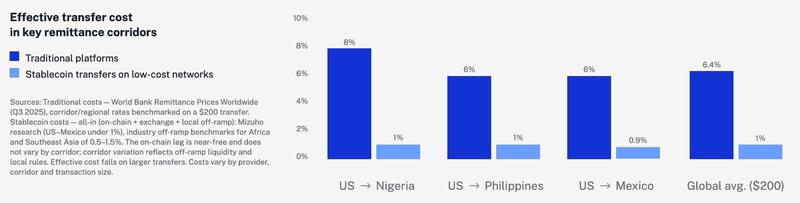
Conventional international payment infrastructure imposes elevated transaction costs, requires settlement periods spanning multiple days and prevents access for individuals located in more than 50 nations worldwide.
Transfers conducted via stablecoins utilizing Ethereum layer-2 blockchain networks have the capacity to reduce these transaction costs by 80% to 90%, delivering savings of approximately 86% annually in transfer expenses for the typical freelance worker, according to an illustrative scenario presented by Swyftx.
The emerging narrative around agentic AI payment systems represents another potentially significant catalyst for stablecoin transaction volume growth, given that artificial intelligence agents lack the capability to establish traditional bank accounts, making cryptocurrency assets the probable medium for their payment activities.