SOL Faces Pressure as Solana DEX Activity Hits Yearly Lows: Can $80 Support Level Hold?
A significant downturn in Solana's DEX trading volumes increases the possibility of SOL sliding to $75, though strong DApp revenue generation demonstrates the network's underlying strength.

Key takeaways:
- Solana demonstrates superior performance compared to Ethereum when measuring high-revenue DApps, offering fundamental support against recent price declines.
- The growing dominance of Ethereum Layer-2 networks presents challenges for SOL as market participants watch closely to see if the crucial $80 support level will be tested again.
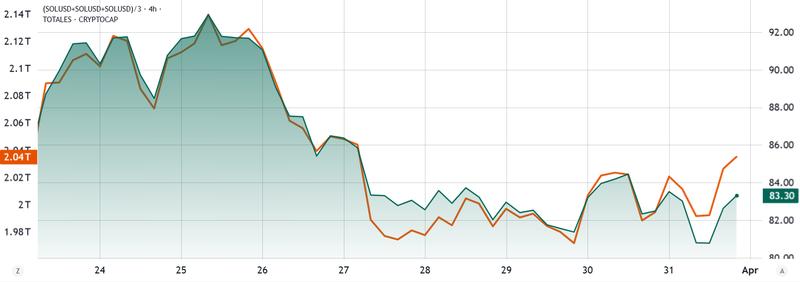
SOL, the native cryptocurrency of the Solana blockchain, experienced an 11% pullback after encountering resistance at the $93 price point last Wednesday. Over the previous week, SOL has underperformed relative to the wider crypto market, repeatedly challenging the $80 support threshold. Network fees on the Solana blockchain have similarly decreased throughout the last two months, prompting market participants to anticipate a possible retest of the $75 price level.
Solana's total value locked (TVL) currently registers at $6.3 billion, maintaining a substantial distance behind Ethereum's $54.1 billion figure. Nevertheless, Solana generated 80% more in network fees compared to its primary rival during the preceding 30 days. This disparity can be primarily attributed to Ethereum's strategy of incentivizing layer-2 rollup solutions, which leverage temporary data blobs to reduce transaction costs.
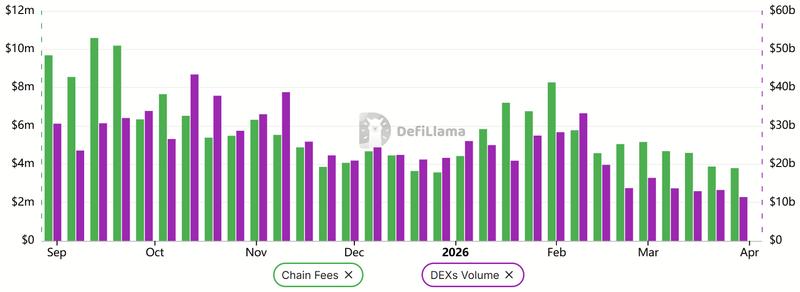
Throughout March, network fees on the Solana blockchain fell to $18.5 million, representing a 42% decline from the $30 million recorded in January. The majority of this reduction can be traced to diminished activity within decentralized exchange (DEX) trading volumes. While Solana continues to lead in absolute volume measurements, DEX trading activity on the network plunged to $55.5 billion, marking the lowest point since September 2024, based on data from DefiLlama.
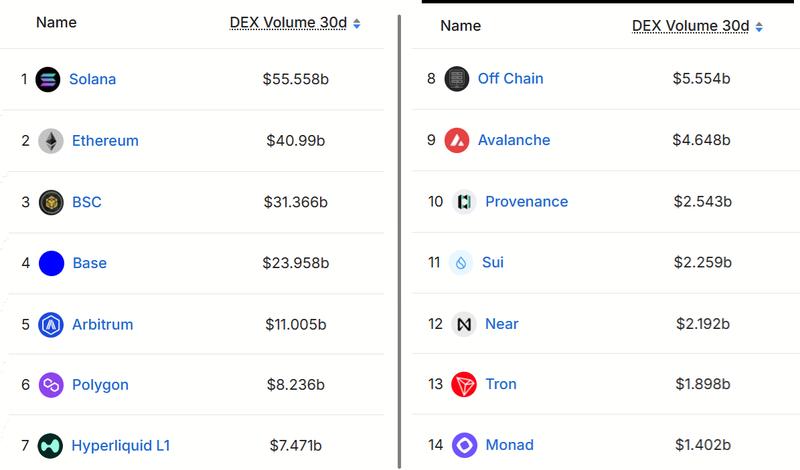
By contrast, Ethereum's DEX volumes reached $41 billion throughout March, declining 23% compared to levels from two months earlier. More significantly, when combining the volumes from Ethereum layer-2 blockchains such as Base, Arbitrum, Polygon, and Optimism, Ethereum's share of the DEX market surged to 42% in March from 33% recorded in January. The gradual erosion of Solana's market dominance offers a partial explanation for SOL's present bearish price action.
Solana DApps revenue could solidify SOL's $80 support level
Despite the downward trend in DEX volumes on Solana, the network remains unmatched in terms of the quantity of DApps generating $1 million or greater in revenue over a 30-day period. This metric provides a compelling incentive for developers to build on Solana, establishing opportunities for users to earn returns via protocols including Pump, Helium Network and ORE Protocol. Given that protocol revenue generation attracts investor interest, maintaining a robust ecosystem continues to be critically important for SOL's potential price appreciation.
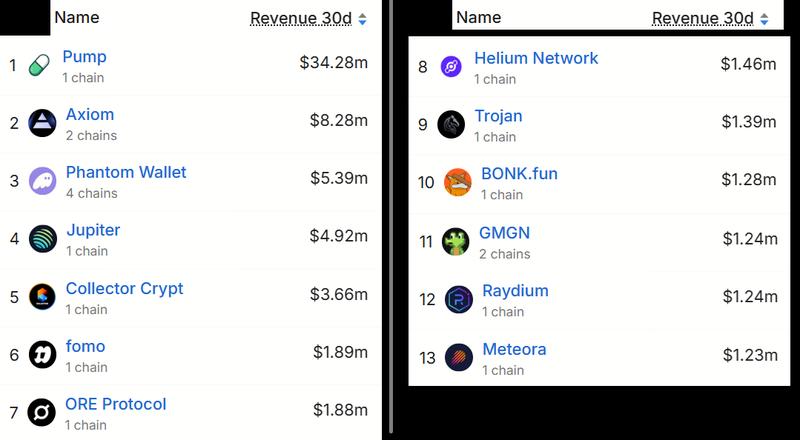
With 13 DApps achieving $1 million or more in revenue during the past 30 days, Solana maintains its leadership position. In comparison, the second-place Ethereum recorded 11 DApps, whereas BNB Chain and Base each accounted for 4 DApps with $1 million or above in monthly revenue. Consequently, there exists minimal evidence suggesting that SOL's price is destined to retest $75 purely based on reduced network fees stemming from weakened DEX volumes.
While DEX activity represents a significant contributor to network fee generation, the long-term viability of protocols operating within the Solana ecosystem illustrates that SOL remains far from being abandoned by the investor community.