Robinhood's Layer-2 Network Attracts More Than $70M in Bridged ETH Within Initial Seven Days
According to HashKey Group's Tim Sun, Robinhood's decision to build on Ethereum reinforces the network's status as the "ultimate settlement layer and liquidity foundation for tokenized assets."
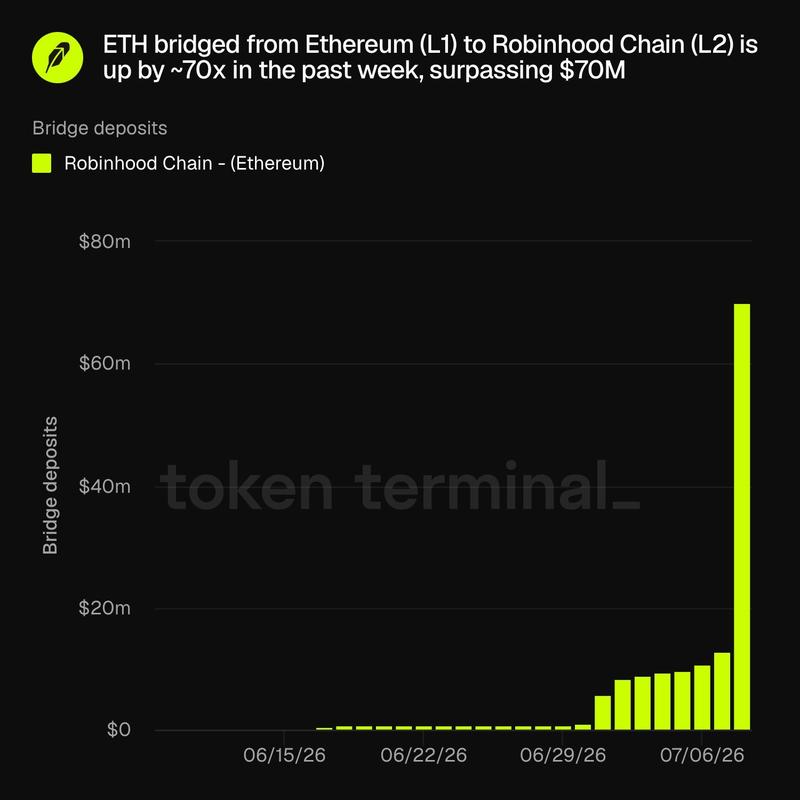
In its inaugural week, Robinhood's recently launched layer-2 blockchain saw Ether bridging volumes surpass the $70 million mark, data from Token Terminal reveals.
Launching on July 1, Robinhood Chain represents an EVM-compatible layer-2 network built on Arbitrum technology that employs ETH as its primary gas token. The company has characterized the network as "AI-native and purpose-built for real-world assets."
Token Terminal noted on Thursday that "If adoption continues, the chain could become a meaningful new source of demand for ETH."
The platform has additionally rolled out tokenized stocks for its customer base spanning over 120 countries, addressing the escalating appetite for tokenized US equity instruments. According to data from RWA.xyz, Ethereum alongside its layer-2 scaling solutions has emerged as the preferred infrastructure for tokenized real-world assets (RWA), commanding over 50% of the market, and Robinhood's strategic decision may further entrench this dominance.
Turning liquidity into economic activity
In a separate communication posted on X, Token Terminal stated that "Robinhood Chain is rapidly turning liquidity into economic activity."
Within its first seven days of operation, Robinhood Chain achieved 194,000 daily active users while generating daily revenue of $39,000, which translates to an annualized revenue projection of $14 million, the analytics platform reported.
Data from DefiLlama, a platform specializing in decentralized finance analytics, presents comparable metrics, indicating that Robinhood Chain has accumulated a total value locked of 46,748 ETH, approximately $83 million based on prevailing market valuations. On Thursday alone, inflows amounted to 31,855 ETH, representing roughly $55 million.
Hayden Adams, the founder of Uniswap, observed on Friday that the majority of activity occurring on Robinhood Chain is ETH-denominated.
Adams further elaborated, "It's the base pair for trading, the highest volume asset, and the gas token to pay for blockspace. It also burns ETH on L1 to pay data storage fees."
In a statement to Cointelegraph, Andri Fauzan Adziima, who serves as research lead at Bitrue Research Institute, characterized the development as "strongly bullish," noting that the initial volume figures "validates the L2 flywheel" as a "meaningful new demand sink."
"By using ETH as the native gas token on this high-velocity Arbitrum L2, every transaction I track creates direct, recurring demand while locking capital and onboarding Robinhood's massive user base."
Tim Sun, a senior researcher at HashKey Group, described the development as "a clear, structural positive for ETH."
Sun explained, "For Ethereum, the most direct benefit is that Robinhood Chain uses ETH for gas." He continued, "As bridged assets, wallet addresses, and on-chain transactions grow, new demand for ETH is generated."
"However, the deeper significance lies not just in how much gas is consumed, but in Robinhood's choice to build its own on-chain financial ecosystem within the Ethereum network. This further solidifies the Ethereum mainnet's position as the ultimate settlement layer and liquidity foundation for tokenized assets."
Market optimists contend that Ethereum's long-term value proposition is anchored in RWA tokenization, agentic AI payments, institutional adoption and network upgrades, such as Glamsterdam, expected before the end of 2026, which is expected to increase layer 1 capacity.
On Friday, ETH prices experienced an uptick to $1,775, though they continue to languish at multi-year bear market lows, representing a 64% decline from their August 2025 peak.