Oobit Brings Tether-Supported Crypto Payment Solution to Colombian Market
Colombia becomes the latest market for Oobit's cryptocurrency payment platform, backed by Tether, as Latin American consumers increasingly adopt stablecoins for daily transactions.


The Tether-backed cryptocurrency payments provider Oobit has introduced its platform to Colombia, marking another step in the company's regional expansion throughout Latin America.
According to the company's statement, Colombia represents the ninth active market for its operations and comes after previous launches in nations such as Brazil, Argentina and Chile. The announcement referenced Chainalysis statistics indicating that the Colombian peso holds the second position worldwide when measuring the proportion of centralized exchange stablecoin acquisitions by individual currency.
The platform offered by Oobit functions as a non-custodial cryptocurrency payment solution, enabling customers to utilize digital currencies straight from their personal wallets via a Visa-connected payment infrastructure that merchants accept at over 150 million locations spanning more than 80 countries worldwide, the company reports.
Customers are able to make purchases with cryptocurrency directly from their digital wallets, eliminating the need to transfer assets through conventional banking off-ramp services.
According to Oobit's data, the platform has witnessed activity levels in Brazil surge by over 200% following its launch in that country during November 2024, with regular users making purchases averaging approximately $400 monthly through roughly 20 separate transactions.
The platform's transaction data reveals that USDT (USDT) represents the highest volume of activity, surpassing both Oobit's proprietary token and USDC (USDC) in terms of usage. Shopping at grocery outlets and supermarkets comprises 35% of all platform activity throughout its Latin American operations, with restaurants, food retailers and department stores following in transaction frequency.
Brazilian platform users have additionally utilized cryptocurrency for purchases at fuel stations, beauty establishments and consumer electronics stores, the company noted.
Crypto payments expand across emerging markets
Digital assets including stablecoins are experiencing growing adoption for routine purchases and consumer payment activities throughout developing market economies.
During April, Mercado Libre, which operates Latin America's most prominent online commerce platform, introduced stablecoin-powered money transfers connecting Brazil, Mexico and Chile through its proprietary Meli Dollar token. According to the company, this stablecoin has functionality within Mercado Libre's broader marketplace platform and can be allocated to customers as cashback rewards.
This growth arrives as stablecoin utilization experiences rising momentum throughout the region. According to a 2025 analysis published by Bitso, stablecoins pegged to the US dollar represented 40% of cryptocurrency acquisitions on the platform during 2025, exceeding Bitcoin's (BTC) 18% portion by more than double. The cryptocurrency exchange indicated this pattern demonstrates increasing stablecoin implementation for payment processing and additional routine financial activities across the Latin American region.
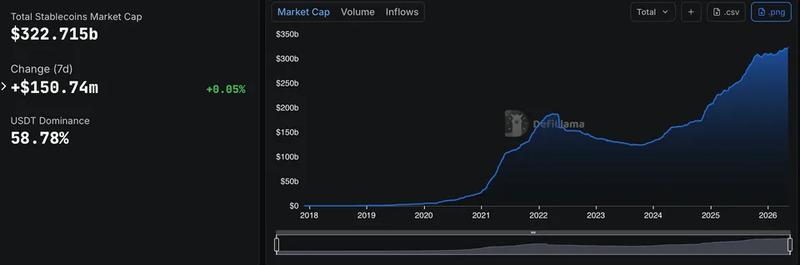
Information compiled by DefiLlama indicates the stablecoin marketplace has expanded from roughly $243 billion one year prior to exceeding $322 billion at present.
Bitcoin is also finding application as a direct payment method in certain developing market regions. Africa Bitcoin Corporation executive chairman Stafford Masie stated during a March appearance on the Coin Stories podcast that BTC serves as regular currency in various African locations, characterizing local commercial environments where business owners process payments directly in satoshis rather than using dollars or domestic currencies.