Oil Crisis Sparks Major Bitcoin Turbulence: Five Key Market Developments This Week
As tensions escalate between the US and Iran, Bitcoin encountered dual death crosses and witnessed the complete collapse of its attempted rally toward $74,000 entering the second week of March.

As March's second week commences, Bitcoin (BTC) finds itself in a precarious position, with market attention squarely on Middle Eastern developments.
- The cryptocurrency wiped out its most recent breakout effort and concluded the weekly session beneath critical resistance levels.
- Volatility in crude oil markets and resulting inflationary concerns dominate trader focus this week.
- Two fresh death crosses have emerged for Bitcoin, delivering a stark cautionary signal to bullish investors.
- Futures and options markets hint that a more comprehensive Bitcoin price reversal could be on the horizon.
- Large holders demonstrated minimal enthusiasm for taking profits during the climb to $74,000.
Bitcoin returns to a "monotonous bear market"
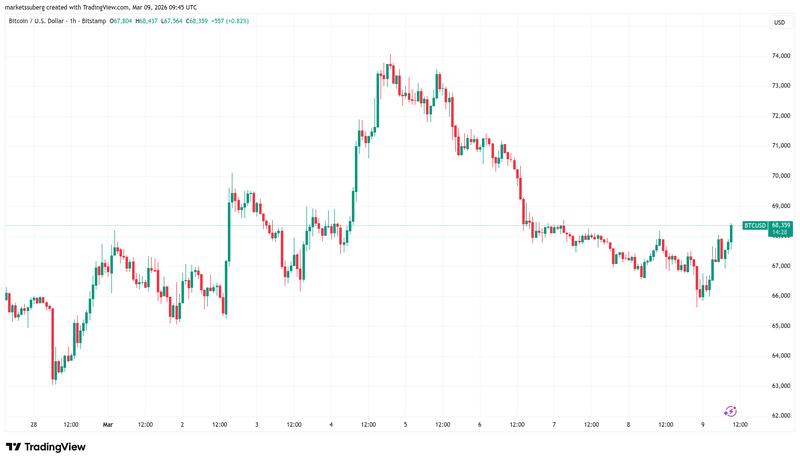
Sellers of Bitcoin exerted maximum pressure to drive prices downward heading into Sunday's weekly closure, with the BTC/USD pair approaching $65,600 on the Bitstamp exchange.
Information from TradingView showed a subsequent recovery, though this proved insufficient to prevent a weekly settlement beneath a crucial long-term trendline.
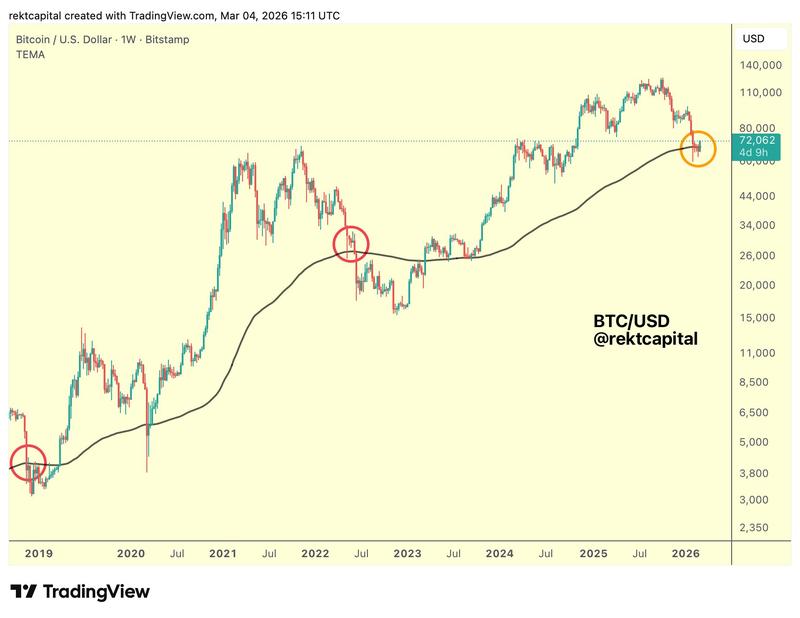
According to Cointelegraph's previous coverage, the 200-week exponential moving average (EMA) holds special importance throughout bearish market cycles, since its failure as a support level suggests additional downward market movement.
"Bitcoin has now nearly completely reversed its gains from the beginning of this week," commented trader and analyst Rekt Capital in a post on X addressing the situation.
"The 200-week EMA remains a resistance barrier for price action unless demonstrated otherwise."
Rekt Capital was referencing Bitcoin's surge to $74,000 during widespread risk-asset turbulence attributed to escalating Middle East tensions.
"The deviation led to a rapid weekend selloff as anticipated. The $BTC perspective stays the same; we're experiencing a monotonous bear market until evidence suggests otherwise," trader Jelle added.
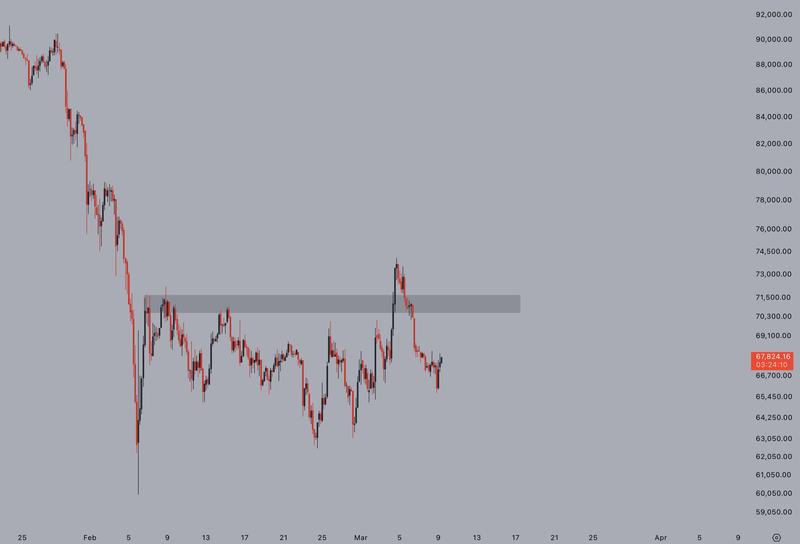
While market observers await directional signals, crypto trader, analyst and entrepreneur Michaël van de Poppe interprets the prevailing BTC price behavior as considerably better than worst-case projections.
"Bitcoin continues to be range-bound. This isn't negative, it's actually remarkably resilient, considering: - Oil surged 15% again this Monday morning, reaching the highest point since '22. - Gold and commodities are experiencing declines - Nasdaq suffered substantial losses," he communicated to his X audience on Monday.
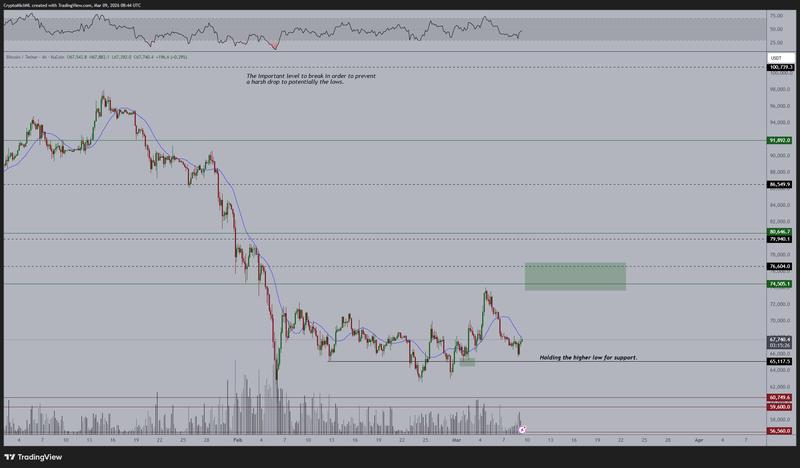
According to Cointelegraph's reporting, extended-timeframe BTC price forecasts persistently indicate a macroeconomic floor around $50,000 or beneath that threshold.
Crude oil instability emphasizes US inflation concerns
The upcoming week's US macroeconomic releases will undoubtedly receive heightened scrutiny as geopolitical disruption triggers inflation alerts.
February's Consumer Price Index (CPI) reading, alongside postponed Personal Consumption Expenditures (PCE) figures from January, are scheduled for release, along with updated US Q4 GDP statistics.
Despite PCE being recognized as the Federal Reserve's "favored" inflation metric, CPI currently commands attention due to its sensitivity to crude oil pricing.
The current oil supply disruption centered on the Strait of Hormuz likely won't be captured in February's CPI data, whereas January's index measurement registered below expectations.
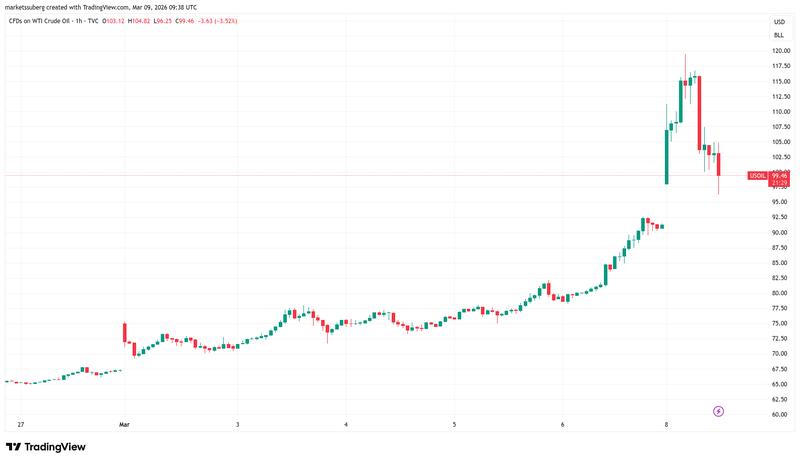
Offering commentary, trading resource The Kobeissi Letter characterized the Hormuz blockage as the most significant supply interruption in history.
"The present supply disruption equals approximately the size of the top 2-6 events COMBINED," it determined, with daily reductions exceeding 20 million barrels.
Nevertheless, oil prices moderated their sharp ascent on Monday following G7 nations' proposal of an emergency strategic petroleum reserve deployment potentially totaling 400 million barrels.
Further elaborating, trading resource Mosaic Asset Company highlighted the oil emergency's extended-term ramifications for the Federal Reserve.
Mosaic observed that an earlier surge in commodity markets aligned with the 2022 CPI peak of 9%.
"The increase in other inflation-sensitive categories such as energy producers is telegraphing expectations regarding the probability of escalating inflation as well," it noted.
Bitcoin death crosses begin to accumulate
Beyond Bitcoin's inability to maintain its 200-week EMA trendline as support through the weekly closure, the asset also experienced an additional "death cross."
The 21-week simple moving average (SMA) crossed below its 100-week counterpart as the week concluded, creating a traditional bearish indicator that reinforces the likelihood of additional BTC price deterioration.
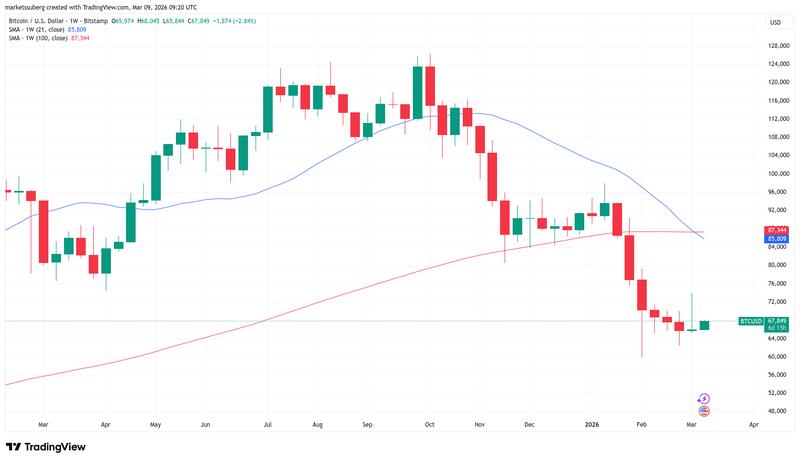
During the previous week, Keith Alan, cofounder of trading resource Material Indicators, proposed that the approaching death cross would supersede any relief rally toward the upper boundary of the current trading range.
More precisely, Alan indicated that the cross would "probably serve as a precursor to the subsequent downward leg unless we receive a significant bullish catalyst."
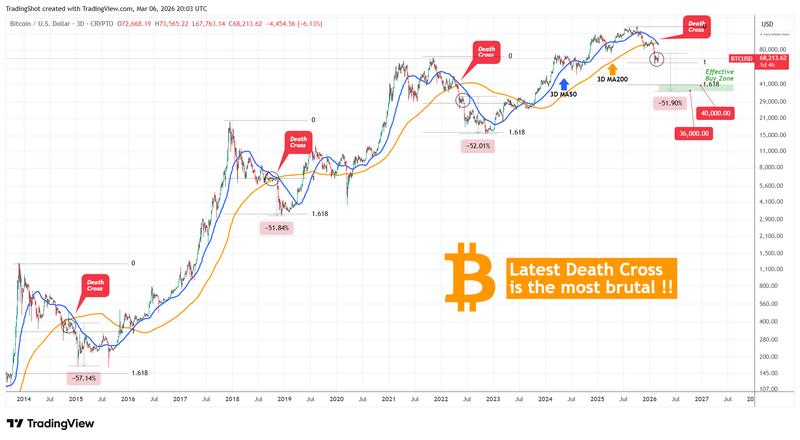
Meanwhile, market observers express apprehension regarding a death cross on shorter timeframes: specifically, the 50-period and 200-period SMA intersection on the three-day chart.
In current analysis, trading platform TradingShort cautioned that bear-market death crosses occurring on three-day timeframes have historically produced 50% BTC price declines.
"Considering that it has additionally tested on two out of three previous Bear Cycles the 1.618 Fibonacci extension measured from the point of that Death Cross, Bitcoin ought to be aiming for the $40000 - $36000 Zone," it communicated to X followers.
Derivatives markets suggest bullish recovery
Searching for indications of a market reversal, blockchain analytics platform CryptoQuant has uncovered potentially encouraging news for Bitcoin bulls during this week.
Within its most recent analysis, CryptoQuant identifies a reversal formation developing on leading exchange Binance's derivatives marketplace.
The Binance Derivatives Market Index, which aggregates multiple market indicators to generate a comprehensive momentum perspective, is presently replicating local BTC price troughs from 2024 and 2025.
"The index lately declined to approximately 0.35, a threshold comparable to observations from July–August 2024, and beneath the 0.43 registered in April 2025," contributor Amr Taha outlined in a "Quicktake" blog entry.
"In the past, measurements approaching these thresholds have frequently emerged during significant Bitcoin market bottoms, preceding price advancement toward fresh highs."
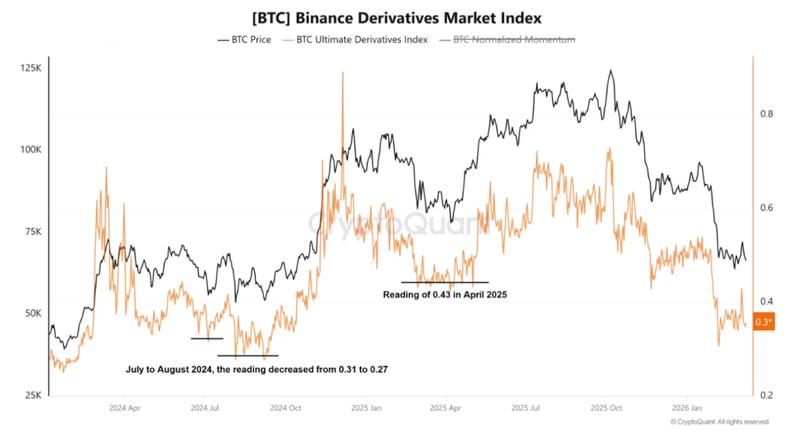
Taha recognized that the pattern might not unfold identically to prior instances, but emphasized that derivatives momentum had "deteriorated substantially."
Large holders remain inactive above $70,000
Panic-driven Bitcoin selling appears confined to speculators at present price levels as whale entities transmit progressively fewer BTC to trading platforms.
CryptoQuant discloses that on March 7, an increase in deposits to Binance originated predominantly from coins that had previously circulated within the preceding week.
This stands in contrast to a deposit occurrence from February, wherein coins dormant throughout the past six to 12 months reentered Binance wallets.
"Such transfers are frequently understood as a potential change in market sentiment among particular investor cohorts, where certain holders may be positioning to liquidate or protect their holdings," Taha clarified.
"In numerous instances, deposits originating from older coins may indicate an increasing degree of wariness or pessimism within segments of the market."
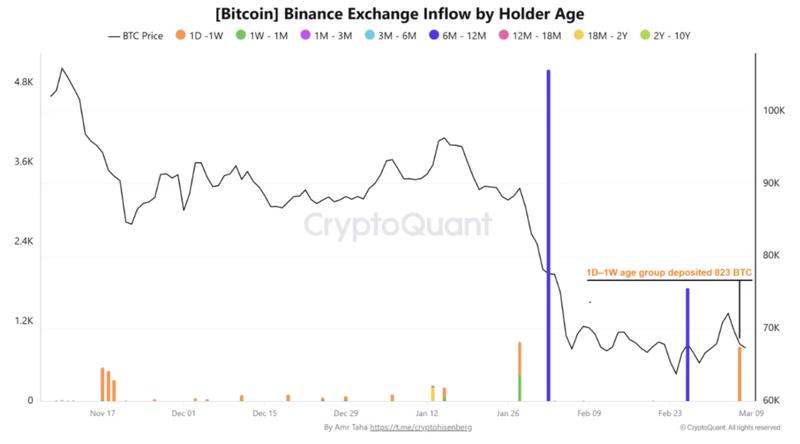
However, as BTC/USD crossed above $70,000 during the previous week, Bitcoin whales restrained their profit-taking impulses, as demonstrated by their Binance deposit activity.
Throughout March 1 to March 8, whale deposits contracted from $8.8 billion to $6.6 billion, according to CryptoQuant metrics.
"Notably, this decrease transpired while Bitcoin price oscillated between $65,000 and $72,000, demonstrating that major investors were not amplifying exchange transfers despite persistent market volatility," Taha concluded.