Market sentiment indicator shows persistent 'extreme fear' in crypto - could this signal opportunity?
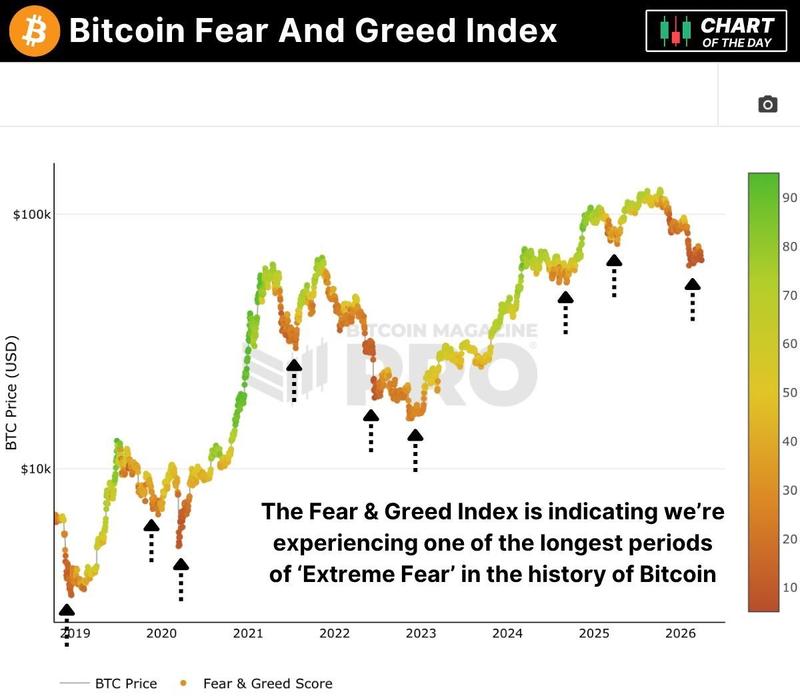
Despite the Crypto Fear and Greed Index holding steady in 'extreme fear' territory, Bitcoin's extended period of consolidation above $60,000 could indicate underlying strength.

Currently showing a score of 11, the Crypto Fear and Greed Index displays "extreme fear" sentiment and has maintained this status for a continuous 12-day period. While a short-lived uptick occurred during the March 17-18 timeframe, the indicator has been locked in "extreme fear" territory since the end of January, specifically Jan. 28.
Market participants leverage this index as a contrarian signal to gauge overall investor sentiment, as its calculation incorporates multiple data streams including volatility metrics, trading volume, social media trends and market momentum indicators.
Through this contrarian lens, historical bull and bear cycles have shown traders treating "extreme fear" signals as potential entry points for purchasing at reduced prices, though considering the persistently bearish market environment since the start of January, questions arise about whether this traditional signal remains reliable under current circumstances.
Crypto analyst Rand Group highlighted on X a notable divergence between how investors feel and where Bitcoin price currently stands. The post explains that investor anxiety has remained heightened driven by geopolitical factors including US and Israel-Iran conflict news alongside growing concerns about US interest rate increases, yet a potentially encouraging sign emerges in that despite these negative conditions persisting, there has been no corresponding uptick in Bitcoin sell-side pressure.
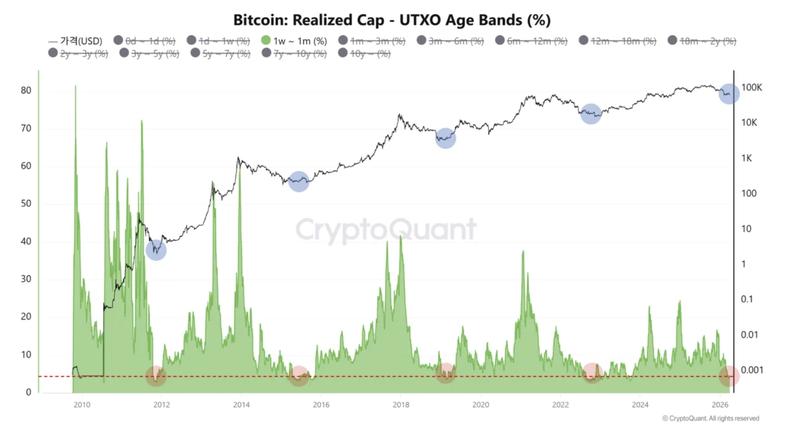
Meanwhile, blockchain data points toward a more stable market environment. According to crypto analyst MAC_D, the proportion of short-term holders, specifically those maintaining positions between one week and one month, has declined to 3.98%. Historical market cycle analysis reveals that when this metric falls beneath 4%, it has typically corresponded with phases where the market was approaching or establishing a price floor.
This decrease in short-term holder activity translates to diminished rapid trading behavior and reduced speculative interest from those engaging in day trading strategies. With long-term holders now commanding a greater percentage of the total supply, this shift points toward an ongoing accumulation pattern taking shape in the market.
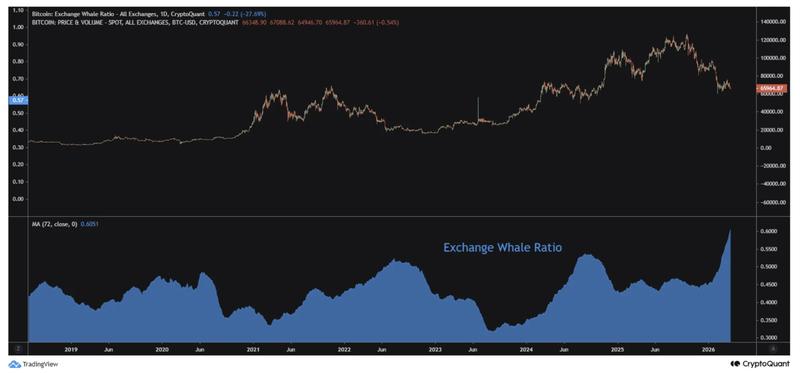
Significant Bitcoin holders remain the primary drivers of market flows, with crypto analyst CW8900 observing that the BTC exchange whale ratio has surged past 60%, marking the most elevated reading witnessed in ten years. Simultaneously, retail investor participation has diminished, dropping to its smallest proportion during this same timeframe. The analyst further commented,
"In general, the bottom appears when the whale ratio is at its highest. We are currently at the point where the ratio of retail investors is at its lowest in the last 10 years."
Analyst says Bitcoin has lost its strength against equities
According to Bitcoin researcher Axel Adler Jr., the near-term correlation between Bitcoin and the S&P 500 index has deteriorated, evidenced by the 13-week correlation metric dropping into negative territory below the zero line.
Throughout 2026, the BTC to S&P ratio has exhibited a downward trajectory, reflecting Bitcoin's continued underperformance when measured against equity markets. While market volatility has persisted at elevated levels, Bitcoin has experienced price declines that exceed those observed in stock markets.
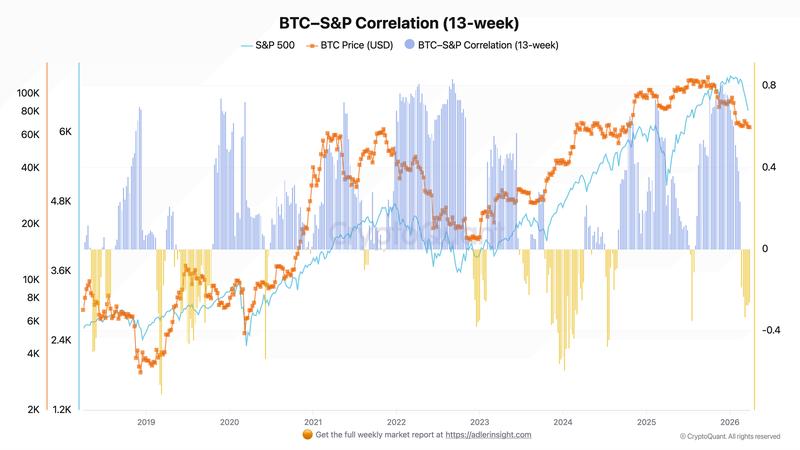
Additionally, the BTC price surge reaching $76,000 on March 17 ultimately proved unable to transform into a durable upward movement. Given the limited engagement from smaller market participants, this performance ratio indicates that BTC is presently being perceived as an asset with higher risk characteristics compared to conventional market investments.
This divergence from traditional equity markets, when viewed alongside the ongoing "extreme fear" phase, could potentially indicate a favorable entry opportunity for BTC market participants.
While Bitcoin's performance relative to the S&P 500 appears weak on the surface, examining the foundational data reveals an alternative narrative. BTC sell-side pressure has remained stable despite negative market developments, while whale accumulation has intensified as retail market participants withdraw from positions.
Collectively, these indicators point toward the possibility that Bitcoin may be silently transitioning into an accumulation phase.