Increased Stablecoin Velocity May Limit Future Supply Needs, Standard Chartered Reports
The velocity of stablecoins has experienced a twofold increase over the last two years driven by artificial intelligence payment systems and expanding traditional finance applications, yet Standard Chartered maintains its projection of a $2 trillion market valuation.

According to analysts at Standard Chartered, the acceleration in stablecoin velocity could diminish the requirement for additional token issuance despite growing transaction volumes across the ecosystem.
The velocity of stablecoins has experienced a twofold increase throughout the previous two-year period, fueled by emerging payment applications and growing participation from traditional finance (TradFi) entities, according to a Tuesday research report from Standard Chartered that was reviewed by Cointelegraph.
The term velocity describes the frequency with which stablecoins circulate in relation to their total outstanding supply, indicating that accelerated turnover rates can accommodate increased transaction volumes without necessitating proportional growth in the supply base.
"If velocity remains constant, rising transactions will create demand for more stablecoins, but if it increases, that will not be the case,"Standard Chartered's head of crypto research, Geoff Kendrick, said.
Notwithstanding the potential implications for demand dynamics, the financial institution continues to uphold its projection that the stablecoin marketplace will achieve a valuation of $2 trillion by the conclusion of 2028, Kendrick said.
Trend challenges earlier assumptions on stablecoin usage
This discovery represents a departure from Standard Chartered's previous projections that stablecoin velocity would maintain relatively consistent levels as the market underwent expansion.
"If velocity increases, however, that would be assumed to reduce the need for the total number of stablecoins required,"Kendrick said.
According to the analyst, the acceleration in velocity "so far appears" to demonstrate a progressive transition in how stablecoins are being utilized toward emerging applications, particularly high-velocity traditional finance substitution and transactions related to artificial intelligence.
According to Kendrick, existing use cases such as savings vehicles in emerging markets have not experienced any uptick in velocity metrics.
USDC leads velocity spike, while USDT remains tied to savings use
The pronounced increase in stablecoin velocity, which has reached turnover rates of no less than six times monthly on average, has been predominantly propelled by Circle's USDC (USDC), which holds the position of second-largest stablecoin measured by market capitalization, trailing only Tether's USDt (USDT).
The velocity of USDC started its upward trajectory during the middle of 2024 throughout all blockchain networks, with particular prominence on Solana and Base, underscoring a transition toward traditional finance applications as well as nascent AI agentic payment systems on platforms including Coinbase-backed x402.
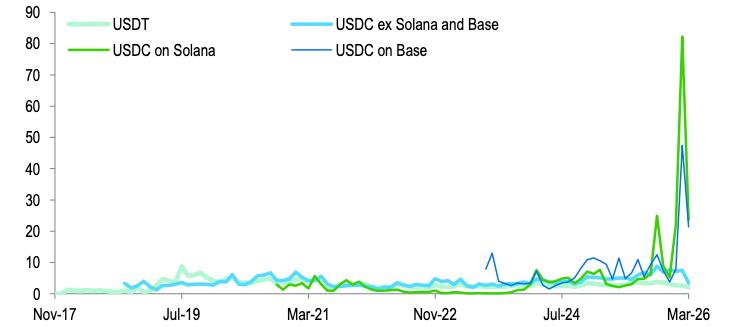
By comparison, the velocity of USDT has maintained relatively subdued levels, which reflects its more dominant presence in the lower-velocity use case of emerging market savings mechanisms, Kendrick said.
"In other words, the two market leaders appear to have different strengths by use case — EM savings for USDT and TradFi replacement for USDC,"he added.