Federal Reserve's Barr References 1907 Financial Crisis While Cautioning on Stablecoin Regulation
Federal Reserve Governor Michael Barr noted that more transparent US regulations might facilitate market expansion, while cautioning that the GENIUS Act's rollout needs to protect against bank runs, insufficient reserves and illegal financial activity.

On Tuesday, Michael Barr, Governor of the United States Federal Reserve, stated that enhanced regulatory clarity for US stablecoins has the potential to accelerate market expansion, while simultaneously cautioning that oversight bodies must continue to tackle challenges related to money laundering threats, the possibility of bank runs, and protections for consumers during the rollout of the Guiding and Establishing National Innovation for US Stablecoins (GENIUS) Act.
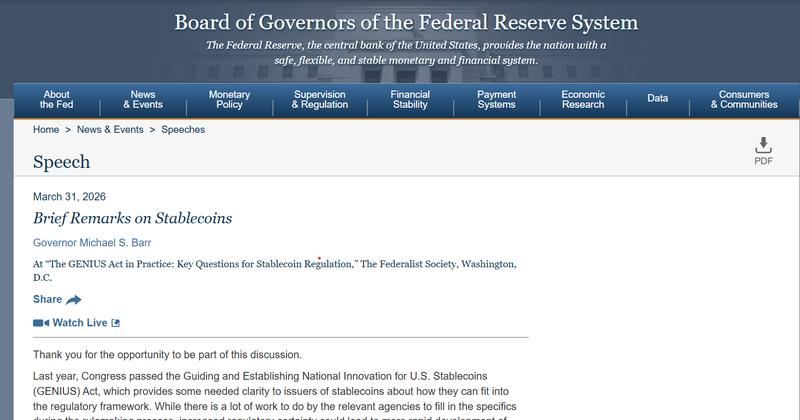
During his address at an event hosted by the Federalist Society focused on stablecoin oversight, Barr indicated that the legislation offers "needed clarity" to those issuing stablecoins, though he emphasized that "a great deal will depend on how federal and state regulators implement the statute."
According to Barr, stablecoins continue to be utilized predominantly for cryptocurrency trading purposes and as a vehicle for storing US dollar value in certain international markets, although they possess the capability to reduce costs associated with remittances, accelerate the processing of trade finance transactions, and assist companies in managing their treasury functions. He additionally drew attention to the danger of malicious entities purchasing stablecoins through secondary markets without undergoing identity verification processes, and expressed concern that issuers might be incentivized to pursue higher yields in their reserve asset strategies in manners that could erode confidence when market stress occurs.
These comments from Barr arrive at a time when federal agencies in the United States are transitioning from the legislative phase to the rule-making process. The Department of the Treasury in the United States initiated a second period of public consultation regarding the implementation of the GENIUS Act during September 2025, emphasizing that the legislation requires conversion into regulatory frameworks that simultaneously promote innovation while addressing concerns around illegal finance, consumer safeguards and risks to financial stability.
Michelle Bowman, who serves as the Federal Reserve's Vice Chair for Supervision, informed members of Congress in February that regulatory authorities overseeing the banking sector were already engaged in developing capital requirements and liquidity standards for entities issuing stablecoins, while Travis Hill, the chair of the Federal Deposit Insurance Committee, stated in March that the agency anticipates stablecoins will not qualify for deposit insurance protection under the provisions of the law.
Barr warns GENIUS Act rollout will test stablecoin safeguards
The speech delivered by Barr provides insight into where conflicts during implementation may emerge. He identified regulations governing reserve assets, the potential for regulatory arbitrage, the range of activities that issuers may engage in beyond the act of issuance itself, requirements for capital and liquidity, Anti-Money Laundering (AML) verification procedures, and standards for consumer protection as the primary issues that remain unresolved.
The GENIUS Act, which became law following its signing on July 18, 2025, established a federal regulatory structure for payment stablecoins within the United States. The legislation mandates that issuers maintain backing on a one-to-one basis using reserve assets including US dollars and Treasury bills, with the law anticipated to become effective either 18 months following its signing or 120 days after the completion of final rules by relevant agencies.
In his speech, Barr also framed the discussion surrounding stablecoins within a historical context. He characterized private money as having a "long and painful history" in circumstances where protective measures are insufficient, referencing the Free Banking Era in the US, the Panic of 1907, the stress experienced by money market funds throughout the global financial crisis and during the COVID-19 shock, along with more recent instances of stablecoin valuation pressure as justification for exercising caution regarding any asset that is promoted as being redeemable at par value upon demand.