EU's MiCA Transitional Window Closes July 1, Forcing Crypto Platforms to Choose
As the EU's MiCA grace period concludes on July 1, cryptocurrency businesses must secure proper authorization or discontinue services to European Union customers, a move that could impact millions of active users.

The Markets in Crypto Assets Regulation framework introduced by the European Union reaches a critical threshold on July 1, marking the conclusion of its transition phase and mandating that crypto asset service providers currently operating under legacy national frameworks must either secure MiCA authorization or cease providing services to clients across the EU.
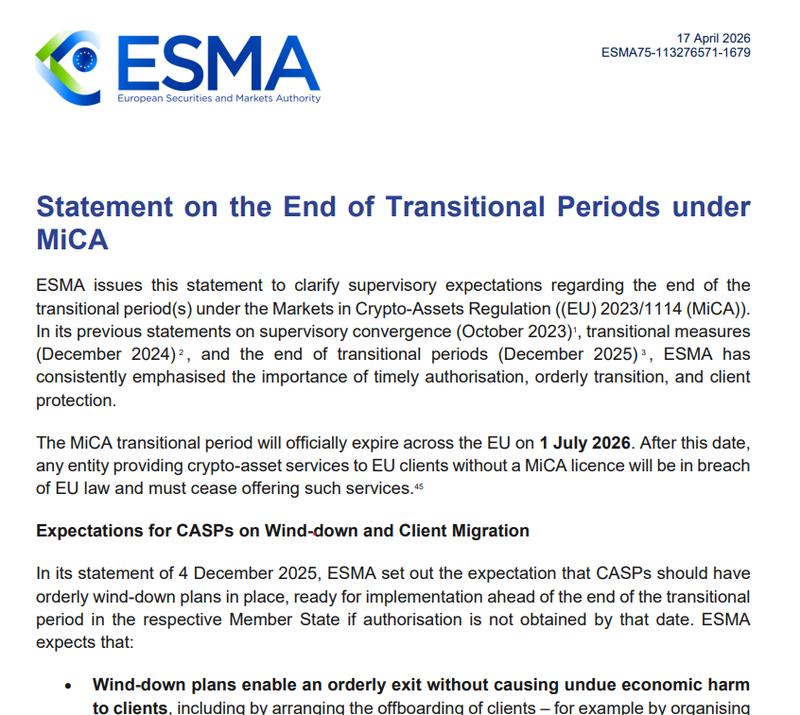
An official representative from the European Securities and Markets Authority (ESMA) confirmed to Cointelegraph that starting from this cutoff date, firms lacking proper authorization "will not be allowed to operate within the EU" and must execute orderly wind-down procedures and facilitate client migration plans instead of continuing operations indefinitely while pending regulatory approval.
This regulatory deadline threatens to compel certain cryptocurrency companies to halt their European Union activities even as their authorization requests continue under regulatory examination, a scenario that could disrupt services for millions of customers who remain engaged with platforms not yet approved under the MiCA framework.
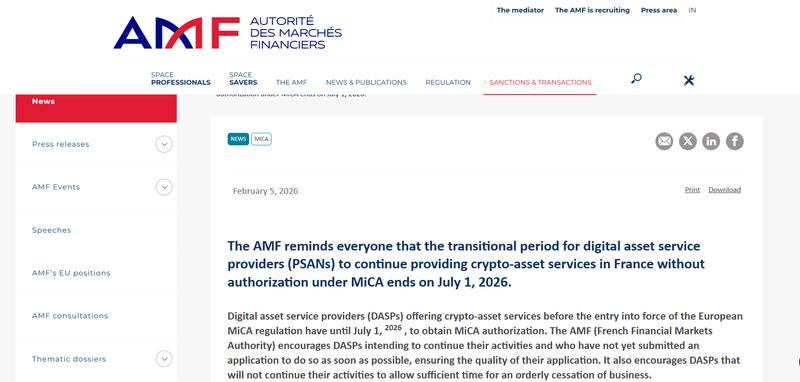
Within France's jurisdiction, authorization has been granted to 19 crypto asset service providers (CASPs) to date, while approximately 25 additional applications are currently undergoing evaluation, according to a representative from the Autorité des marchés financiers (AMF) who spoke with Cointelegraph.
Beginning July 1, service providers without MiCA authorization "must cease their activities," the representative stated, referencing a February advisory from the AMF indicating that providing unauthorized crypto asset services constitutes a criminal violation subject to imprisonment of up to two years and monetary penalties reaching 30,000 euros (approximately $35,000).
The regulatory authority indicates it possesses the capability to place companies on a prohibited list, release public advisories and pursue judicial orders blocking website access for unauthorized service providers that target French consumers.
Germany has established licensing obligations through its domestic implementation of MiCA, mandating that crypto asset service providers previously operating under earlier exemptions must secure authorization no later than June 30, confirmed a representative from Germany's financial regulator BaFin in communications with Cointelegraph.
The nation typically adheres to both European Union and domestic regulatory timelines, the representative noted, and could deploy enforcement actions "where possible and appropriate," while acknowledging that certain applications continue to be reviewed.
By comparison, Austria opted against extending grandfathering provisions for virtual asset service providers under its pre-MiCA regulatory structure, which concluded on Dec. 31, 2025, meaning no cryptocurrency exchanges are currently functioning without proper licensing within Austrian borders.
An official from the Finanzmarktaufsicht (FMA) informed Cointelegraph that the agency has authorized nine CASPs thus far and that the volume of MiCA applications is "significant," though it maintains confidentiality regarding the precise number of pending applications.
Legal experts caution pending applications provide no immunity
Submitting an application and waiting in the review queue will not protect CASPs from the approaching deadline, according to Niall Esler, who leads the regulatory and risk advisory practice at law firm Walkers, in his comments to Cointelegraph. He emphasized that firms continuing to serve European Union customers without proper authorization following the transition period's conclusion will be functioning in violation of law and should not anticipate maintaining operations without consequence.
MiCA mandates that member nations equip their regulatory bodies with authority to demand immediate service cessation, enforce customer offboarding, publicly identify non-compliant companies and levy administrative penalties for conducting unauthorized operations.
The implications could extend to a considerable portion of Europe's cryptocurrency user base. Data analysis provided to Cointelegraph by OKX Europe reveals that among 18.5 million cryptocurrency application downloads recorded across Europe from May 2025 through May 2026, roughly 7.6 million (representing 41%) went to trading platforms absent from the independent registry of MiCA-authorized providers compiled using ESMA and national regulatory data.
ESMA rejected providing projections regarding the number of EU users currently engaged with non-authorized platforms, citing its inability to disclose non-public data.
OKX Europe CEO Erald Ghoos explained that application download metrics underrepresent the actual scope because they exclude users accessing exchanges through web browsers or those who installed applications previously and maintain active accounts.
To address this analytical gap, OKX reports it merged App Store download statistics with website traffic projections and search pattern analysis to estimate real active usage. Ghoos stated the organization estimates "approximately 60% of European crypto users are actively engaging with platforms that hold no MiCA authorization," a figure encompassing some of the planet's highest-volume exchanges by trading activity.
Major exchanges continue pursuing MiCA authorization
Multiple prominent cryptocurrency exchanges remain in the process of obtaining MiCA authorization while national regulatory agencies evaluate their submitted applications.
Bitget, as one example, filed for MiCA licensing in Austria during 2025. The platform's chief legal officer confirmed to Cointelegraph that regulatory approval is anticipated during the second quarter of 2026 and the company will refrain from providing services throughout the European Economic Area until official authorization has been secured.
Binance, on the other hand, submitted its MiCA licence application in Greece this past January through the nation's Hellenic Capital Market Commission and does not currently appear among MiCA-authorized providers operating in the EU. The exchange failed to provide a response to Cointelegraph's inquiry regarding the current status of its application.