Buffett's $17B Treasury Bill Purchase: Warning Sign for Bitcoin's Future?
The Oracle of Omaha dismissed the current stock market pullback as "nothing" compared to historical 50% declines, potentially foreshadowing further losses for risk assets including Bitcoin in 2026.
The Oracle of Omaha, Warren Buffett, who serves as Berkshire Hathaway's chairman, disclosed during a CNBC interview this week that his investment company acquired around $17 billion worth of US Treasury bills in the most recent auction. Could this signal an impending stock market collapse, and what are the implications for Bitcoin (BTC)?
Key takeaways:
- By the conclusion of 2025, Berkshire's cash and cash-equivalent holdings reached $373 billion, representing more than twice the amounts held in 2023.
- When the company's cash stockpiles grow, it has historically signaled upcoming major equity market downturns, presenting a troubling indicator for Bitcoin.
Cash remains more attractive than equities for Buffett
The legendary investor's stance is clear: Berkshire views the current equity market correction as insufficient to warrant significant investment activity.
To put this in perspective, the S&P 500 index has declined approximately 5.75% from its peak level recorded in January.
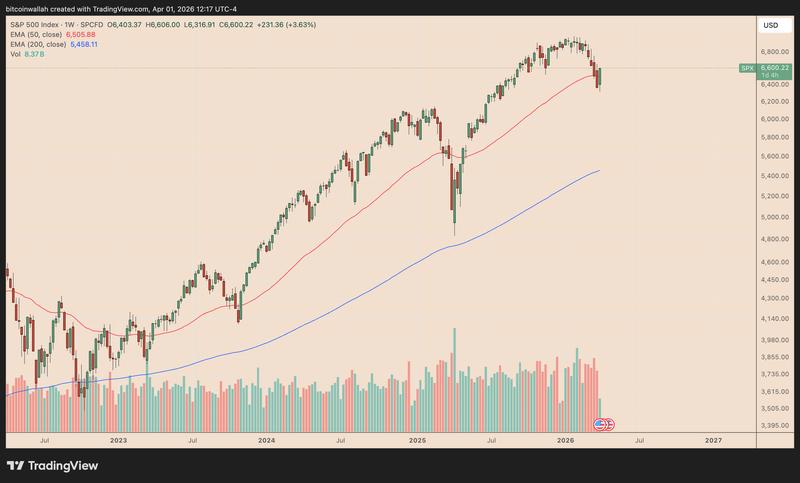
According to Buffett, equities haven't become "substantially" more attractive following this downturn, and he characterized the current sell-off as "nothing" when measured against previous market corrections where values plummeted by over 50%.
This perspective clarifies Berkshire's most recent Treasury-bill acquisition strategy. The conglomerate concluded 2025 holding approximately $373 billion in cash and equivalent instruments, an increase from the previous record of $334.2 billion one year prior and representing more than twice the amount held at 2023's conclusion.
Historical records indicate that Buffett, who infamously labeled Bitcoin "rat poison," has a pattern of accumulating cash positions prior to significant market downturns.
Take 1998 as an example: Buffett started reducing Berkshire's equity positions while increasing cash reserves, elevating the firm's cash and cash-equivalents holdings to $13.1 billion, representing approximately 23% of total assets.
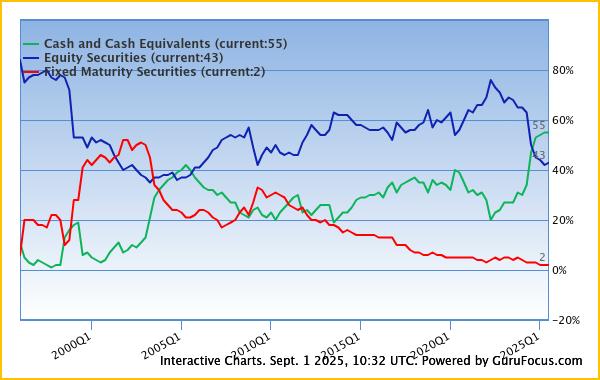
By the middle of 2000, this amount had grown to approximately $15 billion, constituting roughly 25% of total assets, at which point Berkshire began allocating capital toward undervalued opportunities as the Dot-com bubble collapsed.
Stock market correlation could pressure Bitcoin prices downward
Throughout much of the era following 2020, Bitcoin has exhibited behavior more characteristic of equities rather than functioning as a conventional safe-haven asset, frequently tracking the movements of US stock markets, particularly the technology-focused Nasdaq index.
As of Wednesday's data, the 20-week rolling correlation coefficient between these two markets registered a positive reading of 0.47.
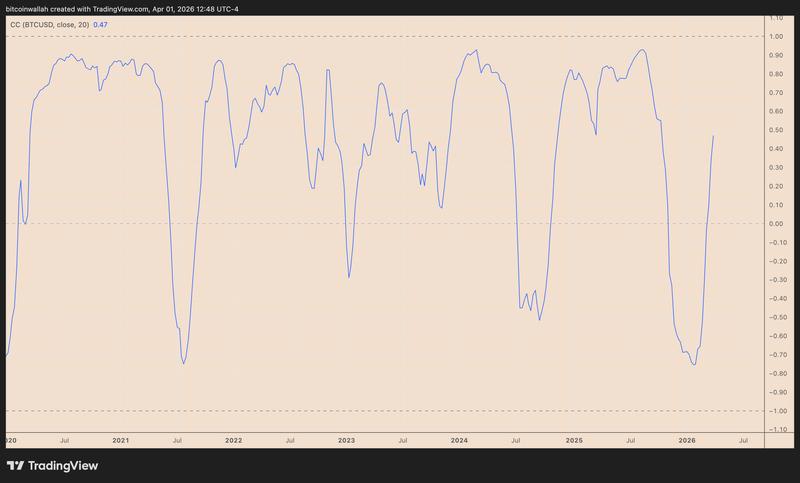
Should Buffett's defensive positioning prove prescient, Bitcoin would likely experience another significant decline in tandem with equities. Emerging quantum-security threats, inflationary pressures stemming from geopolitical conflicts, and recession probabilities approaching 50% in the US are all weighing heavily on BTC's valuation.
Berkshire's investment choices have also shifted away from cryptocurrency-related financial services.
During the opening quarter of 2025, the company completely liquidated its position in Nu Holdings, a fintech enterprise with crypto-friendly operations, after establishing its stake during 2021 and 2022. The firm realized approximately $250 million in gains from these holdings.
Numerous market analysts are forecasting that BTC's price could fall to levels as low as $30,000 during 2026.