British House of Lords cautions Bank of England risks stifling GBP stablecoin market
British parliamentary committee expresses concern that overly restrictive Bank of England stablecoin regulations might render pound-denominated digital tokens economically unfeasible even as it endorses regulatory oversight.

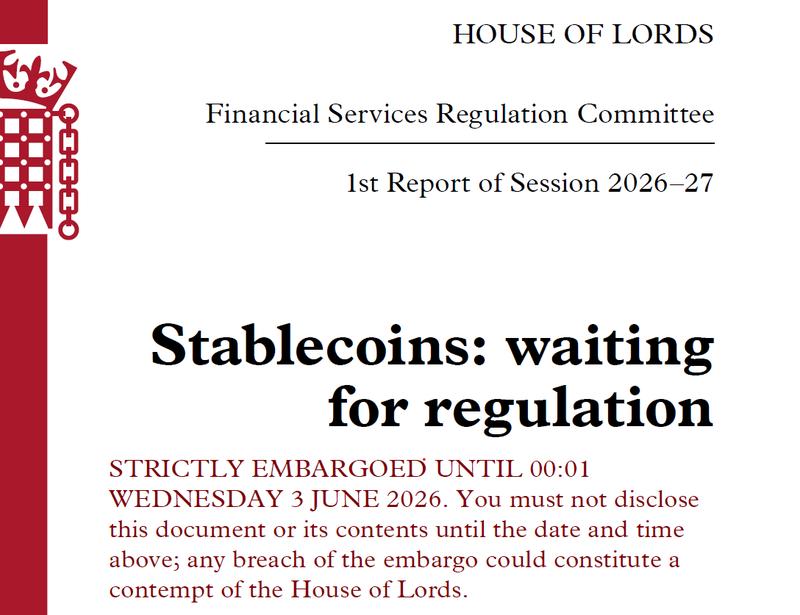
Britain needs to move forward with comprehensive stablecoin regulation while simultaneously ensuring its rules don't render a pound sterling stablecoin marketplace economically unviable, according to a House of Lords committee report published on Wednesday.
The Financial Services Regulation Committee, comprised of members across political parties, stated that the UK finds itself "lagging behind" both the United States and the European Union, noting that the lack of a well-defined regulatory regime has "suppressed stablecoin development and investment in the UK," even as global dollar-backed tokens like USDt (USDT) and USDC (USDC) have experienced significant expansion.
Though endorsing significant portions of the regulatory framework put forward by the Bank of England (BoE) and the Financial Conduct Authority, the committee raised concerns that certain proposed measures could jeopardize both the viability and competitive positioning of stablecoins issued within the United Kingdom.
The committee's report endorses mandates requiring fiat-backed stablecoins to maintain 1:1 reserves in high-quality assets, alongside a proposed backstop lending mechanism from the BoE designed for systemic stablecoin issuers.
Nevertheless, the report identifies multiple components within the Bank's November 2025 consultation document as potentially harmful, cautioning that mandating systemic issuers to maintain a minimum of 40% of their reserve assets in non-interest-bearing central bank deposits has generated "considerable criticism" and may "impact negatively on the viability of stablecoin issuers and the international competitiveness of the UK market."
The committee also highlights proposed temporary limits on holdings for both commercial entities and individual users as provisions that may "unnecessarily inhibit the growth of GBP stablecoins" while presenting practical enforcement challenges.
Interest bans and rewards uncertainty cloud UK tokens
The Lords' report also addresses the politically charged issue of investor returns. Under the Bank's proposed regulatory framework, remuneration to holders of systemically important sterling-denominated stablecoins would be forbidden, aligning the UK's approach with the European Union's Markets in Crypto-Assets Regulation (MiCA), which similarly prohibits stablecoin issuers from distributing interest payments to token holders. Meanwhile, the US GENIUS Act bars payment stablecoin issuers from offering interest, although American policymakers continue debating whether exchanges and other third-party platforms can provide reward programs.
The committee characterizes payment-oriented stablecoins predominantly as tools designed to facilitate rapid, cost-effective transactions instead of functioning as investment vehicles. Nonetheless, it cautions that the dual requirements of stringent reserve mandates coupled with prohibitions on interest payments or alternative forms of remuneration may negatively affect the "business viability" and market competitiveness of tokens issued in the UK, particularly given the ongoing uncertainty surrounding whether card-like reward programs or other non-interest-based incentive structures will receive regulatory approval.
Inquiry evidence highlights risks and UK's strategic choice
These findings emerged after an extended period of testimony collection during which the committee questioned industry representatives and academic experts about whether stablecoins can evolve significantly beyond serving as "on and off-ramps into crypto," examined their perspectives on financial stability concerns, bank funding implications and consumer protection hazards, and explored fundamentally different viewpoints regarding the US GENIUS Act's framework for non-banking institution issuers.
Though emphasizing that any growth in stablecoin markets "must not create new opportunities for illicit activity to flourish," the Lords contend that the UK ought to cultivate, rather than merely supervise, a sector focused on pound-denominated stablecoins.
The committee calls upon His Majesty's Treasury, the Bank of England and the FCA to maintain their current implementation schedules, provide clarity regarding how dual regulatory oversight of systemic issuers will function operationally, and adjust provisions including holding caps and reserve mandates to enable sterling stablecoins to "compete with other forms of payment in the UK" instead of facing regulation so burdensome it eliminates their practical relevance.