BlackRock Bitcoin ETF breaks 11-day withdrawal pattern despite market panic
After 11 consecutive trading sessions witnessing $2.35 billion in withdrawals, BlackRock's Bitcoin ETF recorded fresh inflows, though analysts warn it's premature to declare a market turnaround.

The spot Bitcoin exchange-traded fund (ETF) managed by BlackRock saw a return to positive flows on Monday, breaking a streak of 11 consecutive sessions marked by outflows that accumulated to approximately $2.35 billion.
On Nov. 16, the iShares Bitcoin Trust (IBIT) recorded $76.5 million in positive flows, contributing to a collective $7.9 million in net inflows across US spot Bitcoin ETFs, even as multiple other funds experienced continued withdrawals, based on data from Farside Investors.
These fresh inflows arrived as Bitcoin (BTC) hovered around multimonth low levels near $64,000, concurrent with the Crypto Fear and Greed Index—a measure tracking sentiment across cryptocurrency markets—dropping to 10 out of 100 on Monday, marking its weakest level since June 2026.
Nick Pitto, who serves as head of marketing at blockchain analytics firm CryptoQuant, warned against reading too much into the inflows as an indication of wider market stabilization.
"One day of inflows doesn't change the picture too much," Pitto said. He pointed out that Monday's positive flows represented merely about 3% of IBIT's total withdrawals across the preceding 11 sessions, with US Bitcoin ETFs collectively losing more than 31,000 BTC throughout the past month.
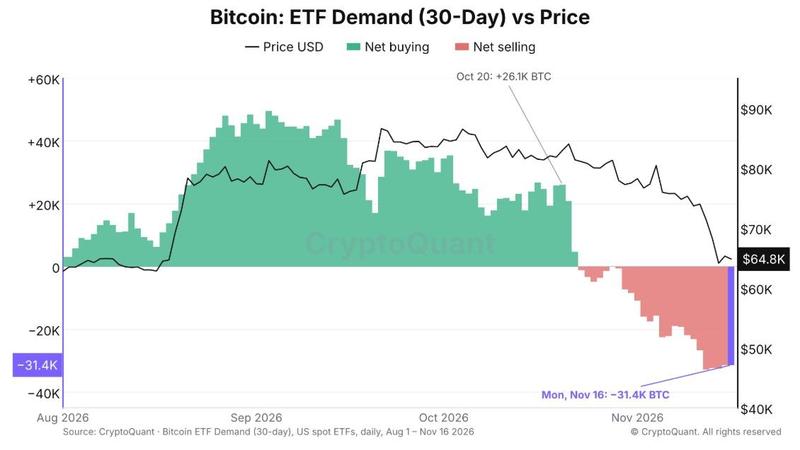
"It's too early to call this dip buying," he said, adding: "We'd need to see several days of inflows in a row, and from more funds than just BlackRock's."
The same day also represented the cutoff date for the majority of institutions to submit their third-quarter Form 13F disclosures, which revealed their Bitcoin ETF positions as of Sept. 30. Multiple institutions documented expanded exposure throughout the quarter, though Pitto urged caution about connecting those reported holdings to Monday's inflowing capital.
"ETF buying peaked in August and September. But the filings only show what they held at the end of September, not what they've done since. So they may not explain Monday's inflow," he said.